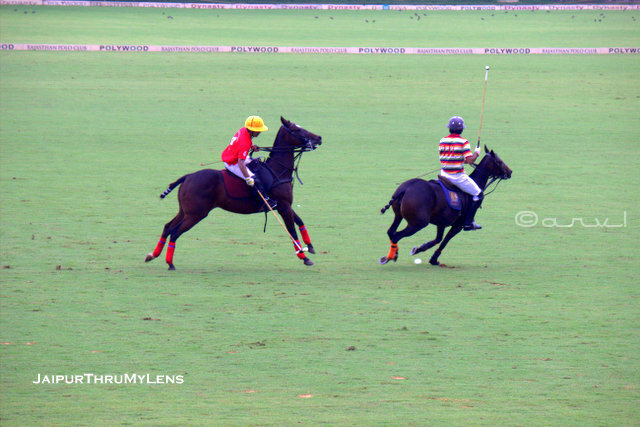
The Jaipur royalty was closely associated with Polo sport. One of the most well-known kings of Jaipur, Sawai Man Singh II was an accomplished polo player. His wife, Gayatri Devi, was fond of riding horses. Maharajah Sawai Man Singh II died in London in 1970 while playing polo. This blog traces the origin of polo sport as well as the history of polo in Jaipur.

All about polo in Jaipur
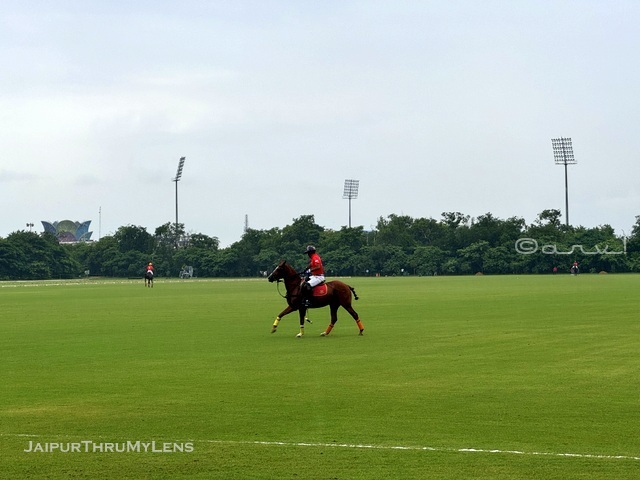
Most residents of Jaipur can recall the polo club in Jaipur, also called Jaipur polo ground. It is part of a large tract of land in c-scheme along with Rambagh Palace Hotel, Central Park, Ashok Club, Birla Auditorium, and Jaipur Golf Club. The Jaipur polo season is short. Many city residents use Jaipur polo club ground for their fitness regime. One can see people walking, jogging or stretching both during the morning and evening in Jaipur polo ground. I know many fitness enthusiasts who prefer polo club ground over the jogging track in Jaipur Central Park.
History of Polo Sport
Polo is considered the oldest organized sport in the world. Many consider Polo a game of Kings, as Polo’s history traces it to 2,500 years or more of existence. The origin of polo is shrouded in mystery and its history is obscure. The history of polo is largely undocumented; however, some accounts provide evidence of the game’s regal status in Asia. There is no consensus among historians about the region where polo originated. Some mention central Asia, others China, Tibet or North-Eastern Indian states. A few accounts also trace the origin of polo to Kyrgyzstan. The presence of horse and tribal culture in Kyrgyzstan and Mongolia does provide some authenticity. It is likely polo followed a logical progression after the horses were domesticated and the concept of light cavalry followed. In the context of Asia minor region the horse mounted armies swept across the region conquering and reconquering land. It is likely that the nobles, kings or emperors developed this sport. Some historians believe polo originated among Iranian tribes in the 6th century BC before Darius I, the founder of the Persian Empire. Persian literature and art provide the most detailed accounts of polo in ancient times. A few historians are of opinion sports got hold of the kings as a method to coach their cavalries. Firdausi, a renowned Persian poet-historian, describes several royal polo tournaments in his 9th-century epic, Shahnama. Some believe the Chinese or Mongols were the first to play polo. In Samarkand, Uzbekistan, ruler Tamerlane’s polo grounds still exist. Based on most accounts, it’s clear that the game has deep roots in Persia and its history. Polo was played across Asia from Constantinople, or modern day Turkey, to Japan in the Middle Ages. In Japan, Dakyu game was played which is akin to polo. Similarly, in Manipur, India, Pulu, an equestrian sport was popular. First Mughal emperor in India Babur established chaugan at the Mughal court. The successive ruler, Akbar was also an accomplished polo player. Some sources mention that Akbar introduced a set of new rules for polo in the 16th century.

History of Modern Polo
British tea planters in India first saw the game in the early 1800’s in North Eastern India, especially in Manipur. It was from here that polo was taken to the western hemisphere by the British. Most accounts credit Lt. Joe Sherer and Capt. Robert Stewart for taking it back from Manipur and introducing it to the British. British cavalry drew up the first rules for polo in the 1800s.
Polo in United Kingdom
The Hurlingham Polo, founded in London, soon became the epicenter of polo and established its official rules in 1875. Polo was well established in England by the 1870’s. In 1876 polo game first reached USA. Within the next 50 years, polo became incredibly popular in the US. Indian teams from the states of Patiala and Jodhpur were at the forefront of playing modern polo during the 1870s. The first polo club to be established in India was Calcutta Polo Club in 1862. Other accounts mention the first polo club to be started in Silchar town in 1834.

Polo & Argentina
British cattlemen brought polo to Argentina, which is now the world’s top polo destination. Every December, thousands of polo fans watch The Campeonato Argentino Abierto de Polo in Buenos Aires. It is one of the most important polo tournaments in the world. In Argentina, many boys learn to play polo as soon as they can ride horses in the estates. This is a reason why the best polo players are from Argentina. Weather conditions in Argentina are ideal for polo and considered as “Mecca” for polo sport.
List of countries where polo is actively played includes the United Kingdom, India, Brazil, Ireland, the United States, Australia, New Zealand, and South Africa.
Jaipur Polo: Kings and Royalty
Historians believe polo was being played in the region even before Jaipur was founded by Maharaja Sawai Jai Singh II. The Chovgan stadium in the walled city Jaipur is related with “Chovgan”, a sport some consider similar to modern polo. Chovgan was an equestrian sport practiced in Persia, the area today we know as Iran and Azerbaijan. The Chovgan stadium in Jaipur still exists today but is no longer associated with modern polo.

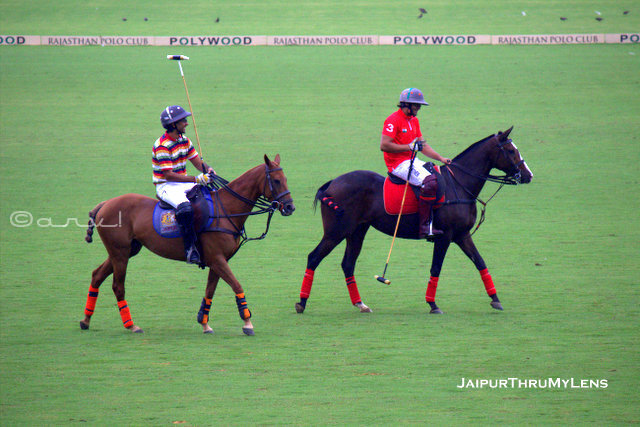
Most websites trace the history of polo in Jaipur to Maharaja Sawai Man Singh II. The modern connection to Polo in Jaipur is restricted on social media to the current descendants of Jaipur Royalty, Padmanabh Singh who leads the Jaipur Polo Team. However, not many people talk about the period before Maharaja Sawai Man Singh II came to power. Here is a picture of Padmanabh Singh playing polo in Jaipur at Rajasthan Polo Club.
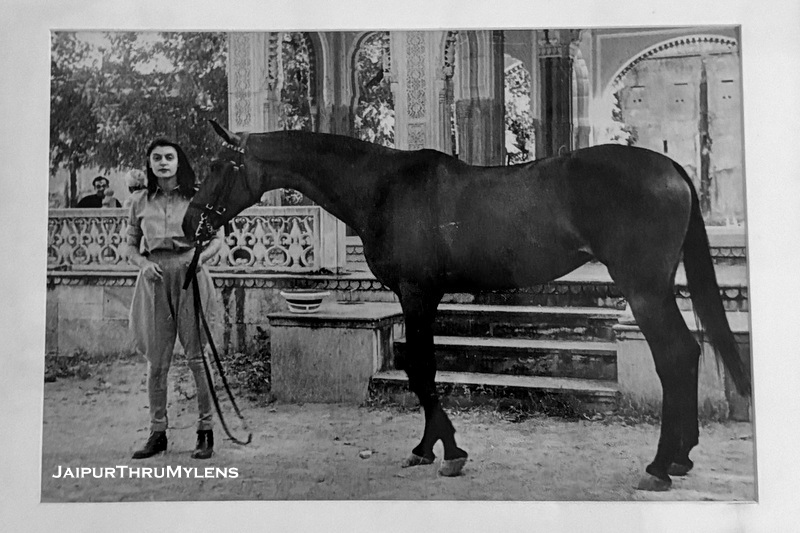
Maharaja Sawai Ram Singh II has also been mentioned as a polo lover. He loved riding horses. Here is a picture of Sawai Ram Singh II.

His relative, Sir Pratap, a Jodhpur regent, was also a polo player. Sir Pratap was the younger brother of the ruling king and Prime Minister of Jodhpur State. He invited Col. Stuart Beatson of Bengal lancers to help raise Jodhpur Lancers, a local polo team in 1889, as per a few accounts. Later, Sir Pratap traveled to England and won many polo tournaments/matches in 1897 at Hurlingham Polo Club and Ranelagh Polo Club. His team was one of the first Indian teams to play in England.

Not many people know that Colonel Stuart Brownlow Beatson also indirectly contributed in giving impetus to polo in Jaipur. His contribution to the history of polo in Jaipur is not talked about. Jodhpur has contributed to the growth of modern polo in Jaipur. Some of the greatest players of Jaipur Polo Team had played or were trained by Jodhpur Polo Team.

Jaipur Polo Team
In the context of modern polo, Jaipur Polo Team headed by Maharaja Sawai Man Singh II participated and won many polo matches in India and England. Playing polo was his passion. Chhatri of Maharaja Sawai Man Singh II at Gaitore has marks of polo engraved on the white marble.
Jaipur Polo Team carved out its own name with an unbeatable record from 1930 to 1938. It won all polo open tournaments in the United Kingdom as well as the Indian polo championship. The Jaipur Polo Team comprised of accomplished players like Hanut Singh, Abhay Singh, Prithvi Singh, and Sawai Man Singh II.
Currently, Jaipur Polo Team is headed by Padmanabh Singh. The uniform of Jaipur Polo Team is striped jersey.
Many websites claim Maharajah Sawai Man Singh II as the most illustrious person in the history of polo in Jaipur. This is partly true. He won a large number of polo matches in England. But it completely omits other people who have been instrumental in the history of polo in India and Jaipur, especially.
Polo as a sport was practiced for many centuries in the Indian sub-continent. Many attribute it to the Islamic rulers and Mughal rule. Sawai Madho Singh II who ruled Jaipur from 1880 to 1922, commissioned a polo field near Jaipur Railway station. Measuring 900 by 500 yards, it was built under the supervision of Samuel Swinton Jacob. This polo field was replaced by a new one that exists even today.
Maharaja Sawai Man Singh II used to play modern polo. Polo underwent changes when rules were redrafted in England in the 20th century. The ancient polo sport practiced was different. If one were to sift through the information being circulated, one only finds mention of Padmanabh Singh of Jaipur.
Modern Polo Game set-up, rules and terms
The objective of the polo game is to outscore the opposing team by hitting the ball through their goalposts.
Polo Field
A polo field is rectangular measuring 300 yards long by 160 yards wide, if boarded with a 12 inch high board. If not boarded and bound by a white line, the field is 300 yards by 200 yards. The field is divided into two halves by a central line.
Polo Team
There are two polo teams. Each team consists of four players, riding a horse.
Polo Equipment. Players use long-handled mallets to hit the ball, which is about 3 inches or 7.5 cm in diameter.
Polo Mallet
A polo mallet consists of a shaft usually made of bamboo with a head also called “mallet head” at one end. The mallet head is cylindrical in shape and has a rounded end made of a hardwood. Polo mallets come in different lengths to suit individual players and playing styles. Most mallets measure between 124 and 137 centimeters.

Polo Ball
The polo ball is usually made of willow and is about 7.5 cm in diameter.
Chukka or Chukker
Chukka or Chukker is the term used to describe the basic period of play in polo. Each chukka is seven and a half minutes long. There are four chukkas in each match. In Argentinian polo, however, eight chukkas are the norm.
Handicap
A handicap in polo is how many goals a player is worth to his team. In polo, handicap is measured from -2 to 10; higher is better. -2 indicates a novice, whereas a polo player with a 10 handicap is an accomplished player.
Jaipur Polo Matches and Tournaments
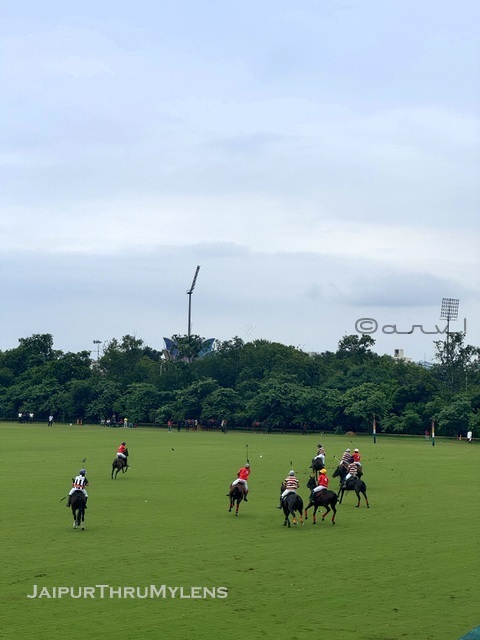
There are many polo matches and tournaments in Jaipur. Typically, the Jaipur polo season calendar is announced in advance. Usually, polo season in Jaipur takes place in two phases; Sept-Oct and Feb-Mar.
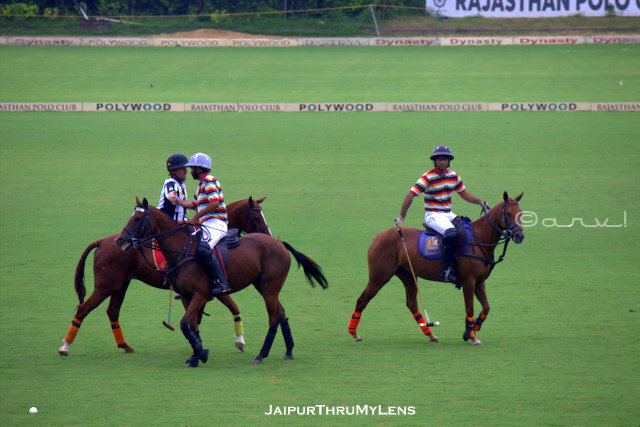
Some of the important Jaipur polo matches are as follows:
- Rajmata Gayatri Devi Memorial Cup
- Sirmour Cup
- Rajasthan Tourism Polo Cup
- SMS Gold Vase
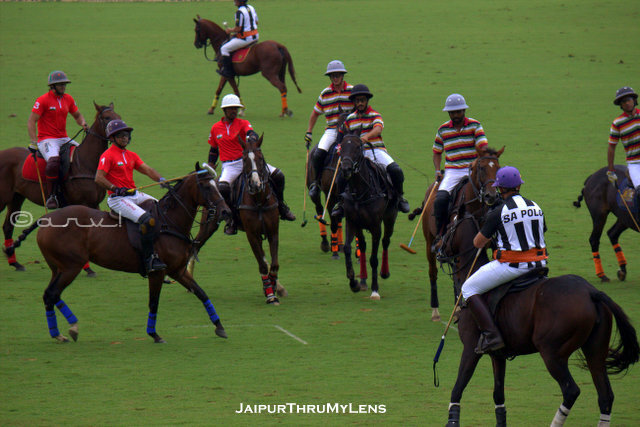
Where to watch Jaipur polo matches?
Rajasthan Polo Club hosts all the important polo matches and tournaments in Jaipur. One can watch polo matches in Jaipur at Rajasthan Polo Club ground near Rambagh Palace Hotel.
Jaipur Polo Match Tickets
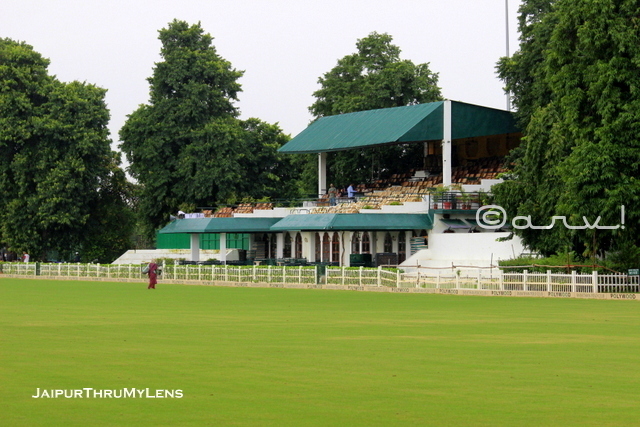
The concept of Jaipur polo matches and tournaments tickets is not in place. Entry is free for Jaipur Polo match visitors. The top floor is where visitors can watch polo matches in Jaipur for free.
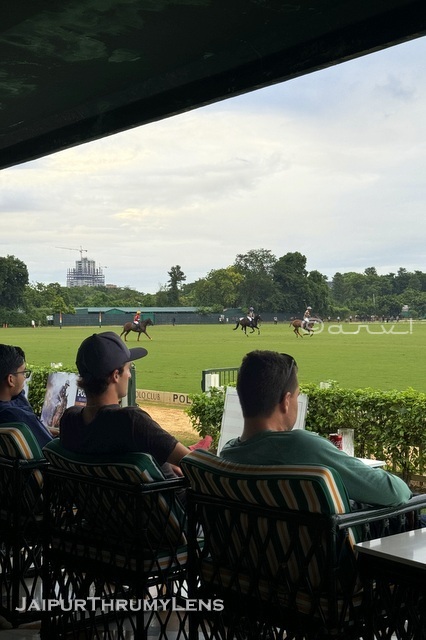
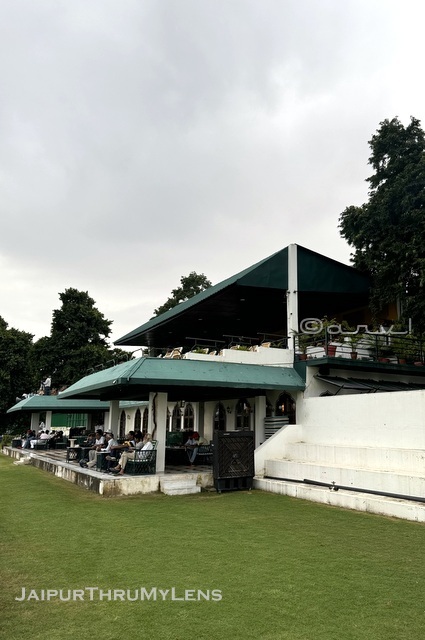

While one is seated, it is hard to ignore the beautiful view of the Moti Dungari Fort.

Moti Dungari Fort has been associated with Maharani Gayatri Devi, the last queen of Jaipur. It was one of her favorite places in Jaipur other than Lily Pool. Lilly Pool is close to Rajasthan Polo Club ground. Many areas of Lily Pool have been claimed by the Jaipur Development Authority. Over the last few years, sections of Lily Pool of Maharani Gayatri Devi with tennis and basketball courts, have become part of the Central Park jogging track. It is here one can feel how connecting this part of Jaipur was with Gayatri Devi. Rambagh Palace, Lily Pool, Moti Dungari Fort, and Jaipur Polo Club, were all connected with the life of Maharani Gayatri Devi. Read: Gayatri Devi | From princess to politician
Polo Palladio Jaipur
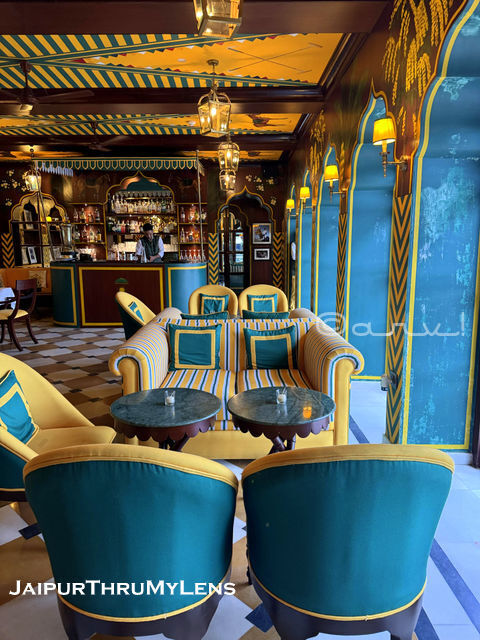
The ground floor is reserved for members of Polo Palladio bar. Polo Palladio is managed by Bar Palladio. Read: Bar Palladio: Chicest Bar in Jaipur. To access Polo Palladio one has to be a member of the same and the membership fee applies.
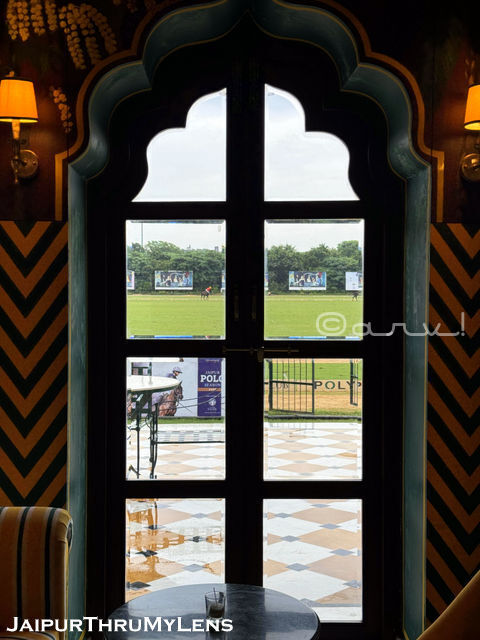
Dutch designer Marie-Anne Oudejans who designed Bar Palladio in Jaipur, has designed the interiors of Polo Palladio. The colors yellow, green, and maroon dominate the interior theme of the bar along with patterns of stripes and chevrons.
Polo in India | A summary
The irony of polo in India is that it is a niche sport that attracts very little crowd. In comparison to popular sports like cricket attracting a few thousand spectators, the polo seating space in most cities in India where polo is played. In comparison, Argentina has a large public following of polo. Some companies have sponsored polo matches in Jaipur. A few of these were Audi, Tissot, Polywood, among others. Typically, hospitality and liquor brands have sponsored polo matches and trophies. However, a lot needs to be done when it comes to polo in India.
Discover more from JaipurThruMyLens
Subscribe to get the latest posts sent to your email.


Your post is a very interesting report on the history of polo. Until today, I had no idea that this sport on horseback originated in India.
LikeLiked by 1 person
I don’t think it originated in India. But India does have a slice of history.
LikeLiked by 1 person
Thank you for the correction!
LikeLike
This is a very interesting post. I never knew about the rich heritage our country has in this game. Thank you for explaining the game and its origin. The photographs helped to tie everything together nicely 😀
LikeLiked by 1 person
I’m glad you enjoyed this post on polo sport, Shweta. Many of the princely states were active in playing polo and had a polo team. Lesser highlighted aspects of our history.
LikeLiked by 1 person
It’s interesting to read about the history of a sport. I always thought it was an English sport, originating in England. Now from you post, I’ve learned that isn’t true. Thanks for writing about this. I appreciate the new knowledge, and of course, your photos are awesome!
LikeLiked by 1 person
It is certain that English people helped evolve an ancient sport. We cannot ignore their contribution. At the same time, polo has its own origins and history that spans centuries.
I’m glad it helped you understand sport better. I suppose it is popular in the US also?
LikeLiked by 1 person
It is, but not as popular as soccer or football. 🙂
LikeLike