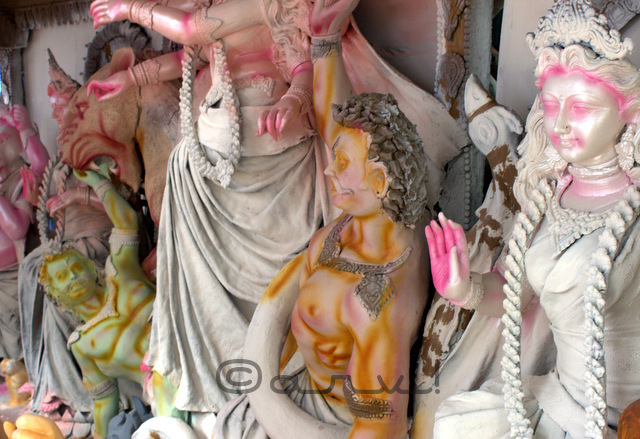
The men who create God? You read it right. It’s about those skilled hands who create idols of God. In this write-up, the focus is on the Bengali artists who make idols and effigies for Durgapuja in Jaipur. Although Durgabari in Jaipur is a famed place for making Durga idols, I visited a lesser-known workshop in the walled Jaipur city. This blog captures the essence of Bengali connection in Jaipur.
Durga Idols, Durgapuja and Bengali artists in Jaipur
Even though the Bengali festival of Durgapuja is not native to Jaipur, it’s celebrated with much fanfare in the city among the Bengali community. As per the available information, Durgapuja was first celebrated in Jaipur in the first decade of the 19th century, probably in 1804 AD at Shila Mata Temple in Amer. Jaipur has a large population of Bengali workers, especially the ones working in the jewelry industry. It’s no secret that Bengali hand is considered as the most skilled one and they dominate the skilled workforce employed in the jewellery industry across India.
The relationship of Jaipur with Bengal dates back to a few centuries when the king of Amer Mirza Man Singh I became governor of Bengal under the Mughal empire in 1594 AD. He brought along with him deity installed in the Shila Mata temple, Amer Fort– Shila Devi from Jessore in 1604 AD. The Bengali priests were also called in and since then a new relationship of Bengalis with Jaipur and Amer. Bengali priests have managed old heritage temples in Jaipur for generations. The best example is Govind Devji Temple – one of the most popular temple in Jaipur. Over the years as Jaipur transformed from a city which manufactured colored gemstones to finished jewelry pieces, many Bengali skilled workmen also followed and made it their home. For the Bengali community, Durgapuja is the most important festival. There is a Jaipur Durgabari Association and it is a popular place for Bengalis to get together in Jaipur. Durgabari in Jaipur is famous for Durga Puja celebrations in Jaipur.
Watching the Bengali Artist in Jaipur create Durga Idols
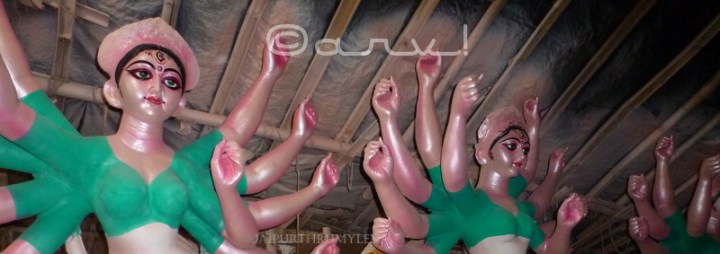
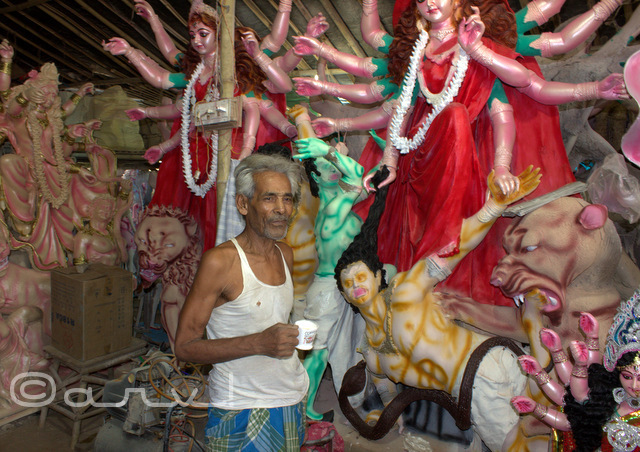
I captured these pictures at Shri Kali Mata Shilpalaya, tucked inside the Jaipur walled city, 2 week ago. Run & managed by a Bengali family consisting of 2 brothers Gautam Pal and Sanat Pal along with their father Ganpati Pal, the creations inside their workshop is a result of a time taking manual work which takes days to create each piece of art. The workshop I visited is designed & made in the same way as the ones in Kuamortuli Kolkatta or elsewhere in Bengal. It was quite dark inside and the only available light source was the incandescent bulb!
This post is not a guide on how these men create idols of God & Goddesses rather it’s just a peek into the world of Bengalis in Jaipur.
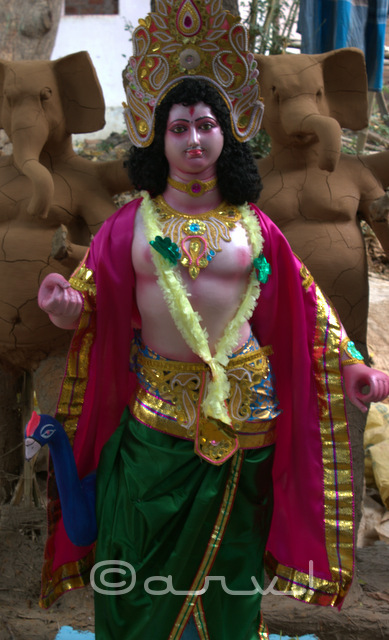
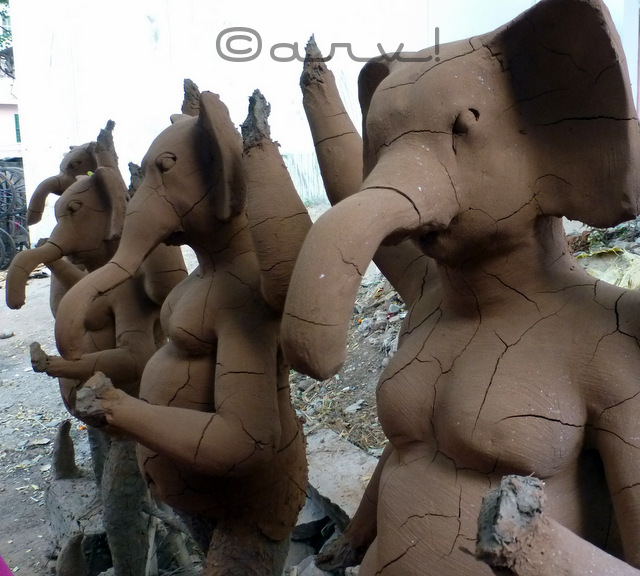
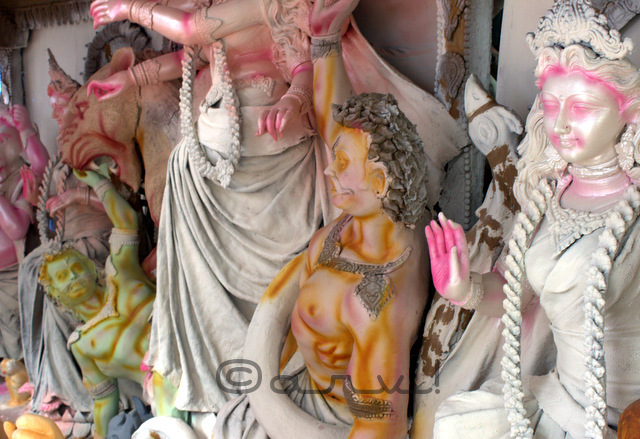
Ganesha idols made out of hay & clay in the below picture are at an initial stage; the one in the center is finished & ready for sale.
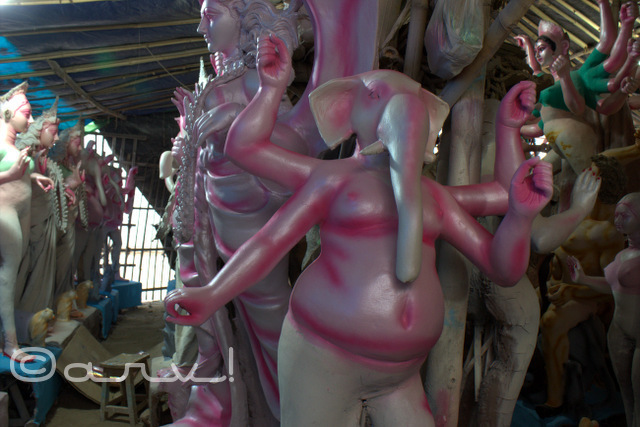
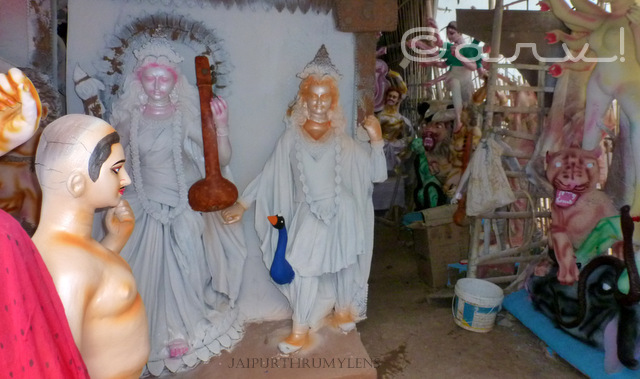
The idols in the following pictures are work in progress.
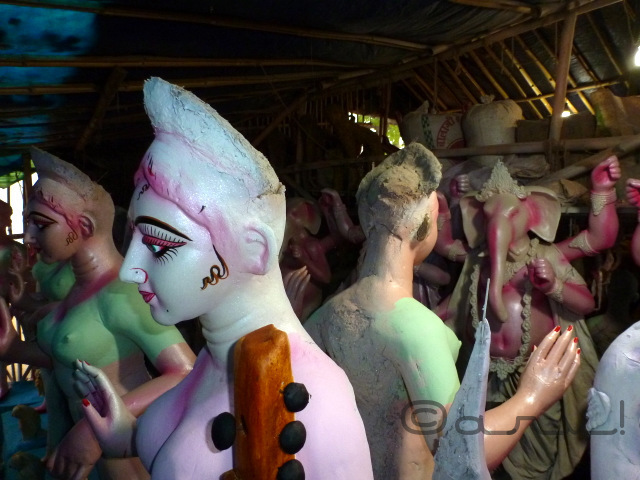
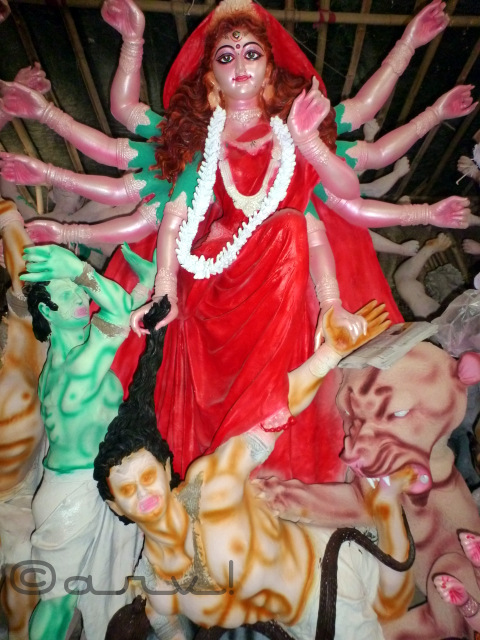
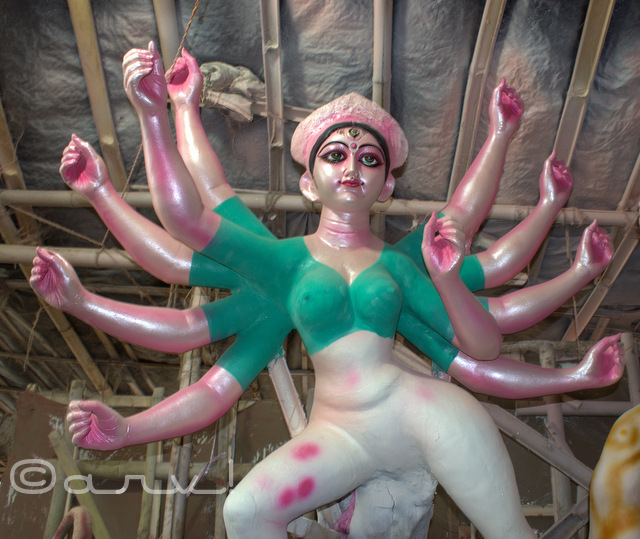
This idol of Goddess Durga has a beautiful face & a typical Bengali look on her face.
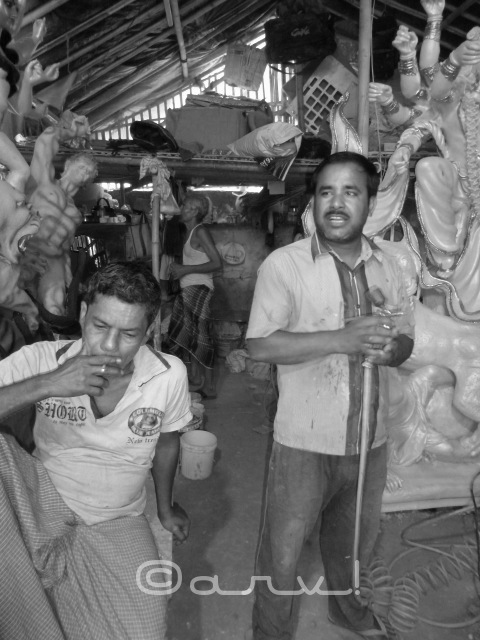
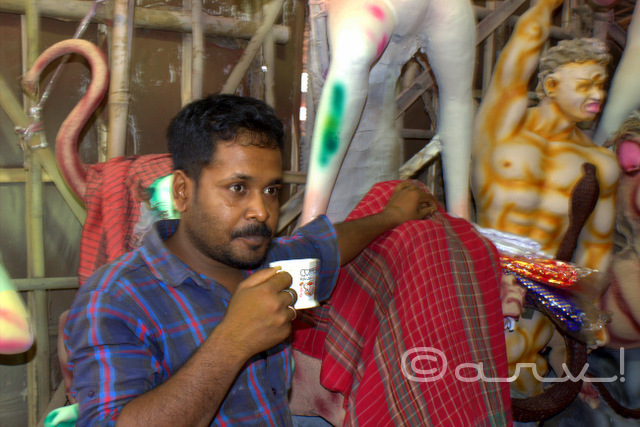
Let me introduce you to the creators of these works of art.
Sanat Pal during a tea break
Ganpati Pal
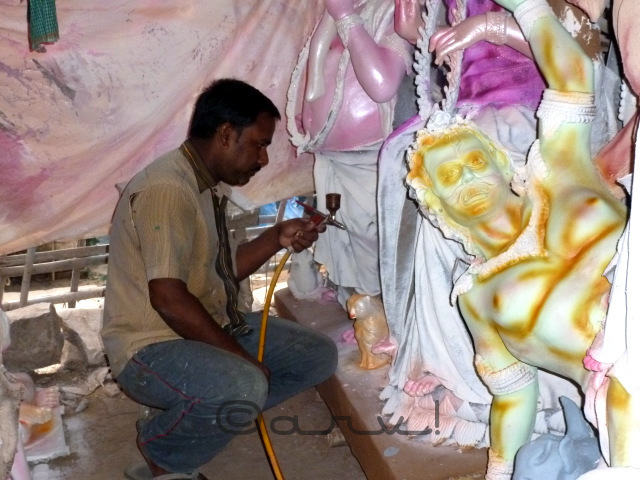
Gautam Pal at work.
Click here to read more posts from the same category.
Stay updated via Facebook, Twitter, Instagram
During the conversation, it came up that there are a few more such Durga idol workshops run by Bengali artists in Jaipur. These artists work for months. Unlike other cities where Bengali artists travel from Bengal to create idols, usually a month before Durgapuja, this workshop is permanent. Ganesha is a popular idol which sells throughout the year. On inquiring about the number of days it takes to complete one idol, Gautam Pal replied that it’s very difficult to quantify since they work simultaneously on many idols but generally it takes around 10 days. Probably, I will provide a list of Durgapuja places in Jaipur in another post. Visiting this workshop was an interesting experience. You can appreciate a work of art once you understand its nuances. If you ever get a chance to explore Durgabari, go for it!!
Discover more from JaipurThruMyLens
Subscribe to get the latest posts sent to your email.

 JaipurThruMyLens
Fascinating Arv, thanks for sharing. I really enjoyed the post, seeing such different ways of life and traditions…
LikeLiked by 1 person
Happy to know you enjoyed the pictures. 🙂
LikeLike
Fascinating glimpse into their world. Thank you
LikeLiked by 1 person
Thank You 🙂
LikeLiked by 1 person
Arv, your posts are such a delight for me. I can’t see and read enough about the beautiful Jaipur.
LikeLiked by 2 people
I’m happy you liked this post and Jaipur. 🙂
LikeLike
A fascinating post on the making of gods and goddesses! As a Westerner one is puzzled by the multitude of deities. I wonder if the practice of creating them is merely an attempt to preserve the cultural heritage of your country.
LikeLiked by 2 people
It’s difficult to answer precisely. It’s being said that religion itself was created to bring in order and create rules for some order. It’s true for all religions.
Hindu religion is unique in certain manner, presence of multiple God is its feature. This also explains why Hindus are tolerant -Co-existence of many God and goddesses unlike one Centre of power in other religion. What you mentioned might also be true.
LikeLike
Some people don’t understand the religious back ground of these Gods and Goddesses, I wish more people were better enlightened. These statues/god & goddesses go back 100’s or even 1000’s of years, the history is amazing as is the art of making these beautiful statues….Thank You Arv for showing us a better glimpse of India’s beauty! 🙂 T.
LikeLiked by 1 person
In India mythology and religion has strong roots. You can virtually find tons of info on each of those God and goddesses! So there ‘s so much to explore and find.
Happy that you liked it. 🙂
LikeLiked by 1 person
Good article ! I never knew that there are permanent workshops there like Kolkata’s Kumartuli. Thanks for sharing your experience!
LikeLiked by 1 person
we can’t compare it with Kumartulli since these are much smaller in size and we don’t have so many Bengali artists here. Thanks for sharing your views here. 🙂
LikeLiked by 1 person
Welcome!
LikeLiked by 1 person
Lovely pictures, Arv, as always!
LikeLiked by 1 person
Thank You Mick! 🙂
LikeLiked by 1 person
Amazing post, Lovely pictures.
LikeLiked by 1 person
Thank You 🙂
LikeLike
A hundred thousand thanks for writing this article! These are the people whose work is always admired but they themselves are not. This is my feeling, I may be wrong.
LikeLiked by 1 person
You are completely right. These workers remain anonymous, while everyone enjoys the festivities. Thanks for reading and sharing your views. 🙂
LikeLiked by 1 person
Another great post Arv! Glad you got to talk to the artists and got to know them.
LikeLiked by 1 person
Thanks Raghav! 🙂
LikeLiked by 1 person
A wonderful post. Great captures 🙂
LikeLike
Interesting post and so unusual. I’ve never read about such a workshops before. This is quite about the culture and the handicraft.
LikeLiked by 1 person
Lidiia these men are not locals, rather they are from a state which is far away from here. It’s inspiring to come across these workshops. yes it’s about culture, art and religion! 🙂
LikeLiked by 1 person
Yeah, I meant Indian culture in general. Or they are not even from India?
LikeLiked by 1 person
:)they are from India but from a different state!
LikeLiked by 1 person
This is a very well documented write up. Interesting cross cultural story
LikeLiked by 1 person
Well that’s quite some compliment! Thank You! 🙂
LikeLiked by 1 person
This is a very interesting and informative post on the process / journey to Durga Puja. I liked it very much. thanks
LikeLiked by 1 person
I am glad you liked the post suyash 🙂
LikeLiked by 1 person
🙂 🙂
LikeLiked by 1 person
These guys are magicians. It’s great to see how they put life in rocks. Thanks for sharing
LikeLiked by 1 person
You are welcome Ankur. I’ll agree with you. 🙂
LikeLiked by 1 person
Really like the title and the sneak peak into the lives of these interesting men
LikeLiked by 1 person
Thank you for the compliments 🙂
LikeLike
Wow arv, great. I didn’t have any idea jaipur has so nice idols and bengali artists have settled there so long. If you have a chance, do visit kumartuli in kolkata, the hub of so many workshops for making idol like the one you depicted. But yours is really special, as it is outside Bengal
LikeLiked by 1 person
I came across few bloggers posting pictures from the place you mentioned. someday….
I guess the credit needs to go to these artist. 🙂
LikeLike
Great pictures … amazing photography…
LikeLiked by 1 person
Thank you niharika 🙂
LikeLike
Great Job.
LikeLiked by 1 person
Thank you 🙂
LikeLike