
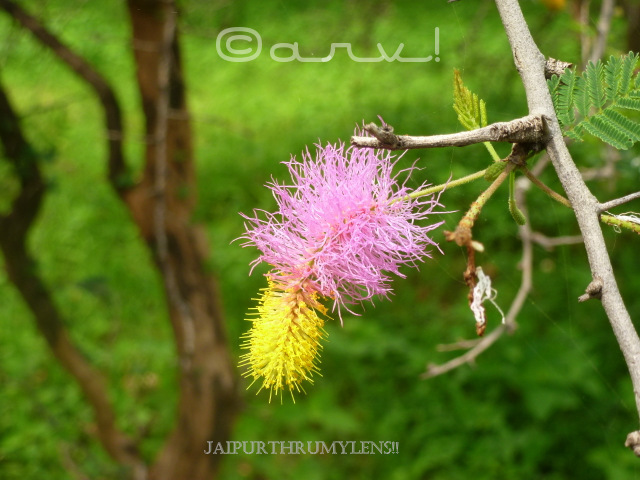
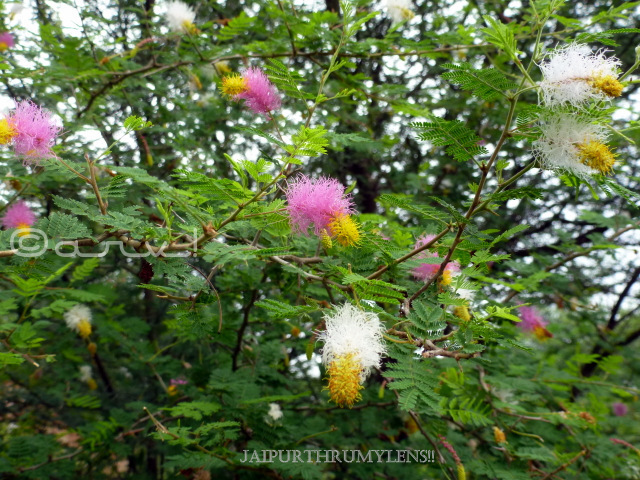
My first encounter with the sickle bush tree was two years ago during a hike in Nahargarh hills in Jaipur. I never paid attention to these trees despite hiking in this region because there is nothing striking about this tree. However, you can’t miss this tree because of its flowers during the monsoon season. The flower of this tree resembles the bottle brush in its appearance and has two striking colors – Pink and yellow! Slowly, the pink fades to reveal white color.
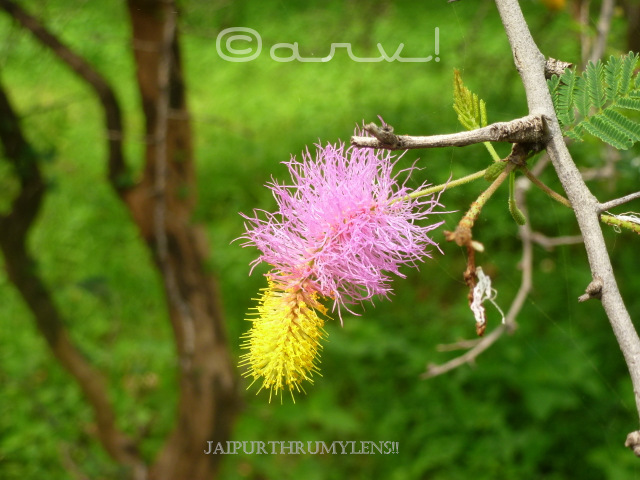
My second encounter with this tree was in the same year on a visit to the World Forestry Arboretum in Jaipur. Here are a few pictures from that trip.
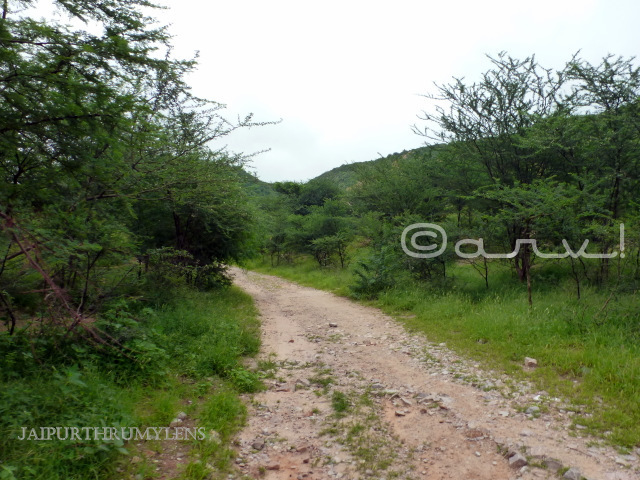
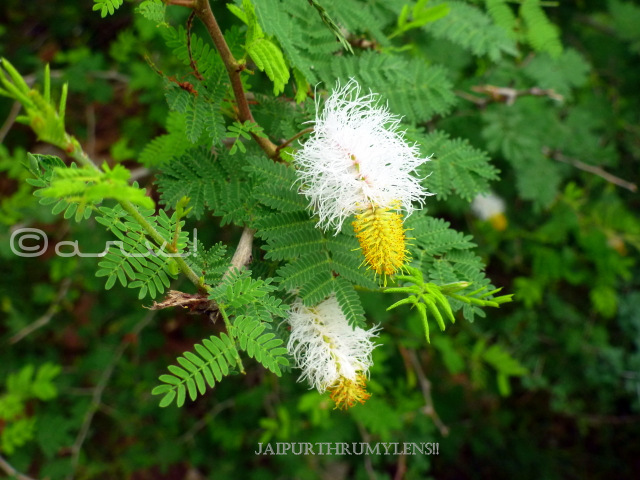
Subsequently, I also found them in Smriti Van, a landscaped forest land in the heart of Jaipur.
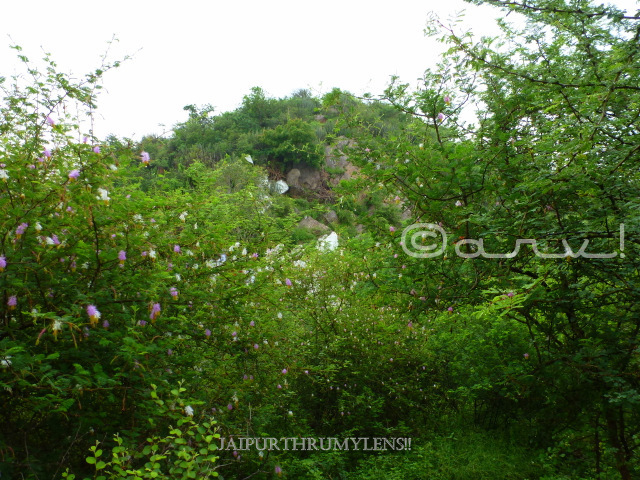
In the following year, I sighted this tree in Aravali hills near Amer. A fellow travel blogger who accompanied me during that hike was mesmerized by the shape & color of its flower. Back then, I had no clue about its name or details.
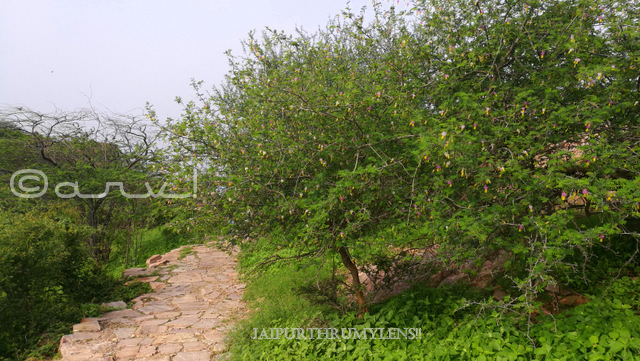
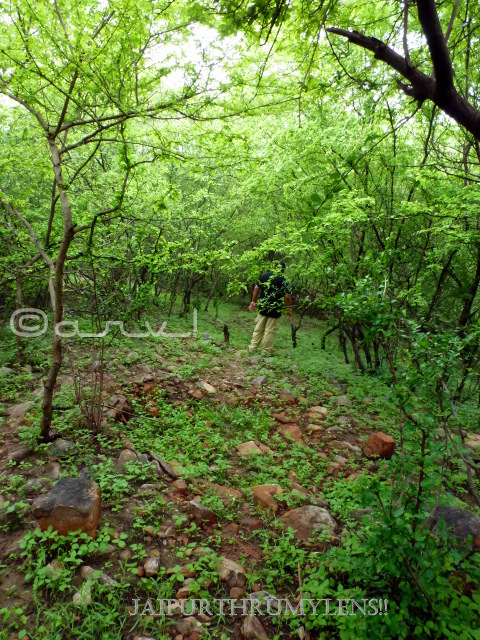
To be fair, Sickle Bush is more like a bush rather than a tree. Even though the botanist and foresters claim that it grows up to 20-25 feet, the ones I found in this region were not more than 7-8 feet tall. Maybe this variant doesn’t grow tall or it can be a geographical issue too.
Check out related post:
I bet you haven’t heard about Thor Danda
Anogeissus Pendula – The resident tree of Aravali Hills
The scientific name of the Sickle bush tree is Dichrostachys Cinerea & also known as Mimosa Cinerea. It is popular by many common names in India like Kunali, Khairi, Goya Khair, Veer Taru, Durangi Babool, Sigam Kathi, Neelajammi, Khoiridya, Marud, Vellantaru, and Viradru. In some countries, it is known as a Chinese lantern tree because of the shape & color of its flowers. The name Sickle Bush stems from its seedpods which are packed close together and curves in the shape of a sickle. I don’t have a picture of seedpod to share.
Last week during a hike, I sighted this tree in a large number.
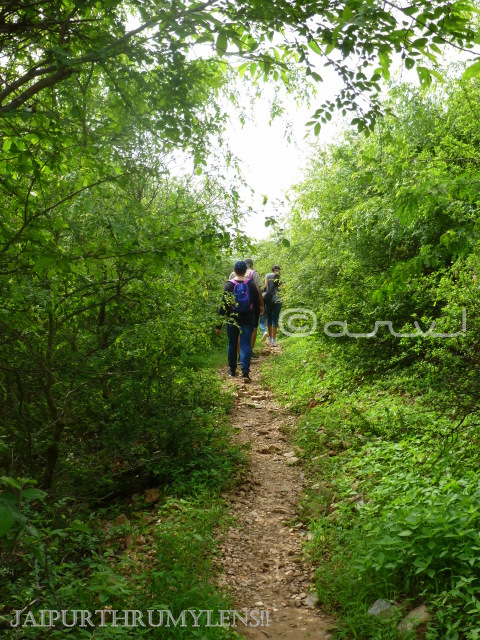
Sickle Bush is a native of African continent although it is found in other continents too – Indian subcontinent and parts of northern Australia. There is a confusion whether it is a native to the Indian subcontinent or not. I’m not sure if this was introduced by traders or colonial rulers because there is no unanimity among experts. I will choose to side with the opinion that Sickle bush is native to the Indian subcontinent. There are reasons to believe so! As per geologists millions of years ago, the Indian subcontinent along with African and Australia continent were conjoined. This is precisely the same area where this plant can be found.
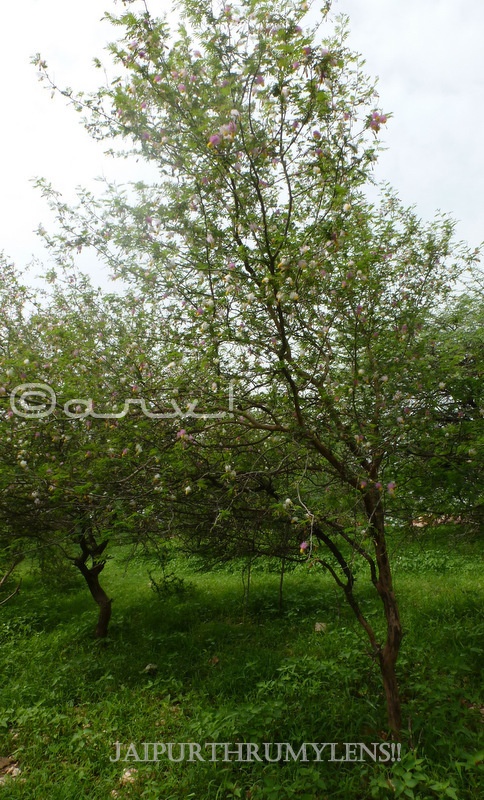
In South Africa, it is popular as Kalahari Christmas tree or bell Mimosa. There is another curious name for this bush – Acacia puncture tyre because its spine is hard and often cause a puncture in tyre and it resembles Acacia tree family.
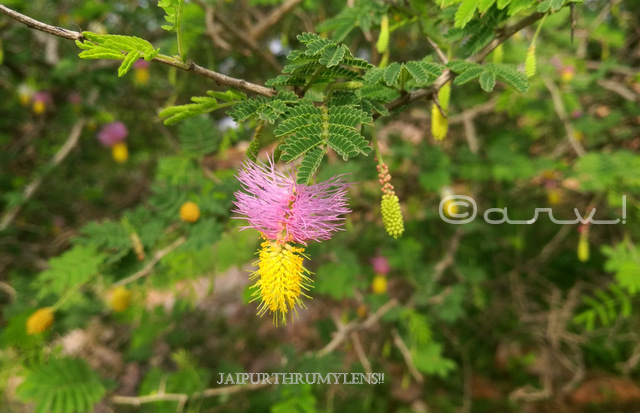
Sickle bush is part of Mimosa genus. Mimosa word is derived from the Greek language and it implies acting swiftly because some of the plants in this species are known to fold their leaves on touching or trapping insects. This genus can be confused with Acacia family because of similar looking features. But the distinguishing feature is that Mimosa flowers have less than ten stamens in its flowers. Many experts treat Sickle Bush tree to be a part of Acacia sub-family.
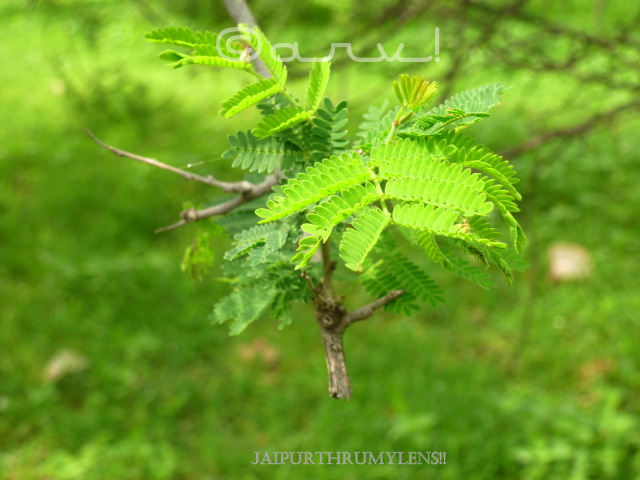
Dichrostachys Cinerea is generally found in dry deciduous forests. Exactly the kind of climate Aravali offers. Some even believe that it offers medicinal benefits. I am not aware of its Ayurvedic benefits but in Africa, the traditional tribes use it for its healing properties.
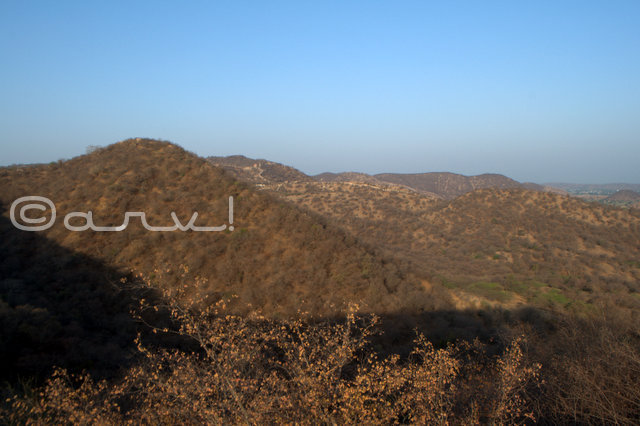
In many countries, this tree is considered invasive and unwanted. It makes a great plant for the Aravali hills because it adapts very well to the local climate. Due to the rocky base, heat and scanty water availability, very few plant species adapt well to local topography & climatic conditions. Dhok, Babool, Israeli Babool are most commonly found trees in Aravali hills. Here is a picture of Aravali hills post monsoon. Do read this post – Hills are green which explains the change in topography of Aravali Hills with the onset of monsoon.
Forest department carried out extensive plantations of imported Acacia trees like Israeli Babool or Vilayati Babool till 1990’s in Aravali hill range across Rajasthan. However, these trees haven’t benefited local ecology. Due to their ill-effects, they are not being advocated anymore. This case is similar to Eucalyptus which was planted under a massive drive across many Indian states till 1980’s but owing to the soil underneath turning infertile, the popular opinion went against it. In Cuba and elsewhere in the Caribbean, this plant is considered invasive; a massive drive was undertaken to uproot these trees. It was introduced during the colonial rule and it is not found naturally in the American continent.
Check out other stories in Trees of Jaipur.
Stay updated via Facebook , Twitter, Instagram, Google+
It is difficult to find a Sickle Bush tree in an urban area but it is quite easy to spot it in a hilly jungle. It is hardwood & locals here consider it as an excellent source of firewood. It can be safely concluded that Sickle Bush tree shies away from urban areas. If you are trekking in Aravalis and come across this flower, I’m sure you will recognize it. Have you ever seen this tree?
If you are a regular reader of Jaipurthrumylens, you must have read my previous posts on unique plants and trees of this region especially in Aravali hills where I hike regularly. I have already written about Thor Danda last year and Anogeissus Pendula. Have you read either of these? Read complete posts on trees found in Jaipur – Trees of Jaipur
Discover more from JaipurThruMyLens
Subscribe to get the latest posts sent to your email.
 JaipurThruMyLens
Lovely post that taught me something new. I went to Japan in the rainy season and think I vaguely recall seeing these flowers in the trees but I am not sure. Will have to take a look through my photographs. Thanks for your post, next time I will be looking out for them more as they are so beautiful. Marcella
LikeLike
Thanks, Marcella! You did find something similar in Japan? Great! Although Japan is not listed where this plant is found, if you find it let me know. Do you love trees and flowers, Marcella?
LikeLiked by 1 person
Hmmm now you say so… maybe it was actually not in Japan but in Cambodia! I love trees and flowers but am terrible with their names and would love to spend more time learning more about them. Your featured image drew my attention as the flower looked vaguely familiar but as you see I messed up with the country 😉 Still a long way to go 😀 How about you, what is your favourite subject of photography?
LikeLiked by 1 person
I’m not good either, Marcella. Just starting. It’s fine…happens with all of us when we travel so much 😉
I’m not specific to any subject. If you have run through my blog you will know that I click a variety of subject. Nature, food, people…..
I’m not fixed on mediums either….DSLR, mobile phone, point & shoot….all works for me. What about you, Marcella?
LikeLiked by 1 person
I’ve noticed your variety of topics and I like that 🙂 Claire and I, we run our travel blog together, are both pretty eclectic and write about topics like gastronomy, hard core adventure, history, wildlife, culture etc… hard to find a niche to skyrocket our blog but convenient for readers with interests stopping by searching for a specific topic. Plus we only write about what matters to us. Most articles though are travel related and we have been praised for the interactive maps we have created for several countries, helping people plan their trips. We are however both totally devoted to our Canon DSLR cameras and rarely use our photos from our phones to publish on our website, although it might be faster.
LikeLike
Did you notice a fragrance with the flower? I ask because only yesterday I noticed mimosa perfume for sale and it struck me that I have no idea what a mimosa flower looks like, though I am familiar with the name.
LikeLiked by 1 person
There was no fragrance. I doubt that flowers from mimosa or Acacia trees have any noticeable fragrance. In any case, the mimosa cluster has many variants so it is possible that the perfume you came across must be from a different variant. Are there mimosa trees in your part of the world?
LikeLike
wow
LikeLiked by 1 person
🙂
Hope you enjoyed this post! I believe your city must be having some amazing variety of trees. Afterall, water is never an issue there. 🙂
LikeLiked by 1 person
Ha ha ha water is an issue in every city today. Yes but compared to your city & state ground water conditions are slightly better
LikeLiked by 1 person
I’m sure it will be. Your city has a river 🙂
LikeLike
That’s what I loved about India, during my stay. The flora. Flowers are amazing. Usually small yet vivid colour and shapes. Yay, for the Sickle Bush tree! Cheers Jamie
LikeLiked by 1 person
Thanks, Jamie! I guess each country has some amazing flora and fauna. I’m glad you enjoyed your visit to India. Haven’t seen you around for a while now. Hope all is well? I have heard about the extreme heat this year in your part of the world.
LikeLike
We have a mimosa tree in our backyard, though the flowers are more flattened than the photos of the Sickle Bush tree flowers. I love that you’ve included photos of both the pink and the white stages of the flower’s life. Beautiful!
LikeLiked by 1 person
You have? well, Mimosa cluster has many variants and then there are geographical differences too. Where do you reside?
All these pictures were captured over a period of 2-3 years so that’s the reason for both colors. Of course, when I shot them I had no idea about the pink color turning into white. 🙂
LikeLiked by 1 person
I live in the US, in New Jersey. Along the Atlantic coast. They’re beautiful trees.
LikeLiked by 1 person
The closest place you can find this tree is in Cuba. 😃 I doubt it is found in American mainland. Thanks for sharing your thoughts. Appreciate it.
LikeLike
They do look like bottle brush flowers, don’t they? And the leaves look exactly like acacia.
LikeLiked by 1 person
There is a debate whether Mimosa cluster is part of Acacia or not. At a recent world meet, Australia has been credited as the place of origin of Acacia. This again led to disappointment as this tree can be found in large number in Asia and Africa. Anyway, the leaves, stem and thorns looks similar to trees of Acacia family. So you are right. I have never seen bottle brush flower, so I will take your word for it. 🙂
LikeLiked by 1 person
Such a beautiful flower and that it has two colours makes it even more intriguing. Have seen a lot of bottle brushes but yet to come across a Sickle Bush.
LikeLiked by 1 person
Certainly, a unique flower. The pink also fades away with passage of time to reveal white colour. Where did you find bottle brushes? Himalayas?
LikeLiked by 1 person
There are lots of bottle brushes in Shillong. The flower is cherry red and looks similar to this one.
LikeLiked by 1 person
Wow. Great. I have never heard or seen about bottle brush. Sounds interesting, Neel
LikeLiked by 1 person
Really! I think I have pictures. Will look up and send you one.
LikeLiked by 1 person
Appreciate it 👍😊
LikeLiked by 1 person
Check this one – https://www.google.co.in/search?q=Bottle+brush+shillong&rlz=1C1CHBF_enIN775IN775&tbm=isch&tbo=u&source=univ&sa=X&ved=2ahUKEwik4fePpeLcAhXNbCsKHR2nCKAQsAR6BAgFEAE&biw=1366&bih=631#imgrc=U70djig_H-Z46M:
LikeLiked by 1 person
Will do. Thanks for the information and link, Neel. 😃
LikeLiked by 1 person
I’ve never heard of sickle brush tree. It looks beautiful in bloom. I’ve never seen anything like it.
LikeLiked by 1 person
I’m not sure which part of the world you live in so I can’t confirm if it can be found there. Rightly said, it looks beautiful in bloom.
LikeLike
A very pretty flower and not one I have seen here although apparently some are grown here they are known as an invasive plant. It is lovely to hear about the flora and fauna of areas…Thank you for sharing 🙂
LikeLiked by 1 person
In some countries this tree is also considered as invasive. I am writing about lesser known trees. It’s unlikely that most people venture out in jungles where this is found. Thanks for appreciating, Carol 😊
LikeLiked by 1 person
You are welcome, Arv 🙂
LikeLiked by 1 person
😃
LikeLike
You write so well…I am new to writing..thank you..really inspired 😊
LikeLiked by 1 person
Sharan, I don’t think I am expert in writing. I started my blog with Photography as a key point. If you were to look at my initial posts, you will hardly find any information or written information. It’s different now. I use simple words. Happy to know you have recently started blogging. You are good at it. Happy blogging, Sharan. 😃
LikeLike
But you are very good at it..And thank you for the appreciation..it means a lot to me..please help me.
How to get followers in WordPress..I don’t have much
LikeLiked by 1 person
Sharan, it is not difficult. Are you present on any other social media? Twitter? FB?
LikeLike
Yes…but I don’t have friend list who is in WordPress
LikeLiked by 1 person
If you prefer I can share few ideas with you through SM. You can reach out to me on twitter – @arvjpr or FB – Arv
LikeLike
Sure…thank you.will connect with u😊
LikeLiked by 1 person
will look forward to the same, Sharan
LikeLike
The dominant feature is obviously the flower, which is very beautiful and unusual in its shape and colour. The sickle tree must be a tropical plant, which exists in northern climes only in botanical gardens. Best wishes and greeting from Canada, Arv!
LikeLiked by 1 person
You are right. During dry season this tree ceases to be attractive. Flower is the most striking feature if this tree. It is a tropical tree and thrives in dry and demanding conditions. You can find this tree in Cuba, nearest to Canada! Thanks for sharing your thoughts. 😃
LikeLiked by 1 person
Fascinating information about a beautiful tree. Thank you for including the background information, as well as the historical and societal significance (and issues). So many plants have been transplanted (pun and all) without understanding of the long-term effects of their introduction on local ecologies. Some have been incorporated (or adapted) with great success — especially in edibles — but even that often came with a cost to the local environments, sometimes one that did not override the benefits, sometimes with costs that are incalculable. These flowers are stunning. I was glad to learn so much about a plant I knew only very little about. Na’ama
LikeLiked by 1 person
Nama, Man has tried to harness nature in his own ways often meddling with laws of nature. We need to understand that it is difficult to rule nature. It is like playing with fire. Just look at sheer number of natural calamities and soaring temperature this year. I’m happy you enjoyed this post, Nama. There is a huge variety of trees in wilderness. I’m also exploring. Thanks for sharing your thoughts. 🙂
LikeLiked by 1 person
Yes, sometimes our attempts to harness nature were beneficial to us (say, domesticating animals and edible plants) but maybe not always to the animals or the plants or the environment. And sometimes they are just disastrous to the planet (e.g. the excessive burning of fossil fuels, polluting, and eradicating multitudes of species).
LikeLiked by 1 person
Absolutely, Na’ama! well said. I think the current turnout of events across the world is a great testimony. What do you feel?
LikeLiked by 1 person
I think that not all utilization of resources is an evil, but that greed blinds too many people to the balance that ought to be maintained if we are to still have a home on this planet in the near future …
LikeLiked by 1 person
I guess you mean consumerism, right Na’ama?
LikeLike
The best thing about your posts (other than those super gorgeous pictures) is the natural flow of writing. It is so enjoyable and really leaves one wanting to know more. Amazing capture of flora and looking forward to some posts on fauna too.
LikeLiked by 1 person
Thanks, Sonia for being so kind with words of appreciation. I have written about fauna as well. I will provide you with a link to the same. My last post on this subject must have been two years ago. I usually write on lesser known flora now. 😃
LikeLiked by 1 person
Please let me know. I would love to read them.
LikeLiked by 1 person
you will find a few in this link, Sonia! These were written casually during initial months of blogging…. https://jaipurthrumylens.com/category/flora-fauna-in-jaipur/page/1/
LikeLiked by 1 person
Will check it out.
LikeLiked by 1 person
🙂
LikeLike
Nice greens! Do you have flooded streets like we do?
LikeLiked by 1 person
Rajeev, I don’t know if this is good or bad, this tree is found only in wilderness. I haven’t spotted any in urban area, till date! You have this one growing in the city?
LikeLiked by 1 person
In Delhi and Gurgaon, they want to cut trees for government employee housing. 16000 trees in Delhi, and 3000 trees in Gurgaon.
Hence, the Chipko movement
LikeLiked by 1 person
ah! that sounds bad! I’m sure there are enough areas available where they don’t have to cut trees.
LikeLiked by 1 person
You replied to this comment.
LikeLiked by 1 person
Well, I suppose that number of new dwelling will downgrade S. Delhi!!
LikeLike
Great post and learning session for me! I am not a flower person but still very interesting read!
LikeLiked by 1 person
Thanks, Raj. I can’t claim to be a flower person, either! It is nature that attracts me. I have written about other interesting trees and plants before. Thanks for sharing your thoughts. 🙂
LikeLiked by 1 person
Nature fascinates me too, But I am a layman about the nomenclature and science behind them. Keep doing your good work. It will definitely benefit people like me. Cheers!
LikeLiked by 1 person
Raj, I am choosy on posting on offbeat stuff. Prior to this, I posted about a plant called Thor Danda, which I found in plenty during hiking trips around Jaipur. Everyone including me thinks it is a cactus. in reality, it is not. It is a completely different species. I don’t get into technical details or facts which can be easily found on the internet. Is there any specific element of nature which fascinates you?
LikeLike
Among the prettiest flowers Imho! As you rightly said, i havent seen it growing in the city but there are several small trees/shrubs growing on the hills in Pune. Despite becoming totally bare in the summer, it grows luxuriant foliage in monsoon and ofcourse these glorious flowers!
LikeLiked by 1 person
Indeed. I’m sure there must be some lovely seasonal bloom even around Pune. Do you get an opportunity to visit these hills, Archana?
LikeLike
I found this post very interesting and informative. Thank you arv for the lovely pictures of Sickle Bush. I have never heard about it, it must be a local wild flower but looks beautiful. You must have seen the bottle brush flowers, which are quite often seen blooming for a longer time…seems to be a sister of that bush. 🙂
LikeLiked by 1 person
I have heard about the bottle flower when other bloggers mentioned it. Yes, it is a wildflower but it is not a local tree rather grows in three continents – Indian subcontinent, Africa, and Australia. Bottle flower is from a different genus. I presume bottle flower must be growing in cold weather. You have lots of these blooming in your area?
LikeLiked by 1 person
Bottle brush is a summer flower, red in color, and I saw it for the first time in my childhood when somebody had planted it in our garden. The plant grows into a tree if it is not trimmed.
LikeLiked by 2 people
Wow. Happy to know more about it. Appreciate your inputs. 😃
LikeLike
This is such a fun and fresh post. I enjoy how eclectic your blog is.
LikeLiked by 1 person
Thank you. I have always enjoyed posting about a variety of stuff. I’m glad you liked it. BTW, you have such a stunning place for flora in GBB! 🙂
LikeLiked by 1 person
Thanks. You sound like a regular visitor to Singapore. Have you gone to the Botanic Gardens? I like that better. Seems more authentic and has an enticing historical background too. 🙂
LikeLiked by 1 person
I’m not regular to Singapore. I missed the Botanical garden because there’s so much to do in Singapore and you have to pick and choose because of the paucity of time. I’m sure it must be worth visiting since a local is recommending. 🙂 Next time.
LikeLiked by 1 person
Next time indeed! 🙂
LikeLiked by 1 person
Certainly. 🙂
LikeLike
What a beautiful post! loved it.
LikeLiked by 1 person
I’m glad you enjoyed this post, Svetlana. 🙂
LikeLike