“Hi! I have the Amer Fort Heritage Water Walk coming up next week. Do you care to join?” It was Neeraj Doshi from Heritage Water Walks on the other side. I instantly confirmed my presence for the Amer Heritage Water Walk. I first met Neeraj Doshi in 2015 during the Nahargarh Heritage Water Walk before its official launch during a preview or practice walk. He started the Jaigarh Fort Water Walk, a few years ago but is currently not conducting the water walk at Jaigarh Fort. The fort management i.e. Jaipur City Palace did conduct the Jaigarh Fort Water Walk recently using another water management expert.
Read Nahargarh Heritage Water Walk
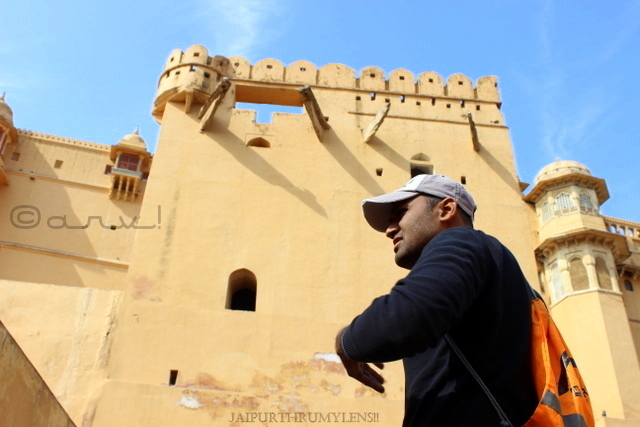
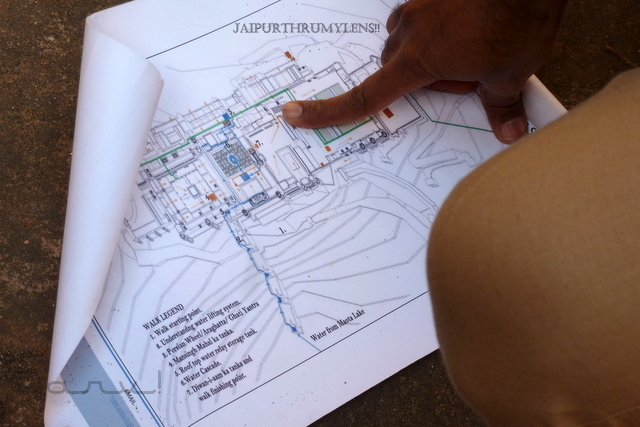
Amer Heritage Water Walk & Nahargarh Heritage Water Walks were launched simultaneously and I have wanted to do the former but somehow, it hasn’t happened for the last three and half years because it is not popular among travelers. Amer Fort is special being one of the most popular tourist attractions in Jaipur. Amer Fort Water Walk by Heritage Water Walks showcases & explains the Amer Fort water storage system.
Read Amer Fort: The only guide you will ever need
Amer Fort Heritage Water Walk Experience | Complete Guide
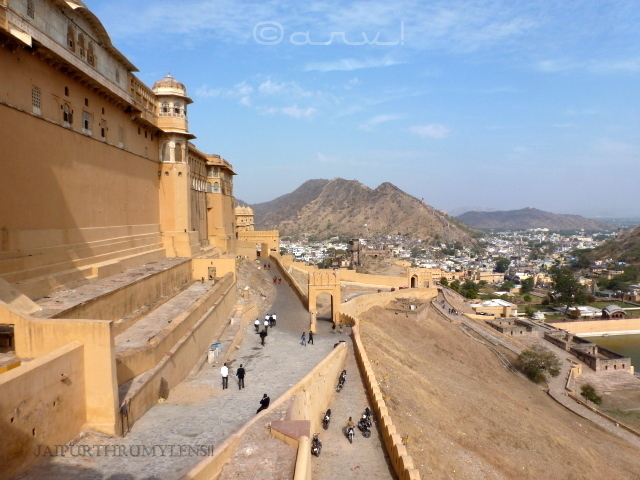
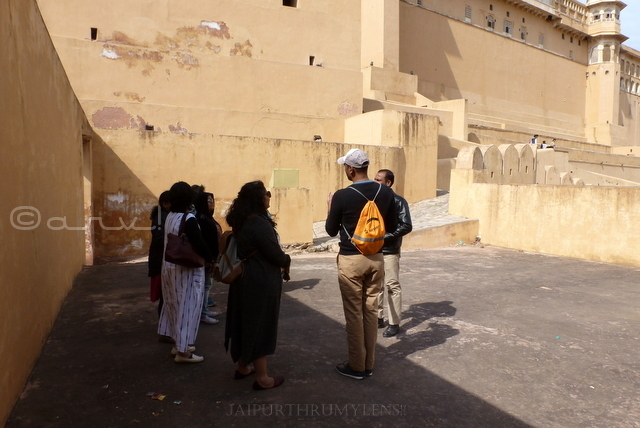
It was the last day of January and luckily, the afternoon wasn’t as cold as the last few days with the sun shining brightly. I was waiting in Jaleb Chowk for the rest of the people who had booked the walk. As soon as they arrived, Neeraj introduced himself & started the Amer Heritage Water Walk. He led us all through the Udai Pol towards the Balidan Gate.
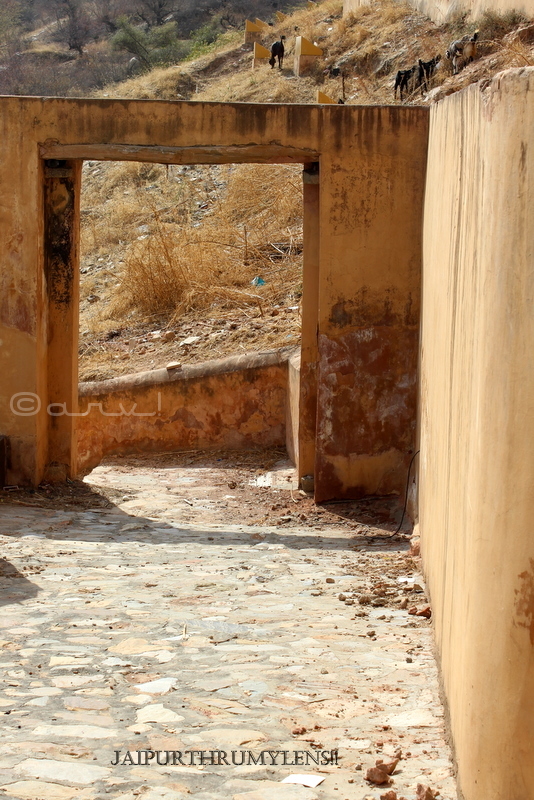
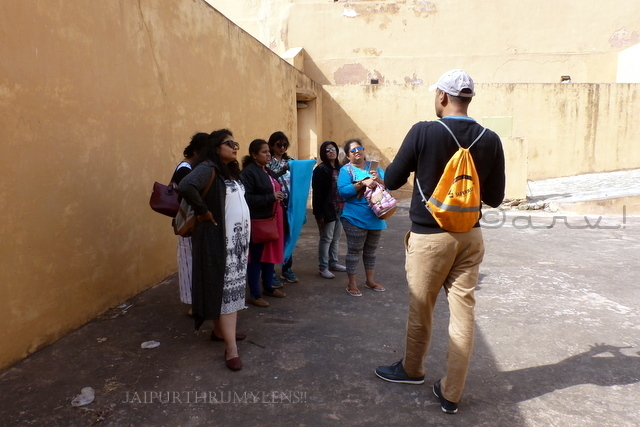
The briefing & introduction about the Amer heritage water walk took on the terrace of the Amer Fort water storage tank at level 3. Neeraj explained the water storage system of Amer Fort; and how water transportation from level 1 to level 3 was different from level 4 onward.
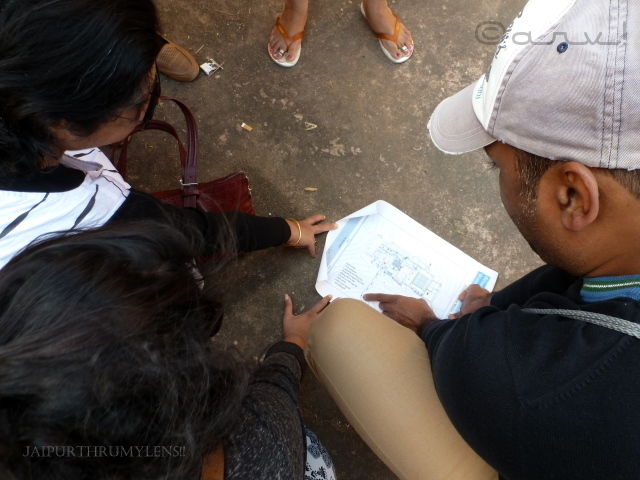
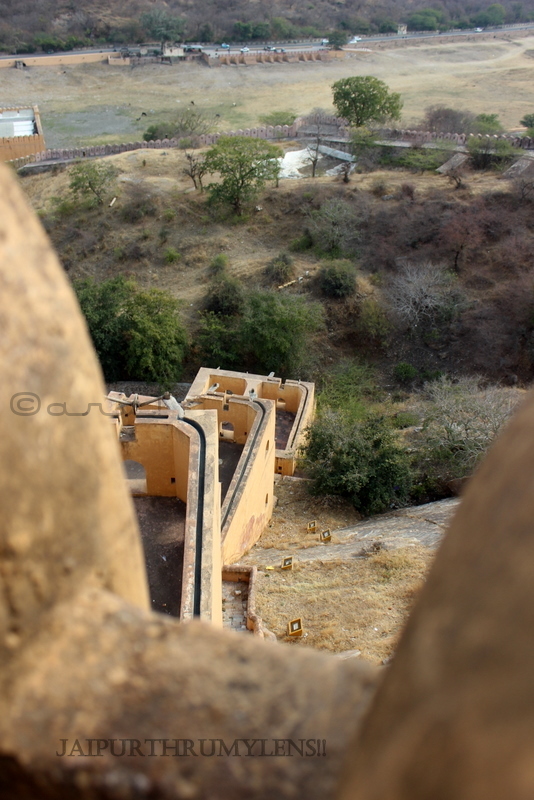
Apparently, Amer Fort relied on two different water storage & systems. Maota Lake supplied a large volume of water to the fort through a specially designed water transport system. It consisted of various levels each having intermediary storage tanks.
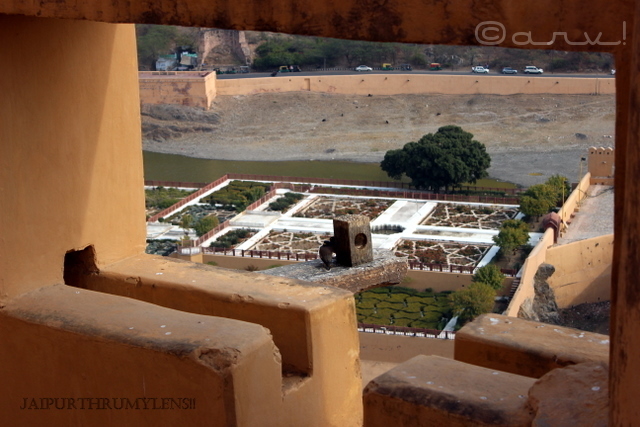
Transporting the water relied on age-old simple machinery propelled by both the human workforce and domesticated animals. Systems & mechanisms in Amer Fort were influenced by the Mughals. Rulers of Amer were generals in the Mughal army and led many conquests from Afghanistan to Bangladesh. It is natural for the Mughal influence and systems to percolate in the Amer Fort.
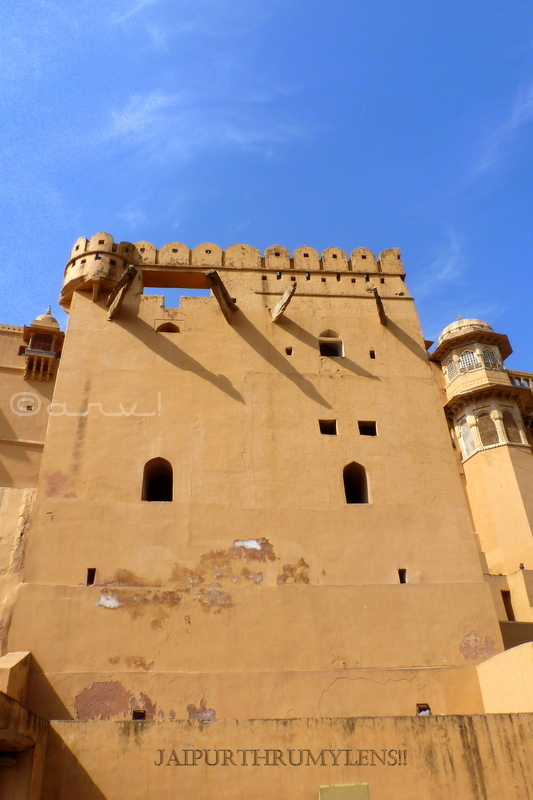
While level 1 to 3 is accessible to everyone, entry to level 4 & onward is restricted.
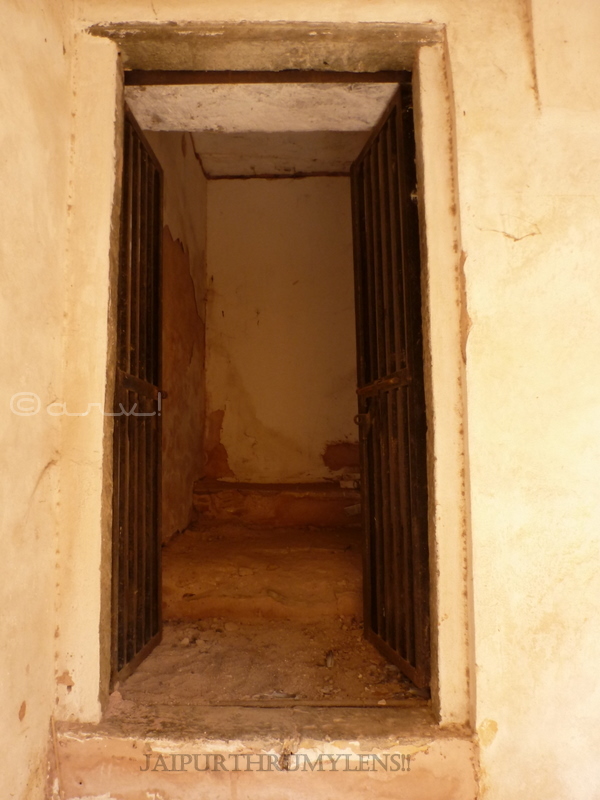
Level 4 has a room that used to house men trusted with supplying water to the residential areas of the Amer Fort.
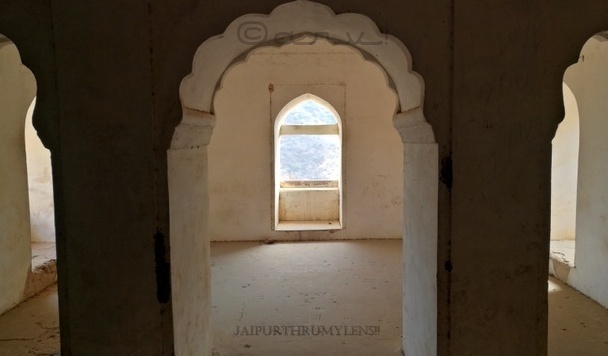
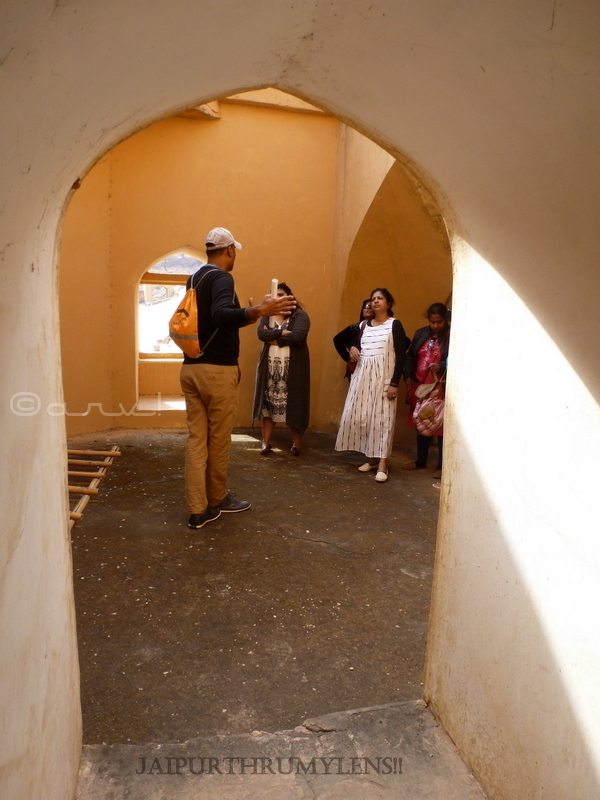
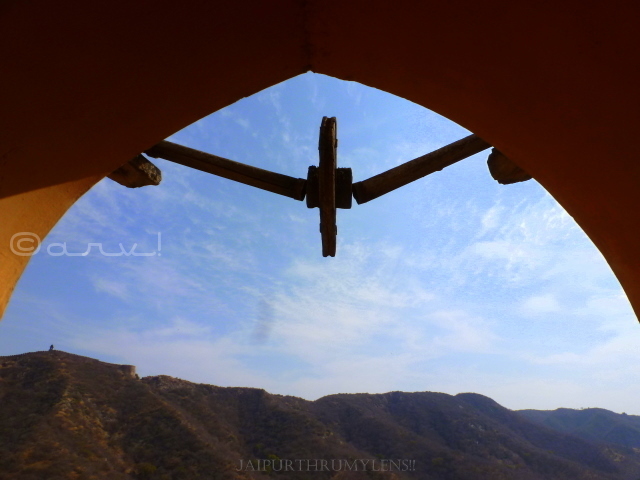
Level 5 has a mechanism to transport the water through Rehat/Saqiya – a Persian wheel and a heating system. It is astonishing how incredible these mechanisms were and they served well for years. If you want to understand how the water-lifting system of Amer Fort functioned, I will soon share the post explaining the water system of Amer Fort.
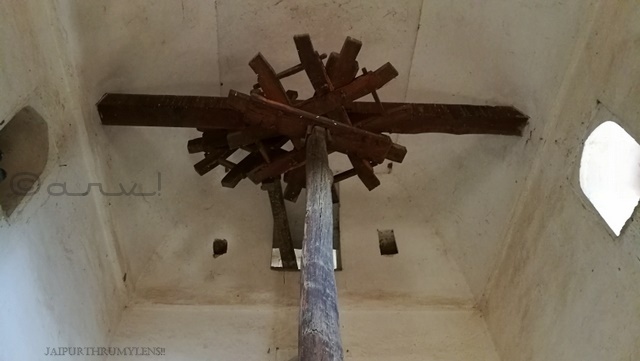
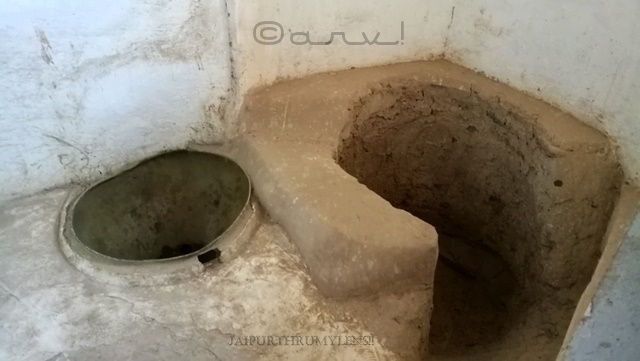
A flight of steps took us to the Mansingh Mahal & Zenana area of Amer Fort, the residential quarters of the queens.
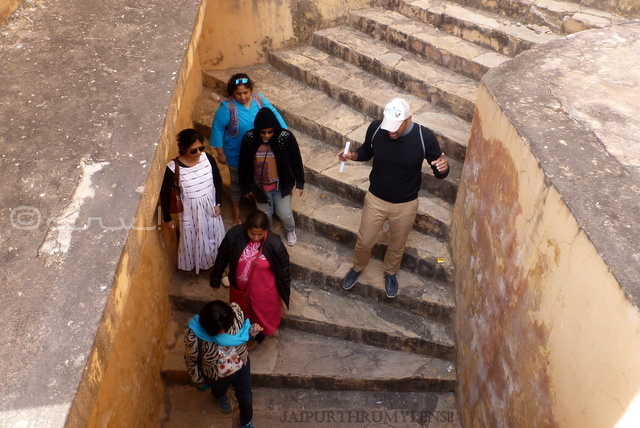
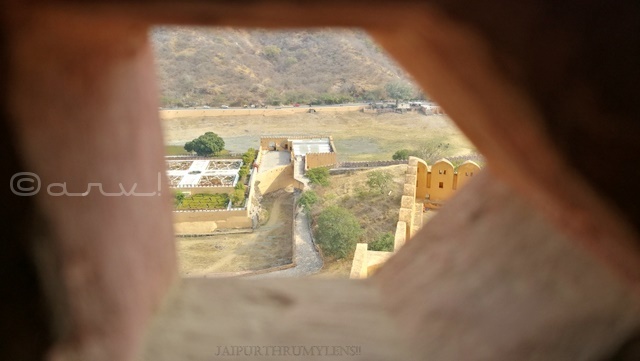
In no time, we were led into a well through the flight of steps. This underground well under Mansingh Mahal stored a few thousand liters of freshwater collected through the rainwater harvesting system meant for drinking purposes. Surprisingly, the well had lots of water because the system was still functional.
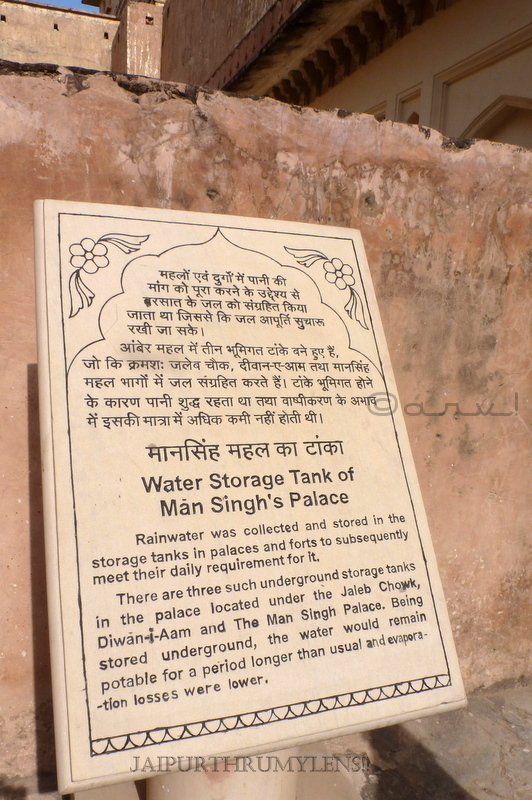
During the Amer heritage water walk, We crisscrossed from tourist sections like Zenana Mahal & Sukh Mahal to a different section of Amer Fort – a water distribution system on one of the terraces of the fort.
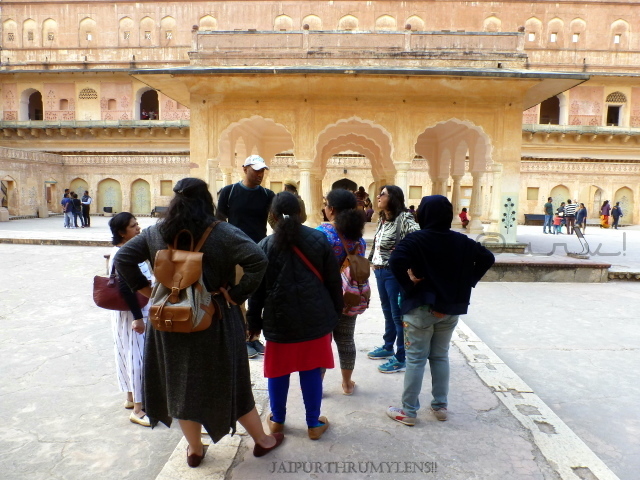
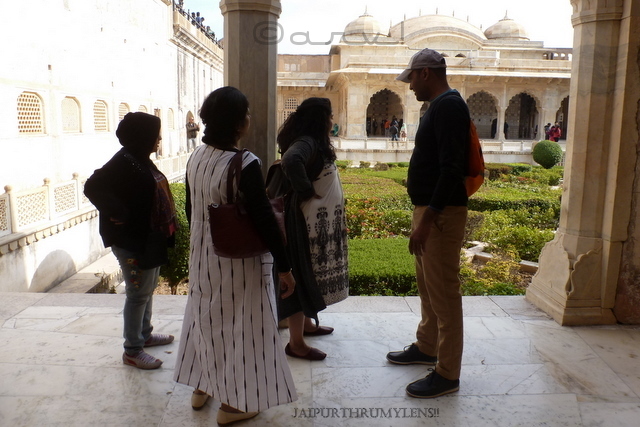
There was an old water pipe made from clay and a water redistribution center. Water is channeled into different areas of Amer Fort through a redistribution center.
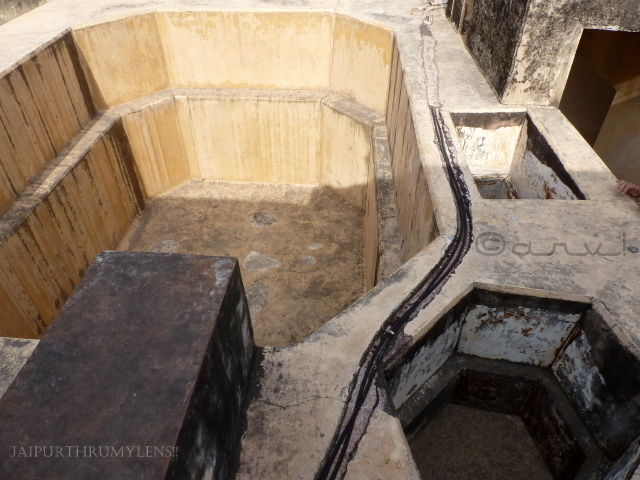
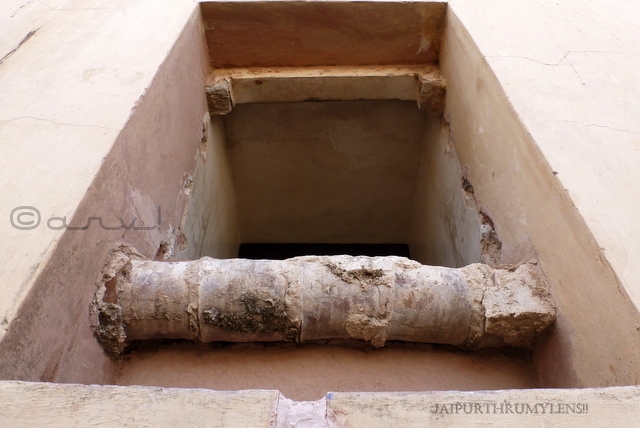
Despite the lack of technology 500-600 years ago, a sophisticated system worked on simple principles of physics. If you have ever been to Amer Fort you must have seen the ingenious system of using water to cool the hot desert air at Sukh Niwas. It replicates the experience of having an air conditioner.
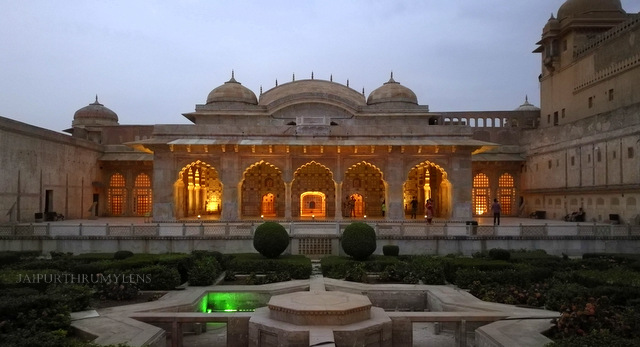
Toward the end of the walk, we entered a water chamber having a water reservoir underneath the Jaleb Chowk of Amer Fort. The large open area was a meeting place used by the royalty during the hot & dry summer months. A fountain provided mist & humidity whereas the lattices cooled the entire hall with the airflow.
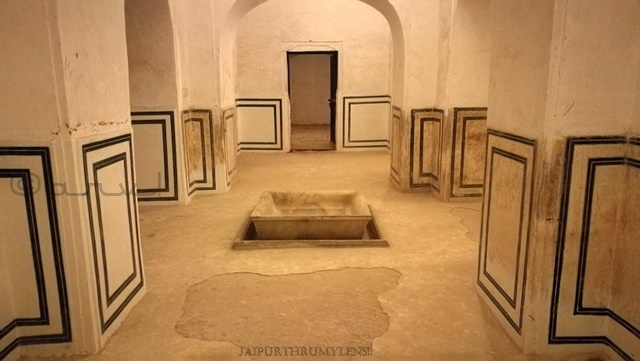
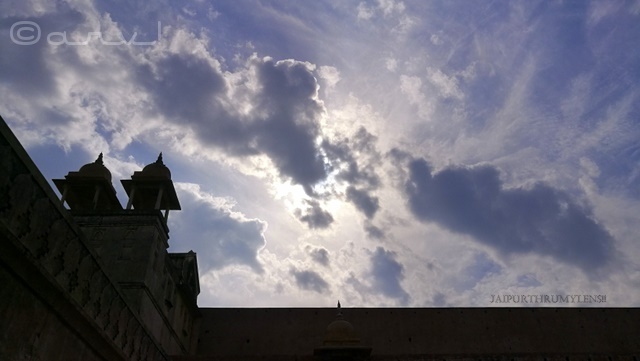
This was the first time I visited this section. It is at a stone-throw distance from the most popular attraction points of Amer Fort – Ganesh Pol, Diwan-e-Aam, and Chhatis Kachari. The Amer Fort Water walk culminated at this point and we walked back to the Jaleb Chowk. I looked up and saw the clouds playing hide and seek with the sun.
We all know how most civilizations developed and prospered in and around the water sources. The lack of water led to the downfall of many civilizations; while some fled & migrated others perished. Rajasthan being a water-deficient region pioneered water conservation & harvesting systems. Many regions across the world are headed toward water scarcity. The mindset & outlook of our ancestors towards a scarce resource – water was different. The water system developed during those times made life possible in difficult circumstances.
Here is a short video that explains this water walk. Kindly enable the subtitles since the voice quality is poor.
Amer Fort Heritage Water Walk Information
What is Amer Fort?
Amer Fort is the most popular tourist attraction in Jaipur. It is a palace and the former capital of the Jaipur kingdom. It was replaced by Jaipur as a capital in 1727 AD by Maharajah Sawai Jai Singh II. Amer Fort is a UNESCO World Heritage Site and clustered under “Hill Forts of Rajasthan”.
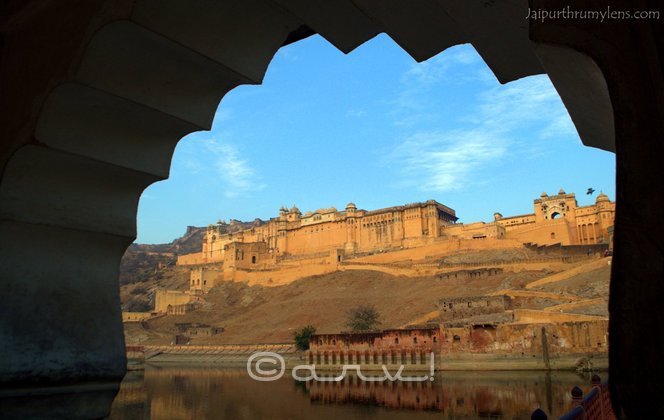
Amer Fort Heritage Water Walk Distance And Location
Amer Fort Heritage Water Walk distance from MI Road, Jaipur is around 11 km. The water walk takes place in Amer Fort.
Amer Fort Heritage Water Walk Timing?
The heritage water walk in Amer Fort is functional when the fort is open. Amer Fort is open from 8 AM to 5.30 PM and 6.30 PM to 9.15 PM under Jaipur by Nite, a night-tourism initiative.
What are the Places to visit in Amer Fort?
While the top attractions in Amer Fort are the elephant ride, Sheesh Mahal, and Ganesh Pol, there are many more interesting things to see. You can read more in Amer Fort Guide
How to book and contact the Amer Fort Heritage Water Walk?
Amer Fort Heritage Water Walk can be undertaken by prior booking only. If you have any queries, email jaipurthrumylens@gmail.com.
What is the Amer Fort Heritage Water Walk Duration?
The Amer Heritage Water Walk duration is around 2.5 hours. Do consider the time taken to reach Amer Fort. One needs at least 5 hours considering all factors like commute, and the time required to explore the fort. During peak season especially around Christmas, New Year, Diwali, etc. it takes at least 1.5 hours to reach Amer Fort one way owing to the rush.
What is the difficulty level of the Amer Fort Heritage Water Walk?
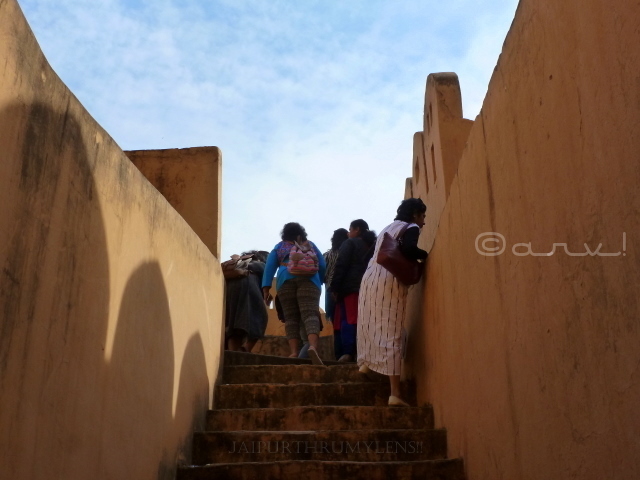
The water walk can be undertaken by a fit person. It might not be suitable for people with disabilities or walking issues. The route is not wheelchair accessible since it involves walking and taking the flight of steps throughout the fort area.
Things to carry with you for the Amer Fort Heritage Water Walk
Good walking shoes, drinking water, a camera for photos or videos, a notepad, and a pen if you like taking notes. Ensure you have your smartphone charged if you like clicking lots of pictures and videos.
Amer Fort Heritage Water Walk Cost
Amer Heritage Water Walk cost is approximately Rs 1500-2500 depending on the booking source.
Is Amer Fort Heritage Walk Worth Experiencing?
It will be hard to generalize whether Amer Fort Heritage Walk is worth experiencing for everyone. Heritage Water walks in Jaipur are best described as specialized walks. For first-time visitors to Jaipur, there are plenty of interesting things to see and do in Jaipur. People interested in water systems or built heritage might enjoy the Amer Palace heritage water walk; others, have plenty of other walking tours to choose from.
Which heritage walk is a good alternative to Amer Heritage Water Walk?
A better alternative to the heritage water walk is a heritage walking tour in Jaipur Walled City providing good insight into the heritage, history, architecture, and culture of the pink city. What weighs in the favor of this walk is there is no extra commute time and the overall experience & the takeaway. Experience and witness more things on a walking tour of Jaipur’s old city; one can experience & understand the living culture. You can read more about the Jaipur walking tour in this post – Heritage walking tour in Jaipur
If you enjoyed reading this post, don’t forget to share it on your social media.
Follow me on Facebook Twitter Instagram
Discover more from JaipurThruMyLens
Subscribe to get the latest posts sent to your email.
 JaipurThruMyLens
What awesome photos–thanks for sharing!
LikeLiked by 4 people
I’m glad you found it interesting. 🙂
LikeLiked by 1 person
I am tempted to claim that all major civilizations knew how to master the supply of water to their citizens. I am very much impressed by this well documented post on the water walks of this mighty fort, Arv!
LikeLiked by 3 people
It is true that all civilizations developed near water source – Mesopotamian, Chinese, Egyptian, and Indian. Water was very important element for the survival of life. I’m glad you liked this post. 🙂
LikeLiked by 1 person
Read this whilst drinking water ha ha great post. It’s interesting to learn about how water was supplied in the past.
LikeLiked by 3 people
LOL! It is surely interesting, Nikki!
How is water problem now in Cape Town? I have heard that situation was bad a few months ago.
LikeLiked by 1 person
It’s ok not brilliant. There’s still water restrictions which means people are trying to use water wisely. Luckily we got unexpected rain last year and that saved the situation. And Germany has donated a lot of money to the city to help build infrastructure needed to deliver water.
LikeLiked by 1 person
wow! Rains surely must provided a breather. In any case, wise use of resource is good. By the way, why this problem arose in the first case? Any idea? It is not a water deficit region for sure.
LikeLiked by 1 person
It is a combination of poor planning and changing weather patterns. The city just isn’t getting that much rain fall anymore.
LikeLiked by 1 person
Ok. I guess the city must looking forward to the reverse osmosis water conversion plant which uses sea water. Many Middle East countries rely on such plants for water.
LikeLiked by 1 person
Yes it is it’s still being built fortunately people are reducing their water usage.
LikeLiked by 1 person
That’s great! Being a responsible citizen is an appreciable effort. Happy to hear this, Nikki! 🙂
LikeLiked by 1 person
That sounds a really interesting walk, Arv.
LikeLiked by 3 people
It surely was, Mick. 🙂
How is your second novel progressing?
LikeLiked by 1 person
The first draft is completed, and rested for a couple of months. I’m now into the first edit.
LikeLiked by 1 person
Great! Good wishes!
LikeLiked by 1 person
Thanks, Arv.
LikeLiked by 1 person
🙂
LikeLike
I am thinking how cognizant people were that time compared to people today. They made such meticulous arrangements for optimal water usage. And, you are bang on when you say about what the tourist guides take you through as I have experienced it in Amer Fort. If I go to Jaipur again, this is how I’d like to see Amer Fort.
LikeLiked by 3 people
Let me book one for you Neel (in advance). I always feel that there are many differences between a tourist and a traveler. Tourist loves the usual thing and also stories. Travelers however, want to try something new/ offbeat and loves historical facts and not cooked up stories.
Well, we have certain luxuries which our ancestors didn’t have. You will be surprised how sophisticated these systems are even though they date back to 16th century. 🙂
LikeLiked by 1 person
Thank you for the offer, Arvind! i will surely connect with you next time I go. And, I myself used to be a tourist until recently, so i totally understand what you mean. I used to always travel but now I travel so very differently.
I can tell the sophistication of the water systems from your descriptions.
LikeLiked by 1 person
I’m glad you have made that transition. It definitely allows you to look at things from a different perspective. You start appreciating the finer details and your entire experience is different from that of a tourist.
LikeLiked by 1 person
This is so exciting! I wish they do this for all willing tourists 🙂 I would be one of them for sure!
LikeLiked by 4 people
Hi, Madhura. Having undertaken such water walks, I feel this is something that involves patience and inquisitiveness and is more suited for explorers and travelers. This walk is best enjoyed when you are willing to travel the “roads less traveled”. There already are other options which are open for tourists but only a few of them opt for it like a tunnel which connects Amer with Jaigarh Fort. Also, some of these places are not suitable for large number of people. If you like this walk, you should consider yourself a traveler and not a tourist. 🙂
Do let me know whenever you are in town, I will connect you with the right person. 🙂
LikeLiked by 1 person
I understand! I had visited Amer a few years ago and though the guide provided us with a lot of intriguing information, as you mentioned earlier, it was fabricated to entertain majority of tourists. I just wish such detailed information was easily available for willing people. I will definitely contact you when I visit Jaipur the next time. I am a sucker for history and everything related to it! Can never get enough of Jaipur or any place in Rajasthan for that matter 🙂
LikeLiked by 2 people
I guess these stories are universal across the world. Have you heard about Haunted tourism in UK? As a part of guided tours tourists are greeted with “ghosts” look alike to give a “haunted” experience. You are right, Rajasthan has a lot to offer for history lovers. As for the information being made available to the tourists, there isn’t much available in terms of written records; you will find information mentioned at all important places in Amer Fort. Where are you originally from, Madhura?
LikeLiked by 1 person
So true. And I am from Mumbai. 🙂
LikeLiked by 1 person
Great! 🙂
LikeLike
As usual a beautifully written post with supporting photographs.
LikeLiked by 3 people
Thanks, Abhijeet. I’m happy to know you liked it. I suppose you have been to Amer Fort sometime in past.
LikeLiked by 1 person
I have been to Amer fort may be two times. I have not seen the water works. With regular guides and touristy crowd one does not feel the place as well. Because everyone is in a hurry to move on.
LikeLiked by 1 person
True. I prefer to pick time when the crowd is less because as you pointed out, the entire experience with crowd all around is not too great. But at times, you have no option.
LikeLike
True. In this kind of places of historical significance, one has to go with right mind. Hardly few hundred years before there were people, their happiness and sorrow still linger.
LikeLiked by 1 person
well said. All these places have become “Insta-worthy” places! If you were to search Instagram for Amer you will be amazed with the kind of pictures you will see… Someone posted a particular style of picture one fine day and now every female is following the trend. “Herd-Mentality” is what one can conclude. I don’t know if this is a humans nature or people from our region were born with an overdose!
LikeLike
I have not seen the picture. I would say having a predominantly young population we tend to follow something unusual.
LikeLiked by 1 person
True 🙂
LikeLike
Looks BEAUTIFUL. This is where we went when visiting Jaipur, brings back so many lovely memories. Very jealous of you.
LikeLiked by 3 people
Oh! Amer is incredibly popular. Many find it to be an exotic place. I’m sure you must have enjoyed your trip. 🙂
LikeLike
Thank you for introducing to the hidden treasurs of Amer
LikeLiked by 3 people
I’m glad you liked it. How was your recent trip to Amer Fort?
LikeLike
Interesting read. I was aware that some portions of the fort are kept in closure and distant form the regular tourists. Would love to visit inside some time. Bookmarking this post for the future.. 🙂
LikeLiked by 3 people
I’m sure you will love it, Rajat. This walk was a great revelation. 🙂
LikeLiked by 1 person
What a fascinating place and post! I’d love to experience the cooling effect of this ancient system. And, I love that you point out how special this system is, especially without modern technology. Humans are quite remarkable, and they’ve always found ways to survive. That’s why we’re here today. But, it’s special to get a glimpse into the past to see exactly what our ancestors were able to accomplish. Great post!
LikeLiked by 4 people
What is striking is that our ancestors lived in tandem with nature. Most of these system depended on nature, simple law of physics and manual labor yet they worked with precision. You are so right! Have you ever been to any old forts, Erin?
LikeLiked by 1 person
You’ve got it! I wish we, as people, were more in tune with nature. I think we’d all be better off. Yes, I’ve been to several old forts – I absolutely love history, and I am always in awe over what our ancestors accomplished with little or no technology.
LikeLiked by 1 person
Happy to hear that you love history, Erin. I agree with your last statement.
Thanks for sharing your thoughts 🙂
LikeLike
How interesting! I visited Amer Fort in December the “normal” way, and I wasn’t too impressed – too many people! This would have been cool to see, though 😀
I will try to add a link to this article when I write about Jaipur on my own blog!
LikeLiked by 4 people
Hi, Samuel. Very few people find Amer Fort unimpressive. I always suggest people to avoid rush time in my blogs. I can understand how too many people can kill the place. I tend to pick time when there is less rush. Keep me posted whenever you publish a write-up, I would love to read it. So did you find something else to your liking in Jaipur, Samuel?
LikeLiked by 1 person
Yeah, The Wind Facade was pretty, but what I really liked was Jantar Mantar. Such a feat of engineering and science, yet so gorgeous ! I loved it.
To be fair, I would have skipped Amber Fort and spent one more day in a wilder place, like Bharatpur or the Chambal River 😉
LikeLiked by 1 person
Certainly, Jantar Mantar is one of its kind. Considering the period when it was built and the precision of instruments, it is mind-boggling! I can understand why you want to skip Amer Fort. There are many other places to enjoy the wilderness in Rajasthan.
LikeLike
First, let me confess, I was a bit confused at the beginning of this post. I quite stupidly thought that water walk would mean circumferencing the fort on a boat on something like that. I don’t know why I thought so because how can one walk on a boat ride also. My bad!!
This is an extremely interesting post because this shows the intricate engineering involved in building the post. It shows how advanced thinking they had in those days. I have been to Amer fort but never knew about this walk. Next time would add this to my list. Thanks for sharing.
LikeLiked by 4 people
You are not wrong in thinking this way. Water walk is not common and I guess that leads to this confusion. You are right that a lot of planning was involved in developing the water systems. Water walk in Amer is a hidden gem, so visitors are not likely to know about it. I’m sure you will enjoy taking one. Did you visit Amer recently?
LikeLike
It seems that you had great times there, Arv. I love this post. Ancient stuffs and technologies always amaze me.
LikeLiked by 3 people
I’m delighted to know that you loved this post, Nurul. I agree there is an intriguing angle to the old stuff. There are many things that we haven’t been able to solve or understand. But it is amazing to know how our old generations used to live in tandem with nature. Have you also found many such amazing things during your travel, Nurul?
LikeLike
There are many things that beguiles me about your jaipur adventures. You’ve given tribute to this traditional eden of jaipur a jewel into her renowned glory, your every pictures is in harmony with your descriptions,not monotonous but interesting to read.You should be the brand ambassador of Jaipur,literally Aarav.
LikeLiked by 3 people
Thanks for considering me worthy enough for being the brand ambassador for the city. Unfortunately, they don’t have any such option.
Do you imply that writing follows picture or it is other way around. Although, from a cursory glance it might mean the same thing but there’s a difference.
Thanks, for being so kind, Neha 🙂
LikeLike
I was there but missed so many features 🙁. Thank you Arv for telling is. Well done Neeraj.
LikeLiked by 3 people
Kavitha, Amer water walk is not for everyone. It is for explorers who are looking beyond the usual. Given the nature os the walk and the engagement required, it cannot be extended to hundreds of people. I’m sure you will revisit Jaipur someday and undertake this one, Kavitha 🙂
LikeLiked by 1 person
We wouldn’t have been able to, true. There was a lady in her 60s present.
Someday Arv. My list grows longer. 🌸🌺
LikeLiked by 1 person
I know, we have very few years on this planet and too many places to visit. Right?
LikeLiked by 1 person
What an interesting way to visit a familiar place with fresh perspective! Like uncovering something buried away. 🙂
LikeLiked by 4 people
Absolutely, Josy. I visited many sections for the first time despite having been here many times. 🙂
LikeLiked by 1 person
Wow! Amer Fort looks stunning with so many hidden spots. I think it’s pretty ingenious how they figured how to store water and circulate it through the undulating terrain on which the fort is built. It’s ironic how they had it figured out and we’re struggling to cope with water shortage — despite having so many devices.
Jaipur looks so different from a local’s (your) perspective. It’s also changed a lot I think. 🙂
LikeLiked by 3 people
As a tourist, our perspective is different when we are visiting such a place. If we visit these places as explorers, we will notice many small details. The water collection system in Nahargarh Fort is spread over larger space and uses aqueducts through valleys. It looks like this technique came from Europe where aqueducts were very common.
As a tourists, one visit a place with a tight schedule; as a local even though I’m pressed for time, I get to visit the same place may be 2-3 times a year. That allows me to see things differently.
Yes, the city has changed a lot over the last few years, as you have rightly pointed out, Cheryl.
Definitely, we have moved to western lifestyle where aesthetics and adhering to standards requires a lot of wasteful use. Water is no different. We have moved away from a lifestyle where we were in tandem with nature. I don’t think we are even thinking about this issue. True? I’m sure you will have many more things to share having traveled and experienced a lot!
LikeLiked by 1 person
I never fail to be amazed at how you are able to write so much on one city and give each post a fresh angle without coming across as repetitive in your content! Kudos to your blogging skills, Arvind. 🙂 I truly admire them.
LikeLiked by 3 people
Thanks, Rama for being so kind. It is all because the city offers quite a bit. Frankly, I’m not able to write as much as I experience. And there are many things that I choose not to write due to the paucity of time. Well, while I can’t travel out of town, I certainly can travel around. 🙂
LikeLiked by 2 people
Well, still a super big thumbs up for you. 🙂
LikeLiked by 1 person
Thanks, Rama. You sure know how to inspire 🙂
LikeLike