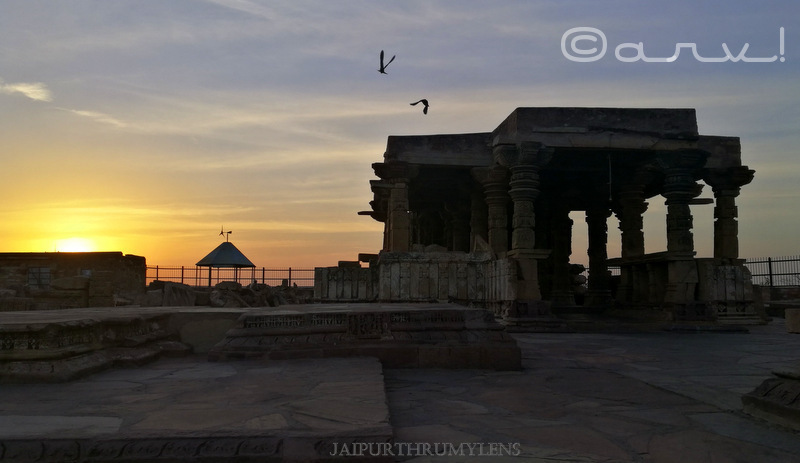
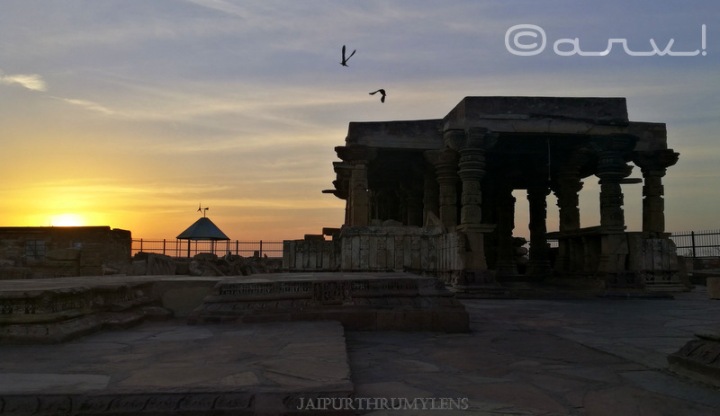
I’m chronicling my trip to Harshnath Mandir in Sikar. I started my return journey for Jaipur from Tal Chhapar in western Rajasthan on a winter afternoon. Tal Chhapar is a Black Buck wildlife sanctuary. As per the current estimate, it is home to 4500-5000 blackbucks and its topography is similar to the African Savanah. Tal Chappar has shot into fame lately because it attracts many migratory birds during the winters from Siberia and Mongolia. The road from Tal Chappar to Laxmangarh is being widened and driving a SUV is also a pain. Past Laxmangarh, its fun to drive on a smooth tarmac all the way to Jaipur. But this time, I had planned a detour from NH 52 towards a less popular temple called Harshnath on Harsh Parvat. It is well-known among the locals but is overshadowed by another temple – Jeen Mata. The Harshnath Temple in Sikar is on Harshgiri or Harsh Parvat, a part of Aravali hill range in Rajasthan.
Read about my previous Tal Chappar trip – Driving Trip to Tal Chhappar Blackbuck Wildlife Sanctuary
People claim that Harsh Parvat (mountain) is the second-highest point in the state of Rajasthan with an altitude of 1800 meters after Mt. Abu. The claim seems acceptable as Mt. Abu is at an altitude of 2000 meters.
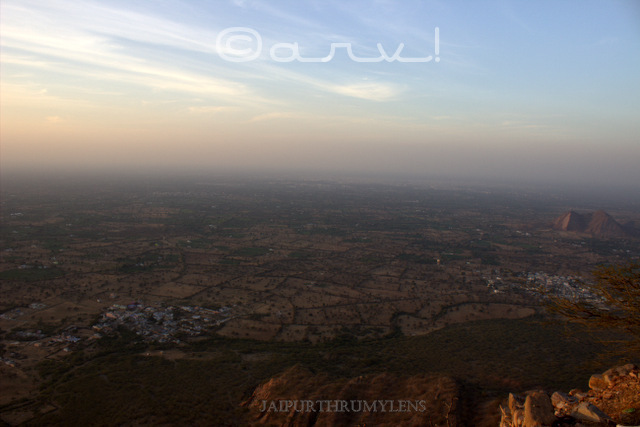
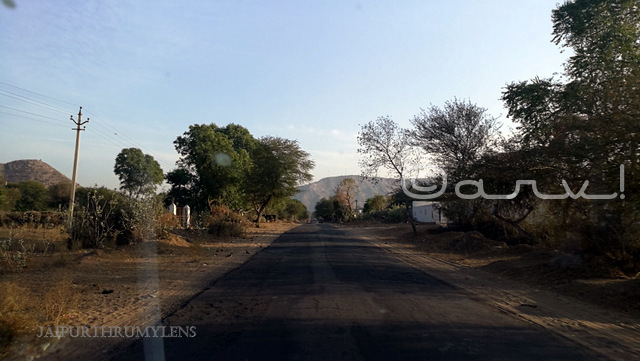
After taking a detour from Bikaner- Jaipur highway and driving through the country roads via small villages, the ascend for Harsh Parvat is abrupt and the road is desolate. In the hope not to miss the sunset, I had an urge to speed up but it seemed impossible because once you drive past the Forest department check post the road is almost non-existent.
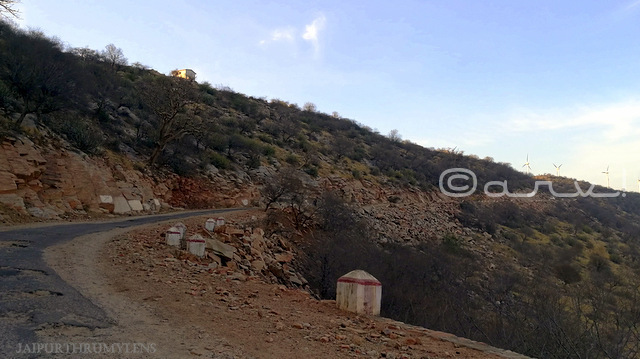
Driving at 10 km/h, it took near about 40 minutes to reach the hilltop. There were hardly any vehicles on this inhospitable way. I can’t recall having seen even 5 cars on the way up! The reason is understandable. With pathetic road conditions, people prefer not to visit. As you ascend the views start getting better with the setting sun.
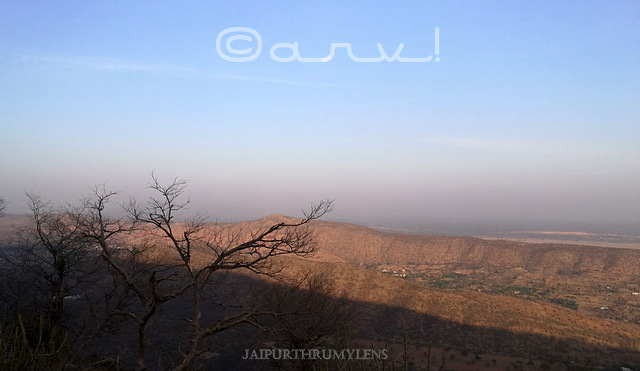
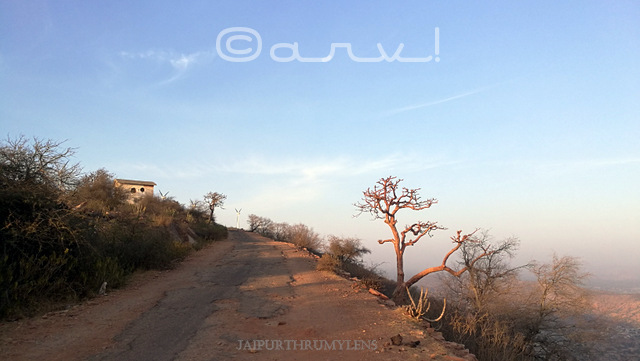
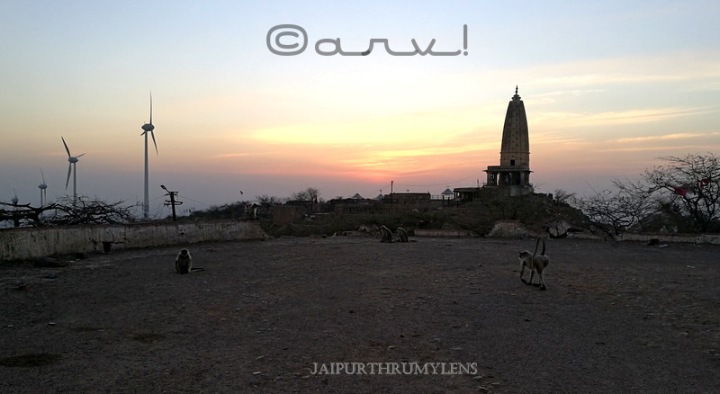
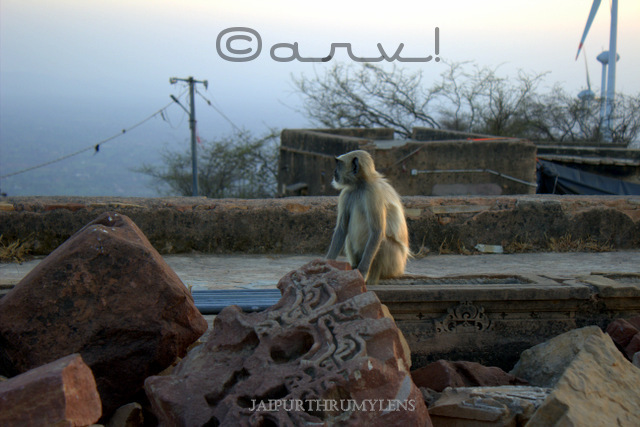
Windmills and monkeys dominate the landscape of Harsh Parvat.
History of Harshnath Temple Sikar
You might be tempted to know what’s so special about this temple. To explain it better, let me brief you with a little history of Harshnath Temple. Harshnath is an ancient temple on Harshgiri dedicated to Lord Shiva and dates to 956 AD. As per the Archaeological Survey of India, the temple was built by a Shaivite Bhavarakta known as Allata during the reign of Vigraharaja I of the Chahamana dynasty.
Most people have not heard about the Chahamana dynasty. Many historians consider the origin of Chauhan Rajput rulers to Chahamana. Chahamana dynasty ruled over a vast area of Rajasthan and Haryana from the 7th to 12th centuries. Their earlier capital was in Sambhar famous for the salt & delicious Indian sweet -Fini. They worshipped Shakhambari Mata and this temple still exists in Sambhar. Ajmer became their next capital under the rule of Ajayraja. That’s how the name Ajmer is derived. Chahamana repulsed attacks by the famous Muslim invader Mohammed Ghazni of the middle east. Famous Adhai Din Ka Jhompra which was converted into a mosque under the Mughal rule was built by this dynasty. Chahamanas were famous as Chauhans of Shakhambari and later as Chauhans of Ajmer.
Sergeant E Dean discovered Harshnath temple on 3rd December 1834 AD. In 1835, he presented a paper to the Asiatic Society along with an inscription deciphered from this site. The inscription provides great information on the history of the Chauhan dynasty and the names of places under their rule. He referred to this temple as Shiva Baidyanath in his paper and mentioned that the stone quality is similar to the one in Qutub (Minar) in Delhi. Dean was of the opinion that the Chauhan dynasty of Rajasthan was related to the rulers of Kannauj. He further noted that this mountain was home to Leopard’s and Neelgai. There’s an interesting mythological story of Harshnath and Jeen Mata which claims that they are both brother and sister. This temple is built in Maha-Meru style
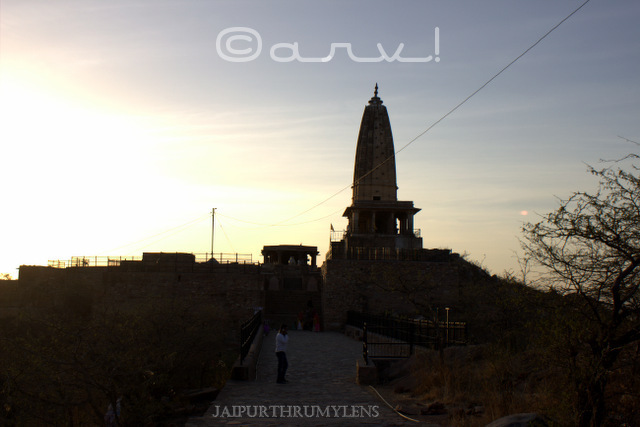
I recall having seen pictures of this temple with a tall spire.
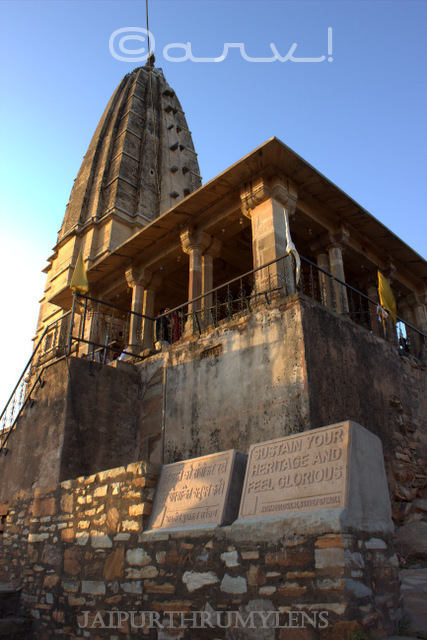
I assumed this must be the ancient Harshnath temple but I was wrong. It was built in 1718 AD by Chauhan king from the ruins of the original Harshnath temple right next to it. Stones from the original temples have been used in building the latter temple.
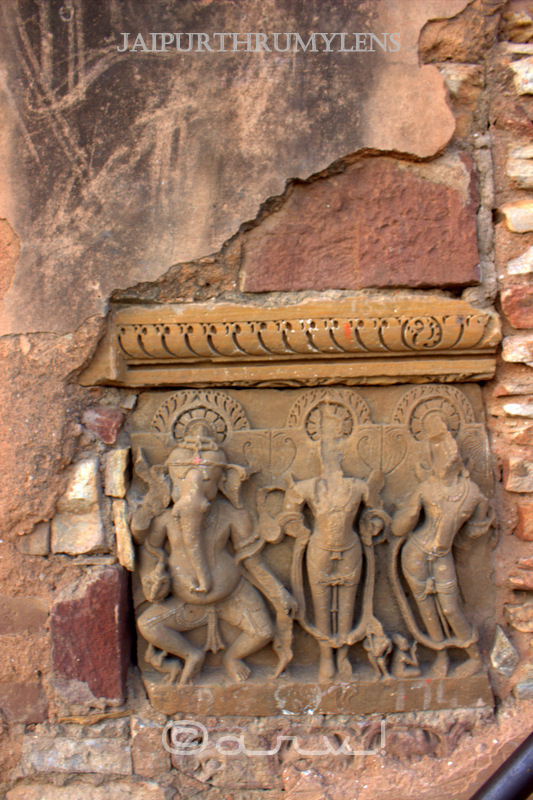
The common belief is that the Mughal ruler Aurangzeb destroyed the original Harshnath Temple in 1679 AD along with many other temples across India under a fatwah against Hindu temples. If you wish to read more about Aurangzeb’s hatred for Hindu temples, you must read this counter-view on Aurangzeb’s tyranny and bigotry cannot be whitewashed
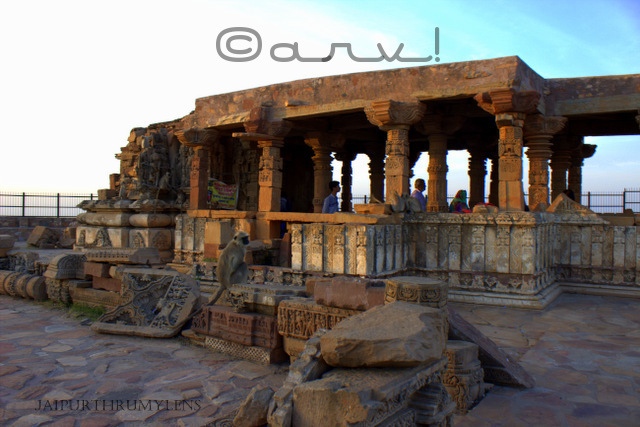
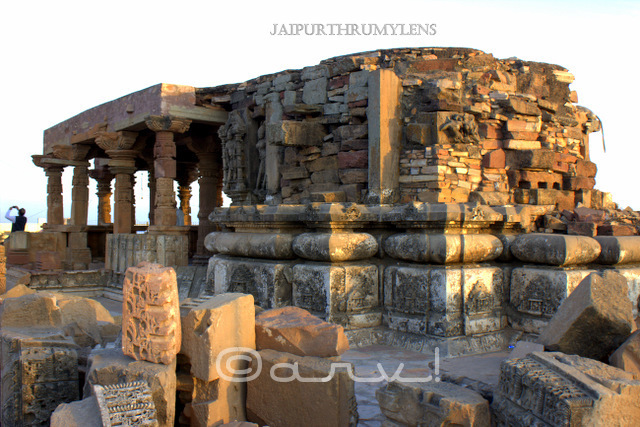
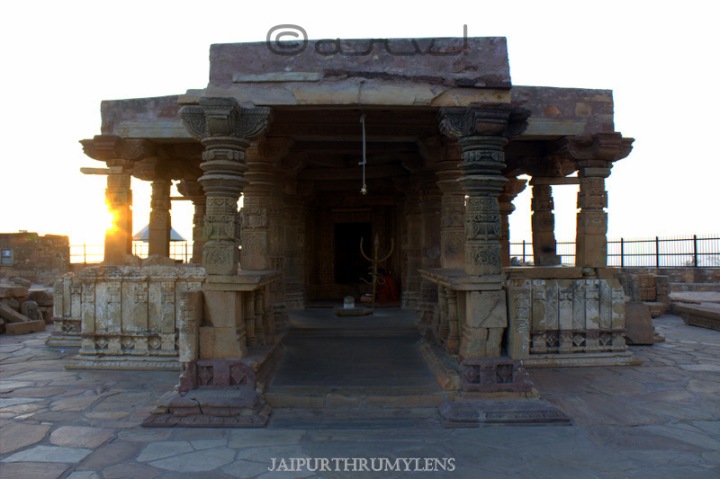
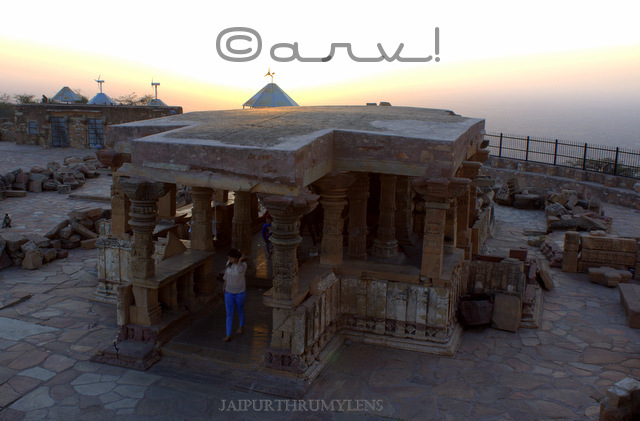
The original 10th-century temple is made of stones. The temple has beautiful and intrinsic carvings on the pillars and ceiling. This temple is contemporary to the famous Khajuraho temples. They were built during the same time period and one can see many similarities in their architecture & structure.
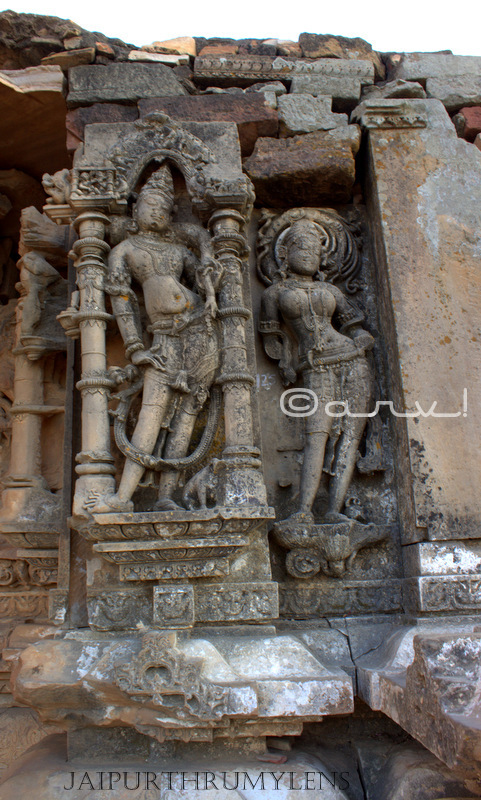
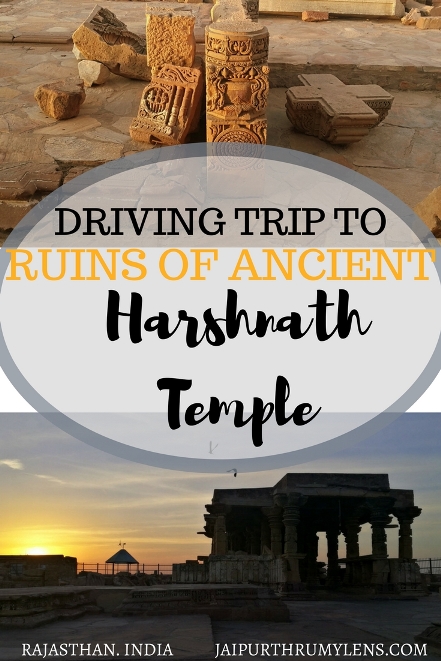
The rich carved stones from the temple ruin can be seen all around the complex.
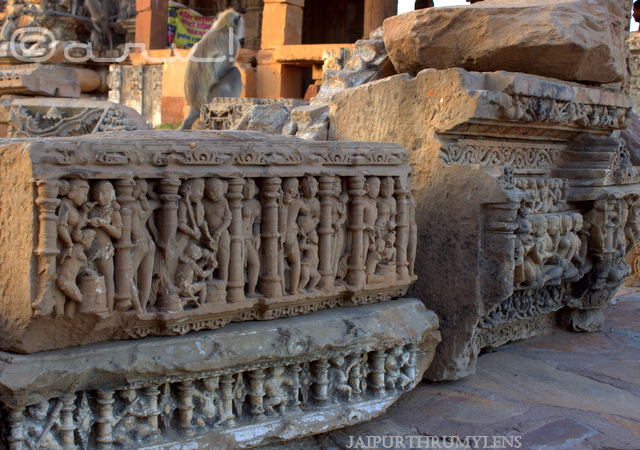

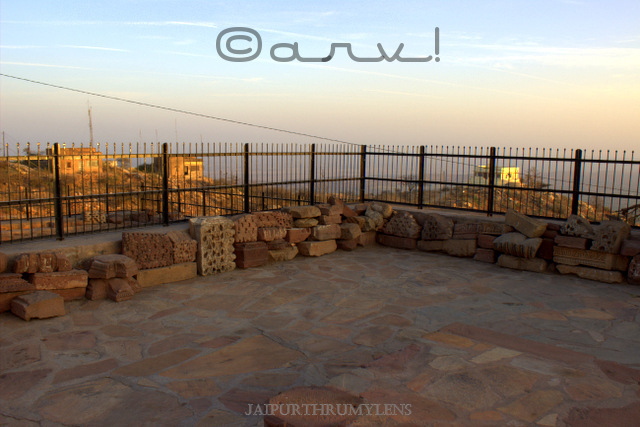
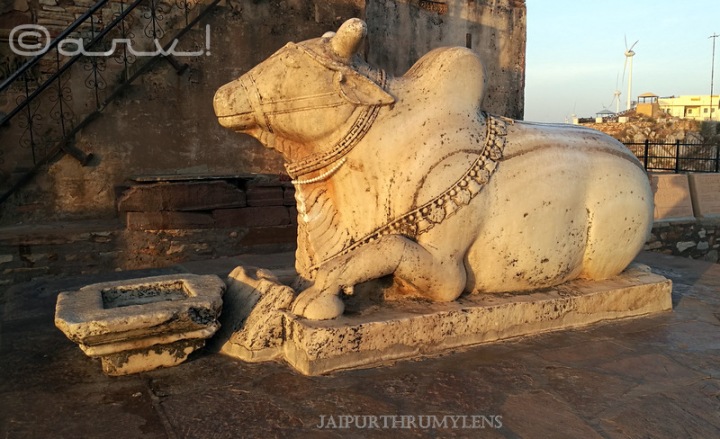
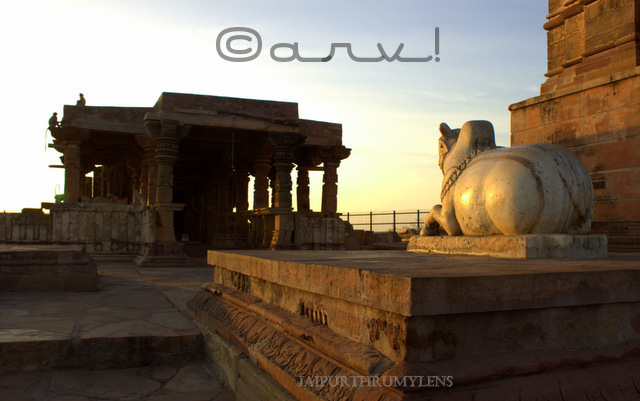
You can’t miss this beautiful idol of Nandi made of white Makrana marble. I’m not sure if this was installed when the new temple was built in the 18th century or if it’s from the 10th century. As a custom, the idol of Nandi is commonly installed in Shiva temples because it is considered as the trusted steed of Shiva. As per Hinduism, every Hindu god has a Vahana or vehicle. Nandi is considered as the gate guardian of Shiva. It stands for truth as well as righteousness.
Here are a few pictures from the sanctum of the ruined temple. The stones have elaborate and detailed carvings.
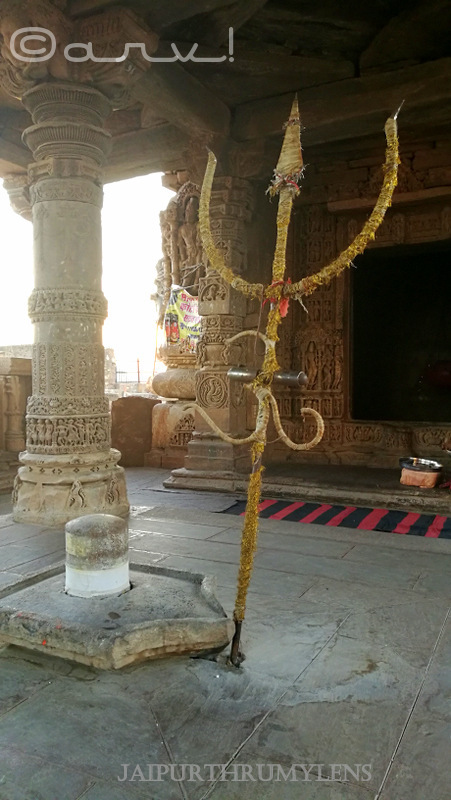
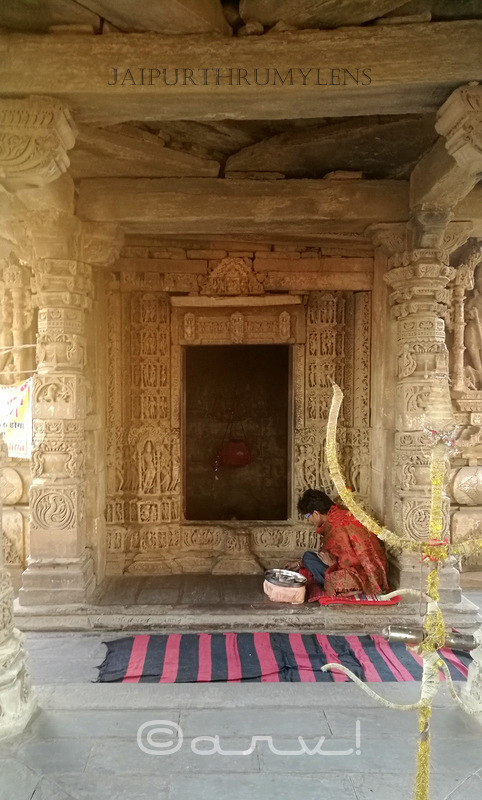
These two temples are not the only temples on the Harsh Parvat. There’s yet another one situated a little further and doesn’t even resemble a temple structure. This temple must have been built during the 18th century since stones and idols from the ruined temple have been used in the facade. It is Behrun Ji ka Mandir and you need to descend down to a lower level to reach the sanctum.
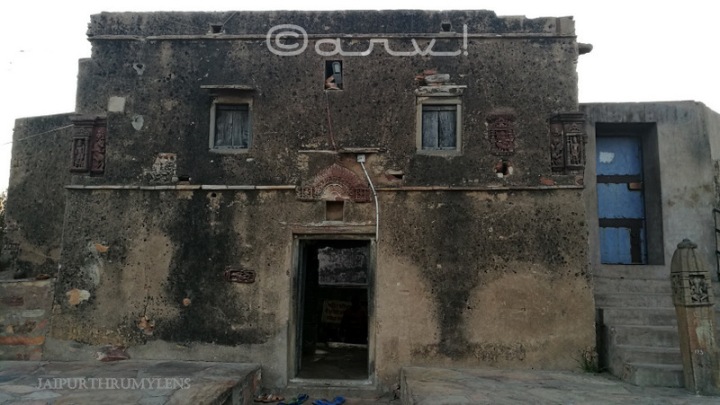
I assume this one is more popular among the locals since there was a flurry of activity and a number of Pandits. While Harshnath temple is under ASI, I assume this one is privately managed. The priest issued an “advanced warning” against photographing the idol and temple.
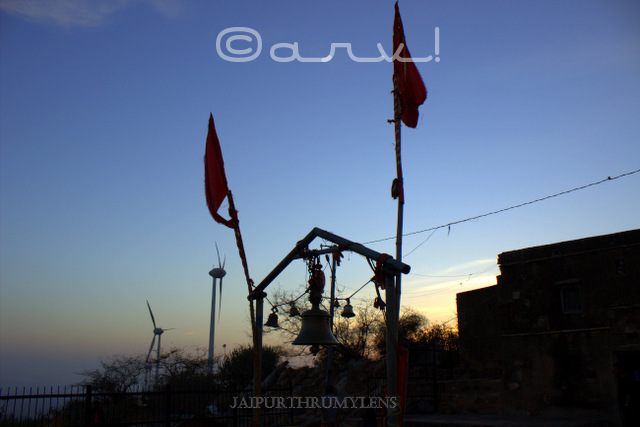
With the setting sun, it became imperative for me to leave ASAP considering the road conditions and the long drive ahead.
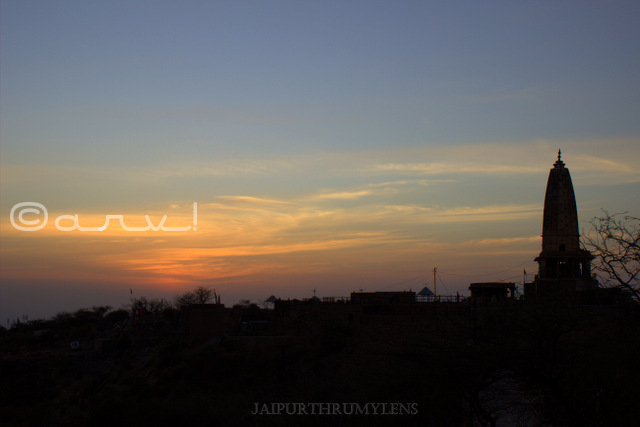
Have you experienced this phenomenon of a place getting firmly entrenched in your mind? Harshnath is one such place which got firmly entrenched in my mind ever since I heard about it a few years ago. I have wanted to visit this place but as they say that it doesn’t happen until it’s destined to, the opportunity to visit Harsh just didn’t materialize for one reason or another.
Follow Jaipurthrumylens on Facebook Twitter Instagram
Check out other Places to Visit Near Jaipur
Harsh Parvat is one of the interesting places to visit near Jaipur. I wish to return here again but on foot! Harsh Parvat makes for a great hiking place near Jaipur. But given the height of this mountain, it’s not going to be an easy one!
Is it worth visiting Harshnath Temple?
Yes and No. Yes, if you love history and heritage. Harsh Parvat is a kind of place that will make some people happy as it is full of peace and tranquility. You can give this place a miss considering the driving distance and road condition from the base of Harsh Parvat to the temple. Do note that any kind of facilities required by a tourist or traveler is not available here.
Discover more from JaipurThruMyLens
Subscribe to get the latest posts sent to your email.
 JaipurThruMyLens
Very nice article, Arv. It is indeed sad to note the amount of destruction that hundreds of our monuments have faced due to Aurangazeb and other such tyrants. That the culture has still stood intact is a testimony to the greatness of it.
LikeLiked by 2 people
Lalitha, One of the professors of history once wrote that origin of all these plunderers were essentially tribal and they were jealous of the advanced and rich civilization of this geographical region. That’s exactly the reason why they destroyed it. Just look at how advanced Sumer was in the middle east and what do we have today in its place? We still continue to lose our heritage. Look at Bamian and Palmyra.
LikeLiked by 1 person
Another fascinating read on the rich and fascinating history of your country! It is sad to read that this ancient temple near Jaipur has been destroyed, just because it was not dedicated to the right religion. This seems to be a universal phenomenon in human history. Thank you for those lovely photos that illustrate your post, Arv!
LikeLiked by 2 people
History is full of such examples. Well, it’s a controversial topic… religion always is! The bottom line is that we have lost much cultural heritage to narrow minds and we still continue to do so. The recent examples are Bamian and Palmyra.
Thanks for appreciating and checking out the post. Have a great week, ahead. 🙂
LikeLiked by 2 people
I love the photo of the birds at sunset (sunrise?). I always say, “You can’t get anywhere interesting on a paved road.” Of course you can, really, but it’s usually worthwhile to explore those unpaved ones to find treasures like this. 🙂
LikeLiked by 1 person
Monica, that’s sunset. The birds are heading home and I captured that picture on a smartphone! 🙂
I agree that we need to get off the usual path to find something interesting. Whether this is a treasure or not, depends on an individual. I love the details and architecture of this temple. Thanks for sharing your thoughts, Monica 🙂
LikeLiked by 1 person
Cool I love driving..
LikeLiked by 1 person
Me too! 🙂
LikeLike
Brilliant post – really loved the details here
LikeLiked by 1 person
Thanks, Avinash. I had no idea that this was an important Hindu temple. 🙂
LikeLiked by 1 person
Looks great! I’d spend the entire day there probably!
LikeLiked by 1 person
So would I only if I had more time. Thanks for sharing your views. 😃
LikeLiked by 1 person
Difficult roads lead to unique experiences always…there is so much story hidden in different parts of our country.
LikeLiked by 2 people
Neel, you are right on both these points. We have so much to explore around us. A lot is unknown and unwritten. I can sense the experience in your words. 😃 Thanks for sharing your views, Neel.
LikeLiked by 1 person
Apart from the bad road conditions and the dilapidated state of structures, it seems to be a worthwhile drive.
I would just go there to see the black bucks, and sunrise, of course!
LikeLiked by 1 person
Alok, it’s an interesting place. I’m sure the sunrise will be amazing but driving through the bad road in dark is a challenge. Probably, I’ll camp there overnight to witness a stunning sunrise.
LikeLiked by 1 person
Camping is a good option to explore with a bunch of people – something i’ve never done!
LikeLiked by 1 person
I have only camped in Himalayas till now. It’ll be interesting to do so in Aravalis. Since we both have something in common- love of nature, I’ll highly recommend it. In my experience, getting up with the chirp of birds much before the sunlight is a far better experience than staying in one of the most luxurious hotels.
LikeLiked by 1 person
Yes, since you raised this point, chirping of birds early in the morning is something we enjoyed everyday in Hawaii. It is not for nothing that it is called a tropical paradise.
I would want to spend a good amount of time traveling in India. Let’s see…
LikeLiked by 1 person
Well, I can see you are already sold on that idea. I’m hoping you do get to travel and explore incredible India. 😃
LikeLiked by 1 person
You have some fantastic photos as your reward for the difficult drive! Happy to hear you were successful getting back to Jaipur without incident!
Thank you so much for sharing 🙂
LikeLiked by 1 person
It was an interesting place to visit. Yes, it all went well. Thanks for reading and sharing your thoughts. 😃
LikeLike
Your posts make me think I missed so much on my recent visit to India. I’m glad for what you share.
LikeLiked by 1 person
There’s so much here that even residents haven’t explored most places. Where all did you visit in India?
LikeLike
All Rajasthan. Loved every stop.
LikeLike
Brilliant post here again, Arv. Thank you for sharing
LikeLiked by 1 person
Happy to hear this, Cornelia 😊
LikeLike
Your eye for detail is remarkable and shines through your pictures arv…Are you a professional photographer? How did you develop so much love for history and heritage?
LikeLiked by 1 person
I’m not a professional photographer in the sense that it’s not my source of income. I capture with all kinds of photography mediums – DSLR, compact camera, and even mobile phone. The cover picture was shot with the smartphone. My interest for the local history and heritage developed fairly recently when I started exploring my city along with a friend on photo-walks. He emigrated to another city and that’s when I started my blogging journey. I generally like to focus on offbeat and lesser-known places but many of the readers also want me to write on more popular sites.
Thanks for sharing your views. Appreciate it. 😃
LikeLike
Another informative post. Nice to know about Hasrhnath Temple.
Beautiful photos. First pic Awesome.
LikeLiked by 1 person
Thanks, Rupam. Happy to hear that you liked the first picture. 😃
LikeLiked by 1 person
These photos are fantastic. I’m hoping to get back to Rajasthan in January/February 2019 and this should be on the list of places to visit.
Those rural Rajasthan roads completely captivated me last time I was there. I’m very seriously considering bringing my bicycle next time or hiring one in town. There is so much beauty and small details that are easy to miss at highway speeds, but traveling 20 km/hr on a bike (or probably more like 5 up that mountain!) you see lots more – and get to meet so many more interesting people. It’s just a matter of mapping out a route with adequate food/lodging options for a few days’ trip.
LikeLiked by 1 person
Todd, cycling trip sounds great. You’ll be able to get a very different experience on a cycling trip. To be honest, there are so many places to go and discover. January and February is a great time for undertaking a cycling trip in Rajasthan. Let me know if I can be of any help, Todd. Thanks for the encouraging words. Appreciate it 👍😊
LikeLiked by 1 person
I loved the views from the top and the ruins of the ancient temples. The roads look a little scary though. 🙂
LikeLiked by 1 person
I’m glad you liked it. The road is an adventure in itself, Cheryl 😊
LikeLiked by 1 person
So true! 🙂
LikeLike
🙂
Found a couple of your comments in my spam folder. I don’t know why WP considers Cheryl as a spammer. 😉
LikeLiked by 1 person
lol! Whoa!
LikeLike
Such beautiful images Arv!
LikeLike
Wow what an awesome place to visit. I love seeing temples and places of worship and this just looks so beautiful. The carvings are insane and you think of the ancient tools they had it must have been a labour of love.
LikeLiked by 1 person
It is amazing to think how much time and effort must have been involved to create such a stunning temple. Have you ever been to any temple?
LikeLike
Your pictures are always beautiful. So much history. I think it is sometimes worth taking a harder path. I have usually been so excited when I have especially travelling.
LikeLiked by 1 person
Thank you 😊 Yes, sometimes it’s better to take a long or difficult path because the reward is great. Thanks for sharing your thoughts.
LikeLike
Beautiful pictures of a stunning site. The air looks so fresh up there. And the history of the place is amazing.
LikeLiked by 1 person
Thanks, Denzil. Yes, it’s a great place. Have you ever been to a similar place?
LikeLike
I can’t say I have. Not to such a grand place
LikeLiked by 1 person
😃
LikeLike