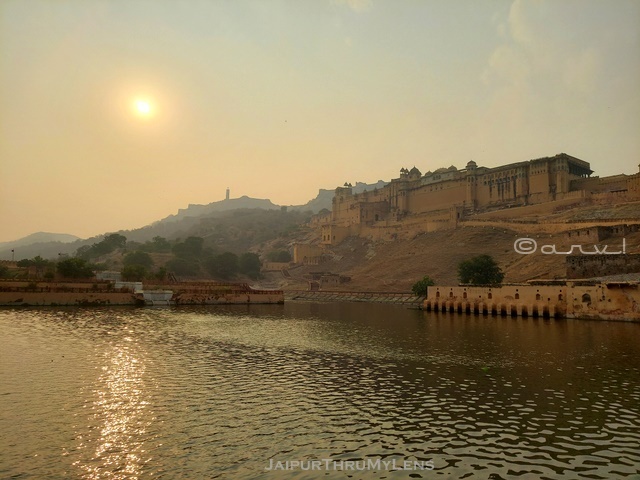
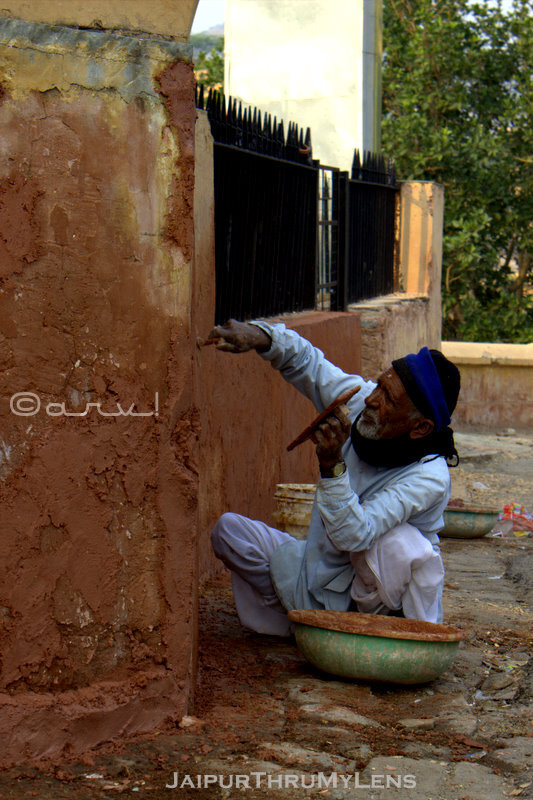
On my way back from Ramgarh after undertaking a Ramgarh Water Walk, I took a pitstop at Amer to capture the setting sun. The Amer Fort looked stunning, as always. Once done with photography, as I walked back to Amer Fort car parking, I saw this artisan carrying out conservation repairs under the heritage conservation project. Ordinarily, a team carries out the conservation program. I presume other team members must have been preoccupied with work since it is impossible to perform this task alone. I walked close to him and initiated the conversation.
Conversing with Heritage Conservation Artisan – Kumawat Community & Challenges with Heritage Conservation
“What’s your name?”
“Chunnilal”
Are you “Kumawat?” (In Rajasthan, the Kumawat community is well-known for its skills in building and construction.)
“No, I’m Mali (gardener)”
“Do you live here in Amer?”
“No. I live on Ramgarh Road, not far from here.”
“Would you appreciate it if I clicked your picture?”
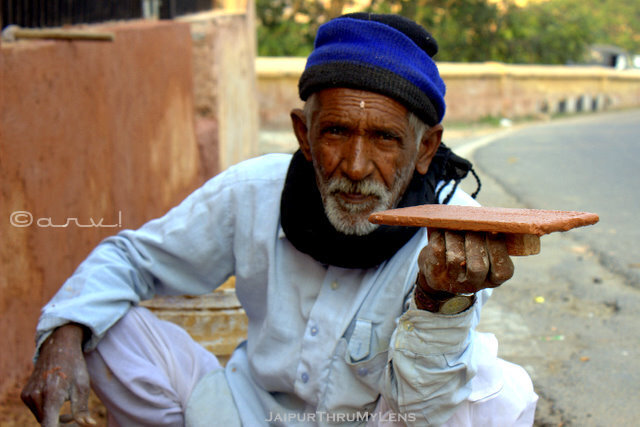
He gave a prolonged pause & looked around before nodding in affirmation. I presume he was afraid the contractor he worked for might object as this 5-minute photography break doesn’t really sound “productive.” A part of him wanted to be photographed. During this conversation, he kept working. But now, he paused and posed for a picture. Here is the picture of one of many people who restore heritage structures in Jaipur.
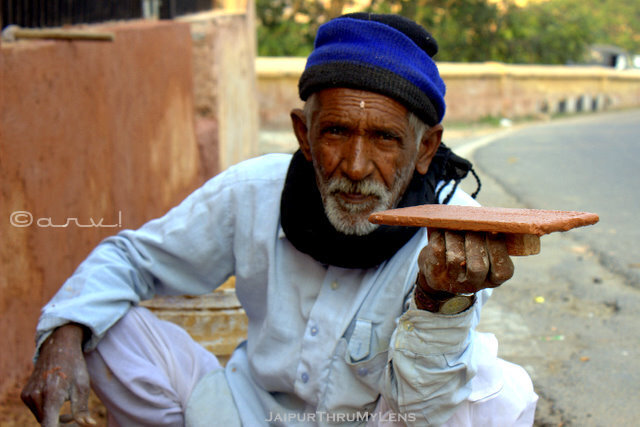
I presented him with the pictures I clicked on the screen and a smile appeared on his face. Generally, whenever I click pictures of people in Jaipur, I try handing them out a copy, later. Many people don’t have easy access to a printed photo; it is a sheer joy to witness the happiness on the face of people while handing a print to them.
Traditional Masons & Builders of Rajasthan – Kumawat community
Behind most forts, fort walls, bastions, lattices, palaces, temples or lime-plastered facade in Jaipur and Rajasthan are traditional craftsmen. In Rajasthan, buildings built using stone-lime and heritage conservation relies heavily on specialized communities like the Kumawats. Kumawats are hereditary masons and builders who have preserved architectural techniques for generations like skilled artisans of other communities.
The Kumawat community often historically referred as Raj-Mistris, Gajdhars, or Salavats holds a uniquel position in North Indian architectural history. They have been referred as “Vishwakarmas” meaning divine architects of building construction. They are the traditional stonemasons, architects, and master builders responsible for building and restoring many of Rajasthan’s iconic forts, stepwells (baoris), temples, and havelis.
Their expertise stretched far beyond manual labor. A head master mason often titled a Gajdhar meaning holder of the gaj, ar measuring rod, served as the chief structural engineer, site manager, and artisan. They had deep knowledge of Vastu Shastra, indigenous stone carving, structural geometry, and traditional material chemistry like Araish plaster techniques and lime mortar mixes.
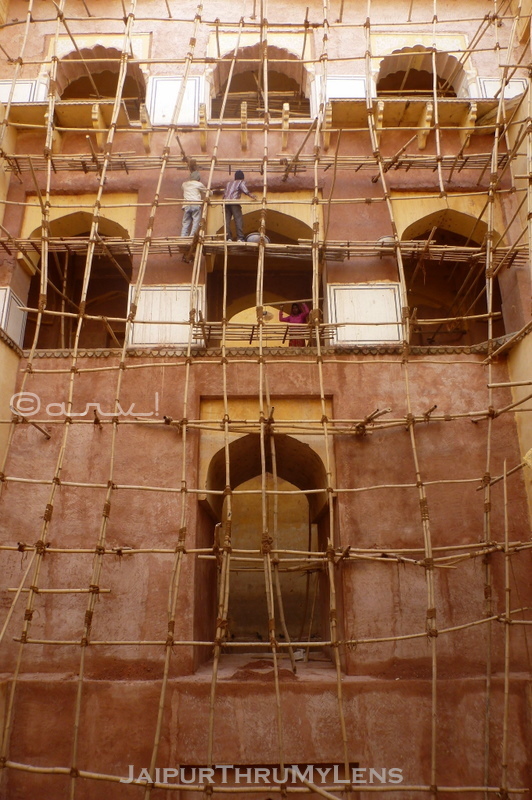
Unlike modern construction, which relies heavily on cement and concrete, authentic heritage conservation in Jaipur demands traditional methods which have traditionally been carried out by Kumawat community:
- Lime Mortar or Chuna – Formulated with traditional additives like jaggery, bael fruit/beal giri, and fenugreek
- Hand-Dressed Stone Masonry – Matching original stone blocks without using machines that could destabilize aging foundations.
- Intricate Plastering – A specialized plaster technique unique to Rajasthan that yields a smooth, marble-like finish called Araish.
Without supporting these unsung workers and passing their knowledge to future generations, conserving Rajasthan’s built heritage at scale becomes nearly impossible.
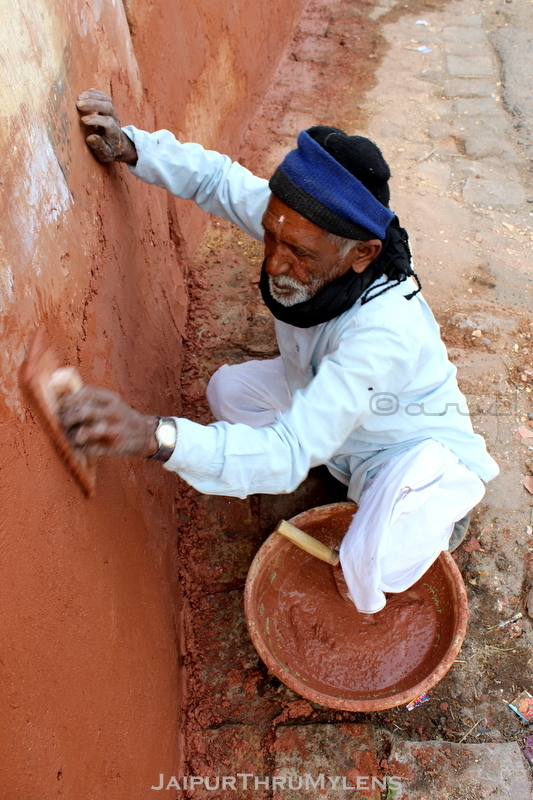
Heritage Conservation & Challenges in India
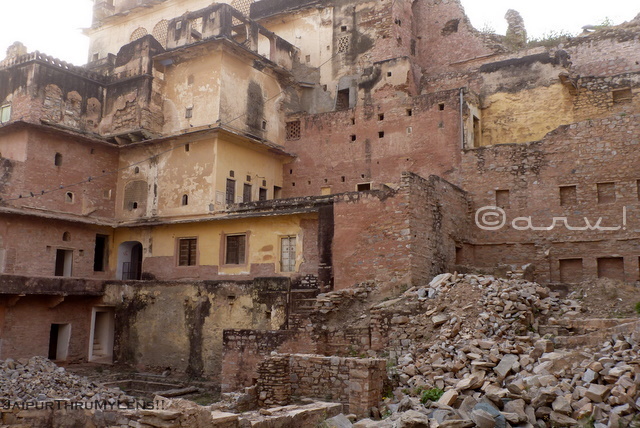
It is ironic some heritage structures receive so much attention while others suffer their own death. Right opposite where this restoration was taking place, an extensive section of the wall of an old Haveli was crumbling. The reason? It is not visible from the road. We live in a world where window dressing remains the norm. Read this blog on the importance of Heritage Conservation in India Heritage Conservation Why we need to conserve our built heritage
5 Core Challenges of Heritage Conservation in India
Here are some of the challenges in heritage conservation in Jaipur and India, in general.
- Lack of funds
- Poor Attitude towards built heritage
- Lack of business model to generate revenue from built heritage
- Lack of enough skilled manpower
- The slow process involved in the restoration
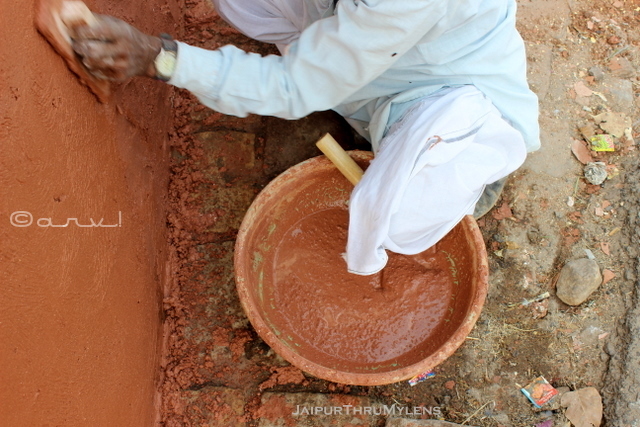
A Case of Amer Fort Wall & Old Havelis in Amer Town
These are some of the reasons but certainly, this is not exhaustive. As I conclude this post, here are two contrasting pictures of the Wall of Amer. The first one depicts a restored section, while the other represents a crumbling structure. What are your thoughts on these two pictures? Do you think we should allow the built heritage to die because it retains no relevance? Read Why the loss of the Great Wall of Amer is inevitable
Great wall of Amer has become quite a rage among international travelers after having been featured in many insta reels and videos. People try to climb on this wall and click insta worthy pictures. However, the government recently closed the access owing to an accident.
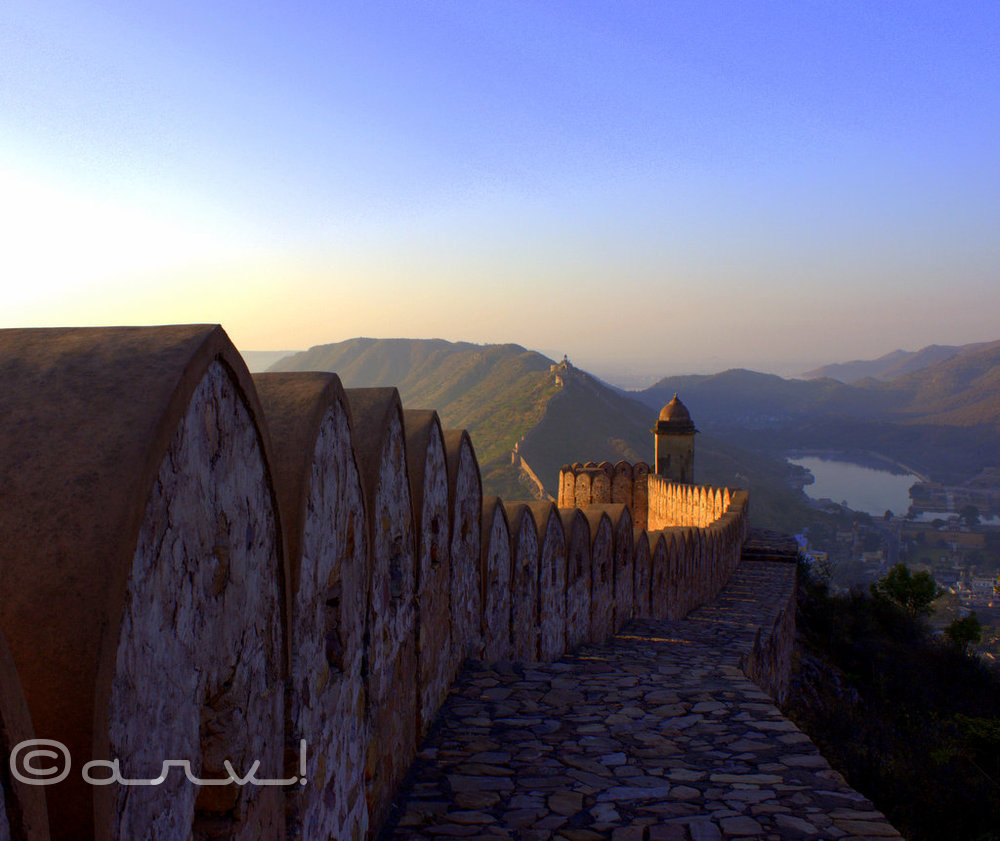
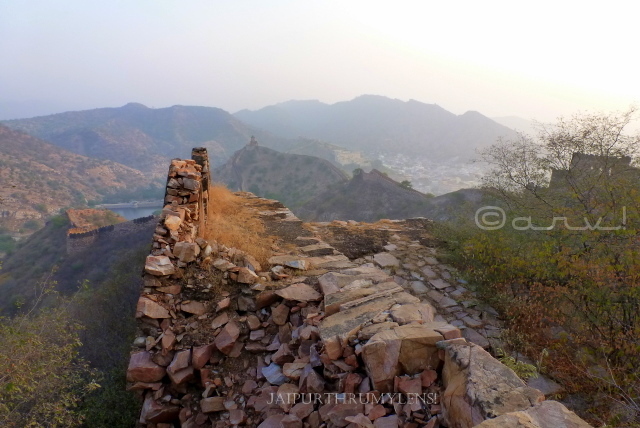
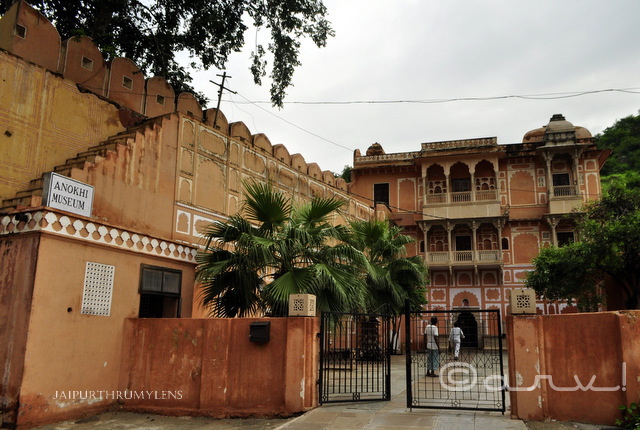
During a heritage walk in Amer town, one will witness Havelis which have been restored like Anokhi Haveli.
Here is another Haveli that needs heritage conservation in Amer.
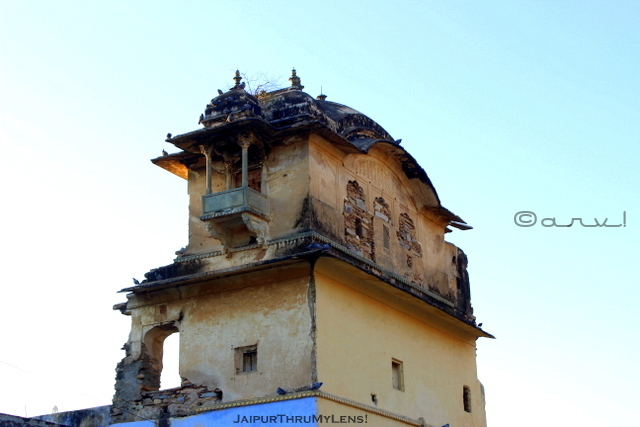
And another one. If you want to read more – Time changes everything
What is your opinion? Should we restore heritage structures or leave them crumbling? What do you think about introducing new elements in restoration process?
Stay updated with Jaipurthrumylens with Facebook Twitter Instagram
Discover more from JaipurThruMyLens
Subscribe to get the latest posts sent to your email.


I read your other post as well. It’s so sad to see such a beautiful heritage being neglected. In some ways, my feelings are divided. I visited Daulatabad Fort years ago and found great beauty in how nature was taking over the building, and almost making a statement of “Everything is impermanent. Even mighty, majestic structures will not outlast the sands of time”. Yet these structures are such a treasure for India. They’re part of the history and culture that make India so wonderful. It seems sad not to at least try to preserve what still can be saved.
LikeLiked by 1 person
I see your point here. In fact, there is another view as well. What is not useful will rot anyways. That’s the principle of nature. But at the same instance, this is part of our history and how we have evolved, so in that respect, it is important. Appreciate your point of view. 🙂
LikeLiked by 1 person
I hope that the attitude toward conservation and restoration of India’s cultural heritage will change and more funding for such projects will become available. I am glad you care so much about India’s treasures, Arv!
LikeLiked by 2 people
I hope so too. I think this heritage defines our evolution into the present day. Thanks for sharing your thoughts.
LikeLiked by 1 person
Wow 🤩 so thoughtful of you to click and present copies of pics. There are so many unsung heroes behind many stories 👏
LikeLiked by 2 people
True. Only a few get the limelight while others remain unknown. Thanks for sharing your thoughts. 🙂
LikeLiked by 1 person
I was surprised that lack of interest in building heritage is a main factor. I met many Indians that were so proud of their heritage, but I guess buildings aren’t included. Or I spoke to only one part of society. Well I’m glad some of these beautiful buildings are being restored. I guess it is too expensive to restore everything in an area with so many heritage buildings. I love that you gave people prints of the pictures you took. Maggie
LikeLiked by 1 person
Maggie, it is true people are proud of their heritage. There are many aspects related to built heritage. There are ownership issues with many claimants having conflicting issues. The cost of repairing these buildings is astronomical esp. the traditional methods. I feel the government help will make this easier. A print in their hand with a smile on face is priceless. Thanks for sharing your thoughts, Maggie. Appreciate it 🙂
LikeLiked by 1 person
This lovely post reminded me of Tughlaqabad Fort at the outskirts of Delhi, now in ruins spread out on both sides of the road but looks majestic even in that condition. I must have driven past almost 15 years ago but the beauty of those ruins are still fresh in my mind.
That is what the neglect of our heritage brings us to! Probably the coming generations would revere their treasured monuments. Your efforts at spreading the awakening towards our heritage is creditable arv. Stay blessed.
LikeLiked by 1 person
I agree even the ruins are majestic; I’m sure it must have been terrific in its true form. I feel these heritage buildings are an important part of our history and culture. This has been my guiding thought. Let’s hope we preserve as many as we can. Thanks for sharing your experience and thoughts. 🙂
LikeLiked by 1 person
Great Post. There are people who work silently and never come to the limelight. Their work is most important, but they never get attention not even proper respect.
LikeLiked by 1 person
Absolutely. Only a few get recognized. For example, generally, architects gets all the limelight rather than these workers. I’m happy we are on the same page.
LikeLike
What a beautiful portrait of Chunnilal! Thank you for sharing his story. I think his work is important, along with heritage conservation in general.
LikeLiked by 1 person
True, he is serious with his work. I’m glad you liked this post. Have you been to Jaipur?
LikeLike
Not yet!! But would love to! Hopefully soon!
LikeLike
Hi Arv, nice post & I agree that our heritage must be protected, maintained and promoted for domestic & international tourists. I remember in Athens, all we got to see were ruins at a ticket price. Comparatively, India has a huge history and heritage sites that can easily be encashed if we have the mindset. There is no shortage of talent, it’s about our approach which is lacking.
LikeLiked by 1 person
I agree. The Greek ruins are ancient and it’s understandable considering the time gap. At least we have something from that period. On the other hand, the structures here were built within 300-500 years. You are right about talent and approach towards heritage. I hope we change it soon. Thanks for sharing your thoughts. I’m glad this post resonated well with you.
LikeLike
Thanks👍 keep writing and have a wonderful year 🙂
LikeLiked by 1 person
You are welcome, hope to see you around. 🙂
LikeLike
THERE IS PLENTY OF MONEY BUT IT IS BEING DIVERTED INTO THE OCKETS OF THOSE HIGHER UP. Poor people like the Mali work long hours for little or no pay because they have no choice.
LikeLiked by 1 person
Christine, I don’t think your comment is in line with reality. No one works for “no pay” as you put it in India. Everyone has a choice. I can accept that wages might be low but it is never forced labor. As for money being pocketed by the “higher up”, it happens everywhere. Capitalist economies have so many examples, the best is Walmart! This write-up is not about people forcing others, rather it is about recognizing the unsung heroes.
LikeLike
I have no idea why they would let something so historic crumble. Here in Boulder, the historic commission fights to preserve ugly houses from the 1960s!!!
LikeLiked by 1 person
Is that so? i never knew that even in the US they have policy to retain the old buildings. Why do they want to protect these houses?
LikeLike
Because they are CRAZY! Most cities have preservation districts, even in my mom’s small town in Wisconsin.
LikeLiked by 1 person
oh! I wish we had better norms to preserve heritage. This proves authorities often don’t get things right irrespective of the place.
LikeLike
London is the worst! Concrete monoliths next to centuries-old beauties.
LikeLiked by 1 person
That’s a good example of how things are.
LikeLike
History is a part of our future and present. Its provides us invaluable inside of our culture, our society and largely our heritage. Efforts should be made to safeguard the legacy and knowledge that our elders have left for us. The unsung heroes who are putting efforts to safeguarding and largely protecting and restoring these remains unknown. Kudos to you ARV on bringing these forward.
LikeLike
What a beautiful portrait and story on Chunnilal. These are the true heroes in helping preserve such rich heritage buildings.
LikeLiked by 1 person
I totally agree with you, Sandhya 🙂
LikeLiked by 1 person
Gorgeous photos as always.
LikeLike
As usual, your posts expand my worldview. Thank you for this beautiful and informative post on heritage preservation. This is a problem that is pertinent to all cultures, I think.
LikeLike
Thank you for sharing your post at SIPB and for the time you took to give pleasure to the worker by taking his picture. I am sure he will always remember this and will have a lot of pride in his work and for you. RT
LikeLike
Handing out printed versions of pictures is so thoughtful ..
LikeLiked by 1 person
Whenever possible….it is not much but it brings smile on the face of receipient.
LikeLiked by 1 person