
One Sunday morning, I was on the Jaipur Agra highway searching for an old Stepwell with an acquaintance; we share a common interest, built heritage. I was informed that the Stepwell is 400 years old and it contains a few intact sections with decorative plaster and paint. Read my previous post on Stepwells in Jaipur-Jaipur Stepwells | The Lost Heritage. While exploring a village, I encountered a man from Meena Community near the railway tracks. Meena community is an important element of the traditional culture of Jaipur. I believe communities like Meena, Gurjar, Saini are all a part of Jaipur’s cultural heritage.
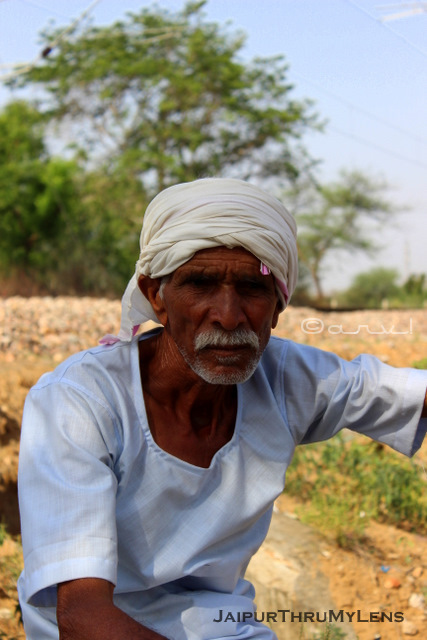
The Meena man in question was keeping a vigil on his flock of goats. After greeting each other, we were in a chitchat.
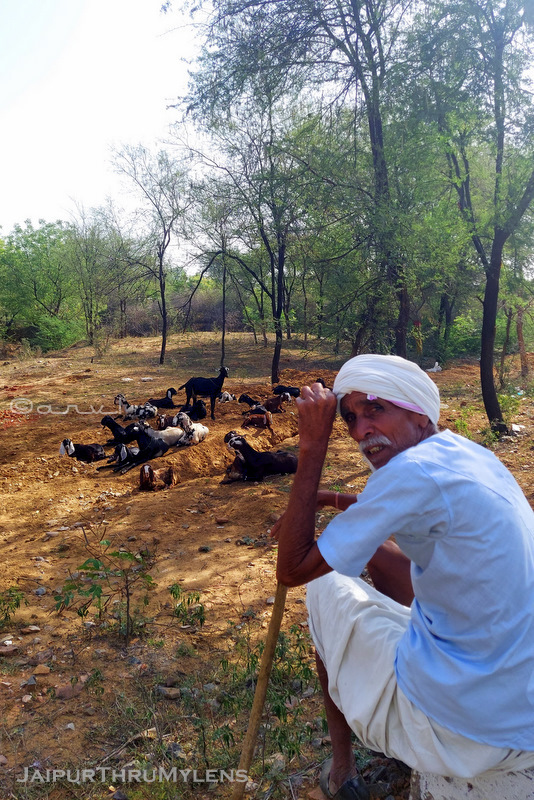
Is your village close by?
Yes, on the other side of the highway.
What’s your name?
N****** Meena (choosing not to mention his full name)
Are people from your village mostly Meena?
No, there are many Gurjars.
How many goats do you have?
Around 14-15
Will these goats command you a handsome return?
Not every time; the maximum we fetch by selling a goat is Rs 20,000. On the lower side, Rs 6000 to 8,000 per goat
So goat herding takes the whole day?
No, I leave home around 6 a.m. and then I return home by 11 o’clock; it gets extremely hot thereafter.
He asked where I was from and what enticed me to the wilderness. I replied that I was from Jaipur and was exploring a Stepwell. He inquired if I was a government surveyor or worked with a government department. I smiled and told him I don’t work with the government and was searching for a Stepwell. I bade him bye in the local dialect and added: “I hope to meet you soon”. Skeptically, he replied in the Dhundhadi dialect.
देखो बीको तो कईं के सका छा (let’s see, what can I say about meeting again).
From my experience, I can say with certainty, people living in rural areas are practical and smart. His reply reflected his belief; we both knew the chances of meeting again were exceptionally scant.
What do we know about the Meena community in Rajasthan?
Meenas are indigenous people residing in the vast region of Rajasthan for centuries. Jaipur, Alwar, Dausa, Sawai Madhopur, and Karauli comprise a few regions with sizeable Meena populations. They are also known as मीण, मीणा, मेंणा. The popular opinion is that they are one of the few local tribes of Rajasthan. In the minds of people, questions about the caste of people using the Meena surname frequently arise. Few wonder if Meenas are Kshatriyas. The government of India has notified the Meena caste as a scheduled tribe; a special reservation for the upliftment of this community was introduced many decades ago. They are protected under the Scheduled Castes and the Scheduled Tribes (Prevention of Atrocities) Act. A considerable population of Meena in Rajasthan can be found in the districts of Jaipur, Dausa, Sawai Madhopur, and Alwar. This is not an exhaustive list, Bhilwara and Udaipur districts also possess a sizeable Meena population. Farming remains the mainstay of the Meena community residing in rural areas.
In everyday conversations in a city like Jaipur, people don’t talk about the Meena caste or community. A couple of decades ago, caste was important to one’s identity; invariable, strangers would end up asking about the caste of a person. Preconceived notions about the caste dictated their attitude and treatment. Things have changed to a large extent, at least in urban areas; in the rest of Rajasthan, especially the rural areas, caste is still important. Not many people look up the internet for information about the Meena caste unless one needs to know for competitive examinations like UPSC or IAS.
What Is the History of Meena Caste?
There are many opinions about the history of Meenas or Minas. The word “Min” is a Sanskrit word meaning fish. As per popular legend, Meena traces its origin to the Matsyaavtar from the Dashavtaar of Vishnu. Dashavtar, the ten reincarnations of Vishnu is part of Hindu mythology; I have mentioned this in my previous post on one of the avatars – Kalki- The Kalki Temple in Jaipur. Another opinion is that the Meena caste inhabited a region called “Matsya Pradesh”; at present, this region is recognized as Alwar. Western scholars have linked Meenas with Aryans. Some Meena believe that this community was engaged in trading via sea route hence linked with fish. This theory is derived from the fish type of seals found in Mohan Jodaro’s excavations. A less popular theory links the origin of the community with Skand Purana; the proponents of this theory believe Shiva in Skandpurana is referred to as Meen or Meennath. Therefore, Shiv’s followers derived the name, Meena. Many challenge these theories; we don’t have a conclusive answer.
A fascinating but lesser-known fact associated with the Meena community pertains to Muni Magan Sagarji. Born in a Meena family in a village near Uniara near Tonk in 1881, he became a Jain Muni (monk). He wrote Meen Puran which documents the history of the Meena caste from the ancient to the middle ages. Well-versed in Sanskrit and Prakrit, he died in 1946. Many consider Meen Puran a historic compilation about the Meena caste.
Meena Caste, Rajputs, and Jaipur
Historians mention that the origin of Kachhawa Rajput rule in the Dhudhar region started close to the 10th century. Jaipur, along with a few more towns, was formerly known as the Dhundhar region. Dhundhar was ruled by Meenas. Col. James Tod’s book is considered the most reliable information on the history of Rajasthan. His account traces the history of Rajput rule to Khoh Gang. Dhundhar was not ruled by any large ruler, rather, many Meena chiefs governed minor territories. Khoh Gang was ruled by Alan Singh, a Meena chief. Many believe Kachhawa Rajputs snatched the rule from Meenas through deceit. Needless to say, it is open to contestation. Over time, the Rajputs fought with the Meena chiefs and won over extensive land. This was the start of the Kachhawa Rajput rule in Dhundhar; the most famous aspect of the rule is their capital, Amer Town and Amer Fort.
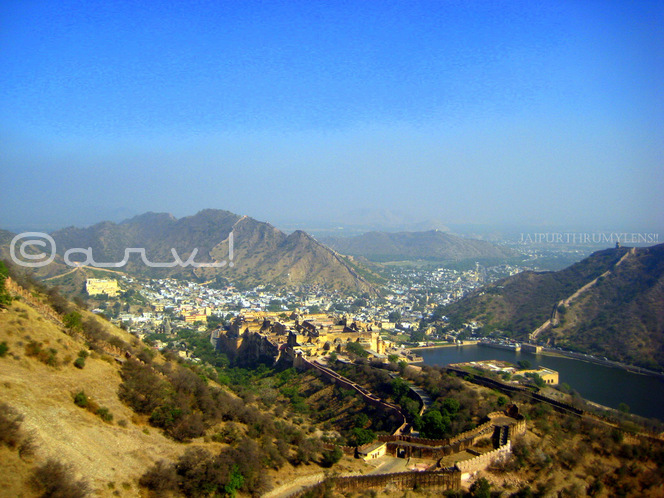
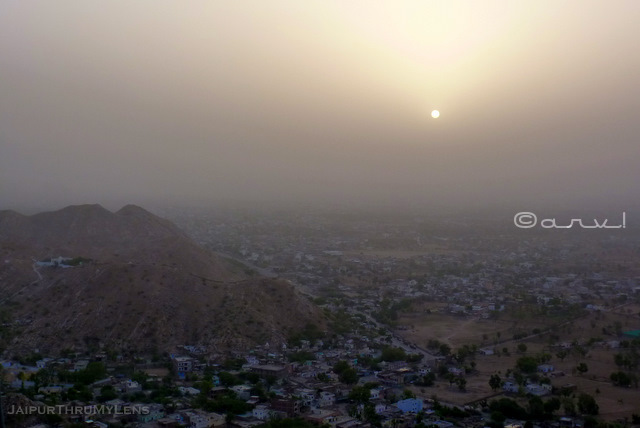
Here is a picture of Khoh village near Jaipur that I clicked in 2014 once ruled by the Meenas. Now called Khoh Nagoriyan, the population of the Meena community in this settlement in Jaipur has dwindled over the years. Here is a picture of Khoh Nagoriya in Jaipur.
For an extensive period, the Meena caste used guerilla tactics to attack Rajput rulers since they were the original inhabitants ruling the Dhundhar region. The popular opinion is Rajputs were fed up with these wars and devised a strategy to remedy the situation. The land was allocated to Meenas to make peace. Over a period of time, some of the Meenas became the most trusted men of Rajput rulers. Opinions and claims differ; each side maintains its own version. It will be challenging to determine a conclusive answer. Presumably, we will have to accept this interplay in the local history of Meena vs. Rajputs in Rajasthan. In my opinion, Meena are an important part of Jaipur culture and traditions.
Discover more from JaipurThruMyLens
Subscribe to get the latest posts sent to your email.
 JaipurThruMyLens
The history of the Meenas is indeed interesting.
LikeLiked by 1 person
It sure is. Thanks for sharing your thoughts, Sandhya
LikeLike
This is a small fraction of Meena History. If you read about complete history then you will come to know that how a ruling ancient Tribe passed through the journey from King to Criminal Tribe. A tribe which is residing in Eastern Rajasthan from ancient times and name of Mataya Mahajanpad came with their surname Meen/Matsya and at present also their majority population is in ancient Matsya Mahajanpad area only and also have mention in ancient Tamil history books. Outsider Rajput rulers who came from MP to Rajasthan, captured their Ruling areas deceitfully. That’s why Rajtilak of Jaipur rulers was always used to do by a Meena. Even Rajmata Gaytri Devi mentioned that Meenas were rulers of Jaipur before their ancestors came to Rajasthan from MP
LikeLiked by 1 person
can you please share,name of the ancient Tamil history book which you mentioned:)
LikeLike
Nice work
LikeLiked by 1 person
Thanks
LikeLike
Interesting Information Arv. On a similar but different topic, when we were in Jaisalmar the owner of our guest house went out of his way to explain to us that he was Brahama and why that was important. Or at least important to him. It seemed like caste was still quite prevalent there. Maggie
LikeLiked by 1 person
It still is in some sections of society because that’s how they have grown up. For the young people in urban areas, it is not relevant as they have other important things to tend to. Overall, it is slated to become less important. It will become less relevant if the politicians stop using it as a bait in the elections.
LikeLiked by 1 person
I hope it continues to be less relevant. Politicians will do anything to get elected.
LikeLiked by 1 person
True. They have the same DNA across the globe.
LikeLike
I must say I’m delighted to hear that caste is beginning to lose some of its importance, Arv. I expect it will be a long journey, though.
LikeLiked by 1 person
It sure is, slowly over the years. Last few years have been at a much faster pace as the new generation is getting integrating with the global world. It will take time for the same to percolate at all levels. Do you have any experience to share from your travels to India on this topic?
LikeLiked by 1 person
Not really, Arv. Although I’ve often observed the interactions between male and female, and between Hindu and Moslem (not all bad, by any means), I’ve not really been that conscious of the impact of caste where I’ve been. I’ve no doubt I simply didn’t notice much of what went on.
LikeLiked by 1 person
Okay. I thought you must have noticed if it did exist 20 years ago
LikeLiked by 1 person
Hi Arv. I’m delighted you joined us this week. Your tale of the Meena caste was fascinating. The man’s face tells a wonderful story of a way of life that hasn’t changed for centuries. Thanks so much for your post!
LikeLiked by 1 person
True, things haven’t changed much for many people. Thanks for sharing your thoughts. 🙂
LikeLike
I didn’t know the tribe’s name comes from meena..meaning fish and astrological sign of Pisces. That was an interesting point.
LikeLiked by 1 person
Well, all these are theories, no one knows for sure. Thanks for sharing your thoughts, Ambica
LikeLiked by 1 person
Arv, through this post you provide a great insight into the history of the Meena Community. You are correct that in today’s urban scenario, caste or tribe hardly matters but casteism still holds strong roots across many parts of the nation. The most ridiculous part that I came to know in the recent past is that even some schools demand caste certificates during the time of admission.
LikeLiked by 1 person
Thanks for the detailed information. The driver who accompanied me during my trip from Jaipur to Jaisalmer was from Meena community. In Kerala we had one IAS officer Teeka Ram Meena who served as Chief Electoral Officer, he did a good job and was in the news for all good reasons.
LikeLiked by 1 person
Thanks for sharing your thought. I’m glad this post resonated well with you based on your experiences. 🙂
LikeLike
Daughter of IAS Teeka Ram Meena is also an IAS, IAS Soniya Meena with All India Rank 36 in MP Cadre and she is famous as Lady Singham in MP Cadre due to her actions against Sand Mafia
LikeLiked by 1 person
Thanks for the information
LikeLike
I think you are wrong about the Rule of Alan Singh Chanda, a Meena ruler. He was the ruler of Amer and not of Kho Nagoriyan Jaipur, though the ruler of Kho Nagoriyan was also a Meena but different person
LikeLike
Not only in Jaipur but also the Establisher of Bundi district was a Meena ruler Bunda Singh Meena. And some Rulers in South Rajasthan also. Kota, Bundi, Tonk, Udaipur, Pratapgarh also have sizable Meena population. Rajputs divided Meenas in Two factions Zamindars(Who have lands) and Chowkidars, who were rebellious against Rajputs , That’s why Rajputs urged to Britishers to declare Meenas as Criminal Tribes and the scenario from Where Meenas got Tribal status. Well educated Meenas of that Time also supported this status after Independence because they know that this will benefit their future generations. And they were right, Today half of UPSC selections from Rajasthan state is of Meenas
LikeLike
But all Meenas didn’t get the benefits of this as Thakur Meenas of UP and Pradesi Rajput Meenas of Maharashtra(Migrated with Shivaji Maharaj to fight battles) are in General Category and Rawat Meenas of MP are in OBC category. You will also find mention of Meena community in many ancient Tamil historical books thus we can say that Meena is very ancient Community in India
LikeLike
Interesting facts.
It is very true that Meenas and Rajputs were closely related. Many evidence indicate that Meena are the ancient ruler of Rajasthan and states surrounding it. With repeated entry of new tribes from Northernwest part of the India, there was always mixing, some were peaceful some were by force with battle. West part of the Aravali is dominated by Rajputs and Eastern part is dominated by Meena. And a very interesting study “Genetic sketch of the six population groups of Rajasthan: a study based on 12 autosomal loci” shows that tribal population especially Meenas has close genetic link with Rajput, indicate origin of Rajputs is from the original inhabitants of Meenas.
Another book by Syed Hasan Mujtaba Rizvi “Mina: Ruling Tribes of Rajasthan” highlighted well the history and evidence of Mina as an ancient ruler of this land.
Even many Gotras of Rajputs and Meena are quite similar e.g Shekawat (Rajput) Bamnawat, Beflawat, Dhondawat(Meena), Rawat (Common to Meena and Rajput).
It may possible that Meena were early Aryans or hybrid of Dravidian and Aryan and latter with repeated entry of tribes from northern west Rajput emerge from Meena.
LikeLike