
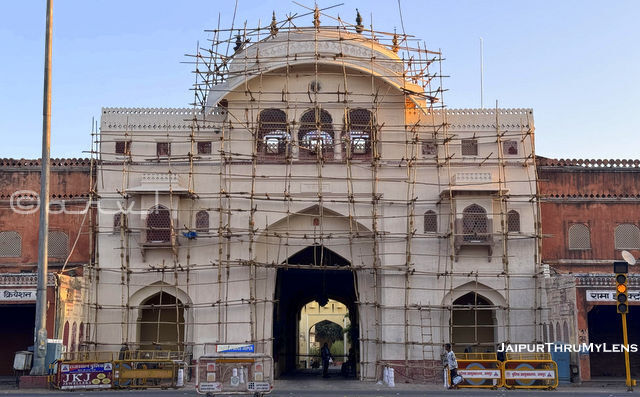
It was November 2025, early morning in Jaipur’s walled city. I was leading a heritage walk, something I’ve been doing for some years in the pink city. When we stopped outside an old haveli wrapped in bamboo scaffolding. It was under renovation. One of the guests, visiting from Spain, looked up at the bamboo poles tied together with jute rope and quietly told his companion he wouldn’t trust it. The comment reached me. And it made me ponder.
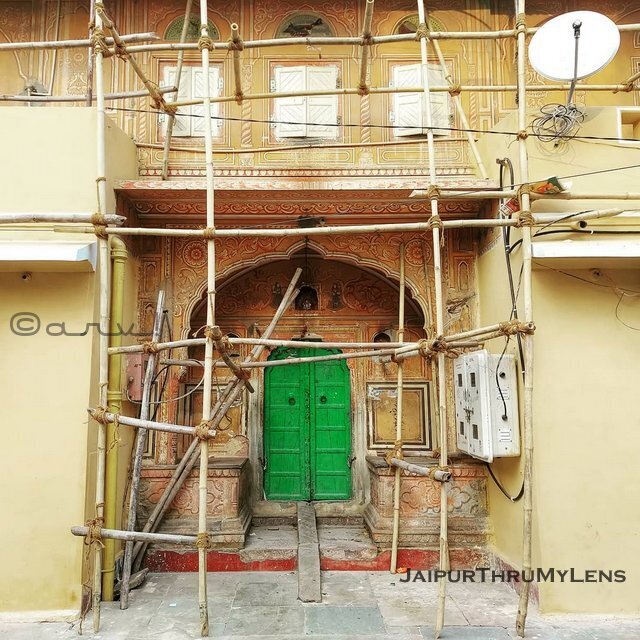
I’ve grown up watching Havelis and buildings in Jaipur using this technique in construction and renovation – bamboo, local hardwood, and jute. This method has been used to built the forts, palaces, and large temples in the region. But for someone who has only ever seen steel scaffolding, this must have looked like a shortcut. A sign of poverty, perhaps, rather than a sign of craft.
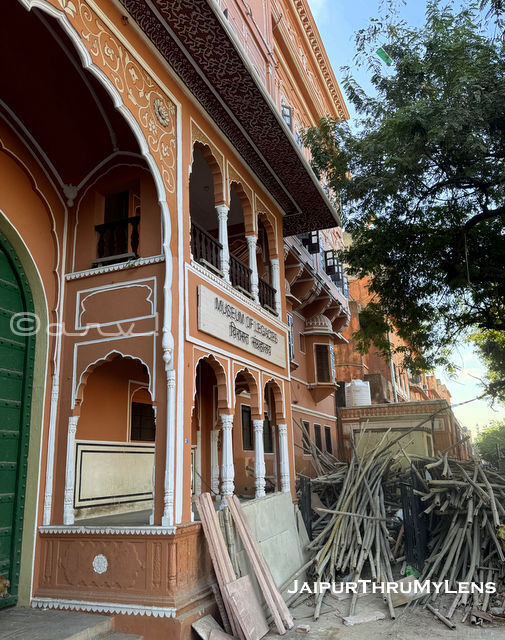
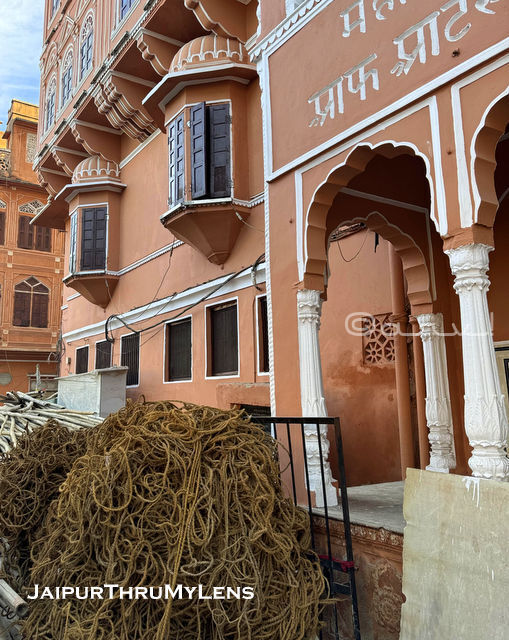
Seen above, bamboo used in scaffolding during restoration of an old Haveli- Museum of legacies.
How Scaffolding has always worked in Jaipur – India?
Walk through the old city of Jaipur, called the walled city during summers, you are likely to come across the thin wooden poles, often bamboo or local hardwood tied together using traditional ropes.This temporary structure is used for climbing the facade and is called scaffolding. For centuries, across India, this method has been used and it requires skills of a trained workers. They understand how to balance, tie, and distribute loads across flexible natural poles. But today, most modern building use metal scaffolding. This raises an important question – Were traditional construction materials actually inferior, or have we simply changed the way we measure reliability and safety? This question becomes particularly important in UNESCO World heritage sites like Jaipur. How we restore, conserve and maintain historic heritage buildings requires balance between historical authenticity, structural safety, and environmental sustainability.
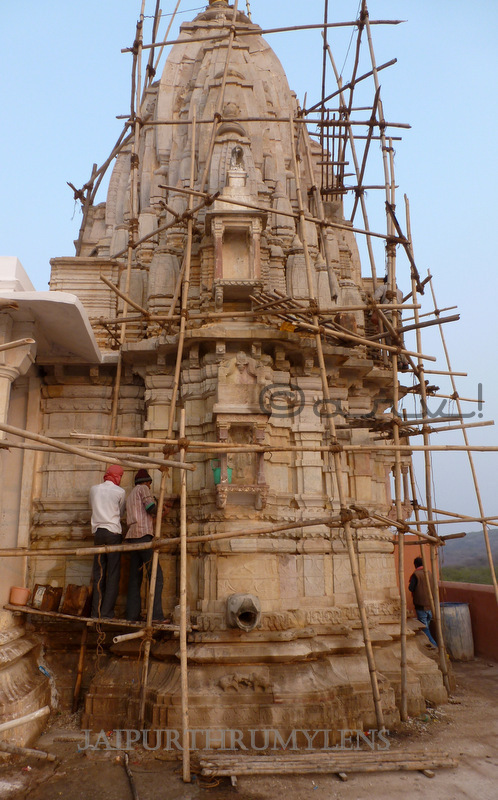
Seen here in the above picture are workers on a bamboo scaffolding during restoration project of Sun Temple in Jaipur, a picture I clicked in 2015.
Why Bamboo was used and is still used?
It is important to understand why Bamboo Was Used from historical context. In many Asian countries like India, China, and Hong Kong bamboo or wooden scaffolding was the dominant system for centuries. Even now, bamboo is still used in many of these countries. And there are reasons for the same. Some of these reasons are:
- Availability: Bamboo grows widely in Asia, therefore, easily available. Similarly, jute which is used widely in India, was grown locallya.
- Cost: Bamboo and jute are cheaper than manufactured iron or steel systems.
- Lightweight: Easy to transport and assemble manually without using equpiment.
- Flexibility: Bamboo bends rather than snapping under stress, unlike steel. This works in favor of bamboo.
Even today, bamboo scaffolding is still used in parts of Asia for both construction and restoration work. It is till used in building or repairing Hong Kong skyscrapers. This should give anyone a pause before they dismiss it as primitive.
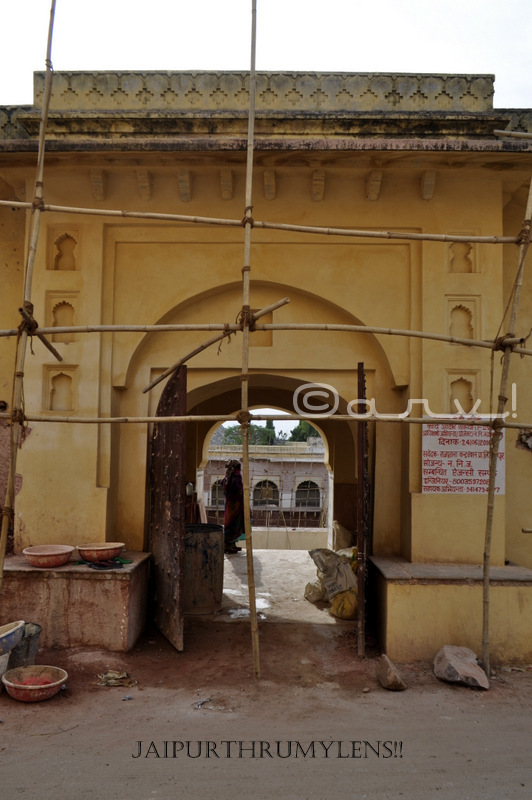
Seen in the above picture, bamboo scaffolding during a restoration of a Jaipur Stepwell.
Is Bamboo Actually Weak? Facts and reaserach.
The common man often assumes bamboo is “weak” because it is a plant, a natural material. However, researchers and architects consider bamboo as “Green Steel” for scientific reasons. Contrary to popular belief, bamboo is structurally strong and impressive as per research. And how?
As per studies, bamboo can have tensile strength comparable to or higher than mild steel relative to its weight. Refer Purdue Engineering
Studies of structural bamboo show strong compressive and bending properties. This makes bamboo suitable for scaffolding structures.
These are some of the reasons why bamboo scaffolding has historically been used even for high-rise buildings in places like Hong Kong; it is in use even now.
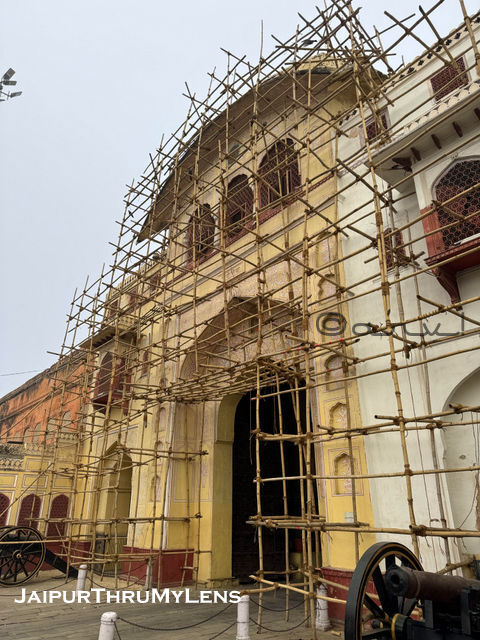
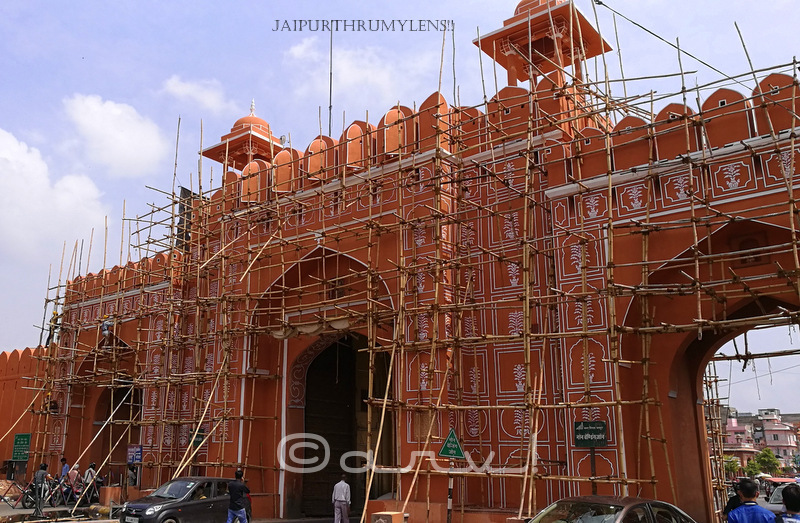
Seen above is Tripolia Gate in Jaipur.
The strength problem is usually not the bamboo itself but the joints. Traditional scaffolds rely on rope lashings,manual tying techniques, and the human element. These can vary widely depending on skills and experience.
A statistical study in Gujarat, India of scaffolding systems found:
- Bamboo scaffolding remains popular due to low cost.
- Metal scaffolding is better for high-rise commercial construction, particularly in safety and standardization.
To sum it up, the suitability of scaffolding depends on type and scale of building and risk tolerance. So one cannot make a blanket judgement as to which is a better scaffolding material.
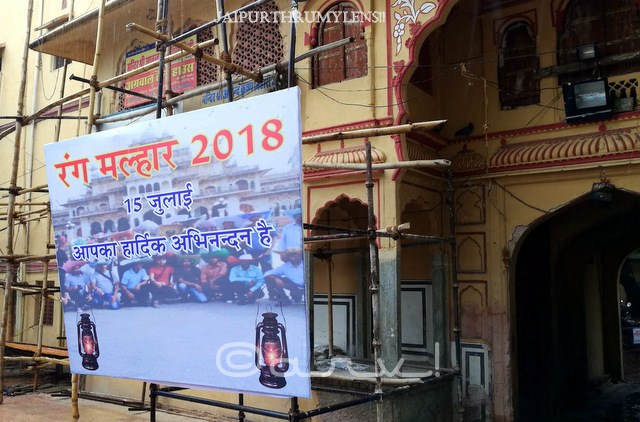
Seen here is a picture from my blog about an art event in Jaipur, Rang Malhaar at Anand Bihari Temple near Jaipur City Palace. Notice how metal scaffoling has been combined with bamboo scaffolding. This can be to improvise resources or to better suit the requirements. But this sort of arrangement of using bamboo and metal for scaffolidng together is uncommon.
An Environmental case for bamboo – Sustainability
From sustainability point of view, traditional materials usually outperform modern ones. A life-cycle assessment comparing bamboo and iron-steel scaffolding found bamboo scaffolding has significantly lower carbon footprint. Iron-steel production requires high energy and emissions. This tilts the scale in favor of traditional scaffolding used in this part of the world. Bamboo is biodegrabale and also carbon absorbing during its growth.
Why Modern Construction Prefers Metal
Despite bamboo’s strengths, modern construction increasingly uses metal scaffolding because of following reasons:
- Standardization
Metal scaffolding systems offers fixed dimensions, modular connectors, and certified load capacities.Traditional scaffolding systems rely heavily on manual human skills & craft knowledge. Modern construction requires fixed timelines, predetermined cost estimates, and reliability. This is where metal scaffolding outweighs tradtional methods and materials in construction process.
- Predictability
Metal scaffolds are uniform, tested under engineering codes, and easier to regulate bringing in an element of predictability.
- Durability
In comparison to modern scaffolding material, traditional scaffolding materials deteriorates faster, can rot or split, and has variable strength between poles.Metal systems last longer and can be reused many times.
Are traditional scaffolding materials and methods still relevant? Why Bamboo Matters for Heritage Cities Like Jaipur?
Jaipur is a UNESCO World Heritage Site. This status places special importance on how historic heritage structures are maintained, conserved and restored. Heritage buildings usually have:
- delicate surfaces such as lime plaster or frescoes
- fragile masonry
- irregular architectural details
Traditional materials are still relevant in the following scenarios:
Heritage restoration
- Bamboo & jute are lighter; it causes less stress on old heritage structures. Metal scaffolding is incredibly heavy. When tons of metal rests against a 200-year-old lime-plastered wall – Araish, you risk structural scarring and “point-loading” cracks. Bamboo is lightweight.
- Flexibility. Metal is rigid. In the event of a tremor, a rigid structure can snap or buckle. Bamboo, flexes, absorbs energy, and returns to its shape; a property that has kept it in use for skyscrapers in Hong Kong for decades.
- Traditional scaffolding materials are easier to adapt to irregular forms
- They are less intrusive than heavy metal scaffolding systems.
Sustainability focused construction
There is a growing interest in low-carbon construction. This might revive interest in engineered bamboo systems giving an impetus to traditional material and method of scaffolding.
Back to That Morning in Jaipur
I thought about all of this later that day, after the walking tour had ended. The Spanish traveler was not wrong when he asked the question. But the assumption underneath it that traditional equals unreliable, that a natural material cannot possibly match a manufactured one is an assumption worth challenging.
The bamboo poles tied with jute against that old haveli in the walled city were not there because no one could afford steel. They were there because they work; they have worked, for centuries, on structures that are still standing. The forts, the palaces, the temples. All of them built and maintained using the same methods the Spanish guest had just dismissed.
Traditional construction methods are not useless. They are different. They are rooted in craft knowledge rather than industrial engineering;and in local materials rather than manufactured systems. Whether that difference is a weakness or a strength depends entirely on what you are building and what you are trying to preserve. In a UNESCO heritage city, the answer should be obvious
Discover more from JaipurThruMyLens
Subscribe to get the latest posts sent to your email.
 JaipurThruMyLens