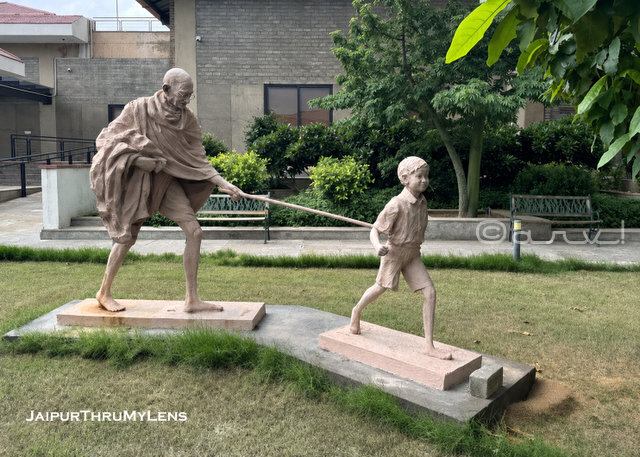
Gandhi Vatika isn’t the typical museums we see in India; tucked inside the Central Park, it offers a completely different pace. Gandhi museum in Jaipur is built around an idea, not objects; a reason why you won’t find glass cases filled with relics or personal belongings of Gandhi Ji. Read Central Park Jaipur Guide
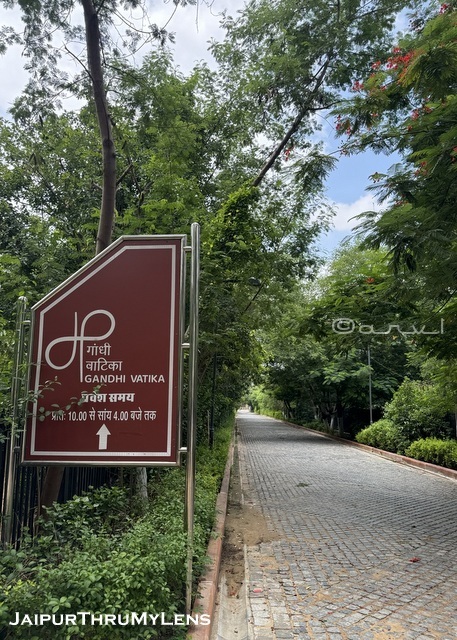
The moment you step onto the driveway leading to Gandhi Vatika, the noise of the road fades into silence. Minimalist architecture, natural light, holographic storytelling, and soundscapes come together to create a journey; a journey that makes you pause and reflect. The museum doesn’t just show you the life of Mohandas Karamchand Gandhi or Gandhiji, as most people in India know him. It tries to connect you to with his principles with which he led his life. In a city known for royalty and luxury, Gandhi Vatika provides visitors a quiet space for reflection and simplicity.
Architecture as a Prelude: Silence, Stone, and Scale
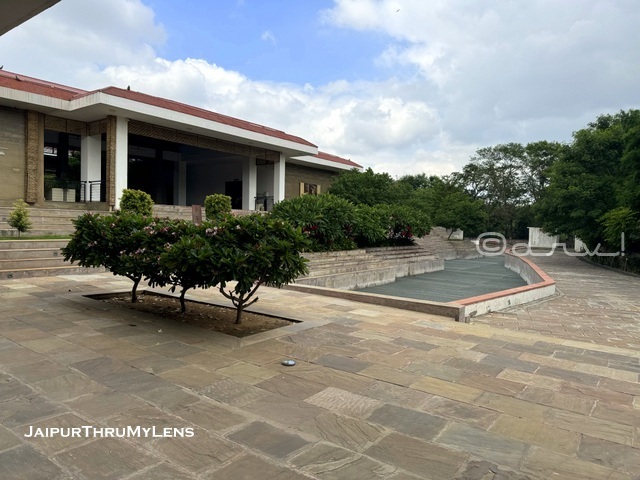
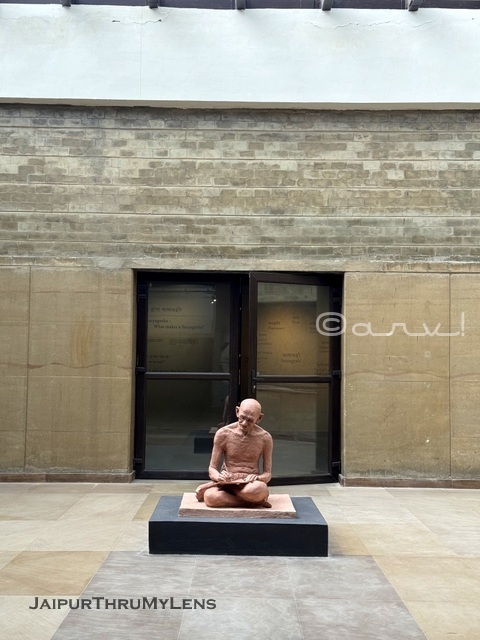
Gandhi Vatika uses its spatial design to shift your state of mind. Set within the lush expanse of Jaipur’s Central Park, the architecture crafted with clean lines, understated stone, and open courtyards acts as a sensory buffer against the city’s urban noise. The courtyards of the museum connects this building with the traditional architecture of Jaipur – Jaipur Havelis.
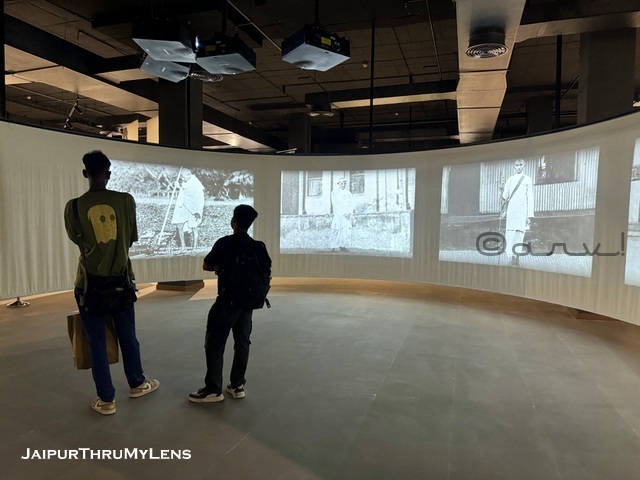
The design relies on space, natural light and shadow play. Open-air corridors frame views of the surrounding park, blurring the boundary between the built environment and nature. Nothing about the structure feels ostentatious; instead, the scale feels grounded and human. The bare textures and uncluttered pathways reflect the very core of Gandhian philosophy: simplicity, transparency, and restraint. Even though Gandhi Vatika Museum is spread over three floors, requiring each around and hour or more, the architecture doesn’t give this feeling.
History | The space through my memories
The place where Gandhi Vatika is built is registered differently in my memory. The place was known as Laxmi Vilas Hotel. It was a popular wedding venue until 1990s. Also, located behind the hotel building was a polo horse breeding and riding center. This was much before the Central park came into being.The uneven and wild terrain behind the Laxmi Vilas Hotel, now part of Rambagh Golf Club, has hosted motocross in days when this sport was not well known.
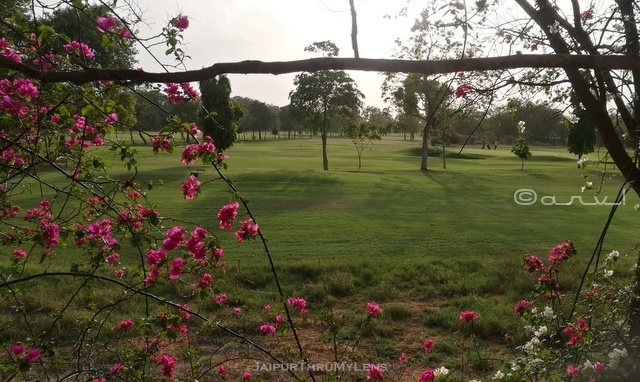
The history of this land is mired with court cases and ownership issues. This entire parcel of land comprising of Central Park, Jaipur Golf Course, Polo Club, and Laxmi Vilas Palace including the Lily Pool – owned by the Sawai Man Singh II and residence of Maharani Gayatri Devi. As per official land records, it was part of villages – Bhawani Shankarpura and Bhojpura. Records mention prior to Laxmi Vilas Hotel came into being, the space housed a motor garage and workshop belonging to Jaipur royalty. The land was leased out by the son of last king- Brig, Bhawani Singh; the Laxmi Niwas hotel started operations on 01.01.1976. In a long court case whereby the Urban Improvement Trust (prior to JDA and NNJ) claimed the ownership and their intention to convert the land into a public park, the leasing out by Brig. Bhawani Singh was held unlawful. JDA took over the land in 2017. Subsequently, the heritage structures of the hotel were demolished. Inistailly, governement wanted to auction the land to hotels. Many citizens fearing that JDA is likely to lease out the space for commercial use, filed a PIL. It was decided that the purpose of acquisition was for public use and hence the land could not be used for commercial enterprise. This paved way for creating a museum for the public. The decision for converting this space into Gandhi Museum was taken during the reign of Congress. Had it been a different political party, probably, it could have been a different museum. Here is a picture of this area from the recent times.
An Experiential Walkthrough Gandhi Vatika | Ideas Over Artifacts
Traditionally, museums comprise glass cases and information board consisting text. Gandhi Vatika takes a fundamentally different approach, guiding through a narrative arc designed to be felt as much as understood.
1. The Shadow of Colonial Crisis
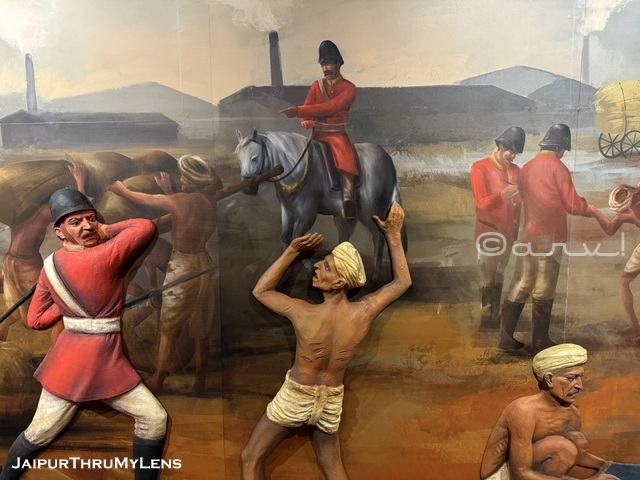
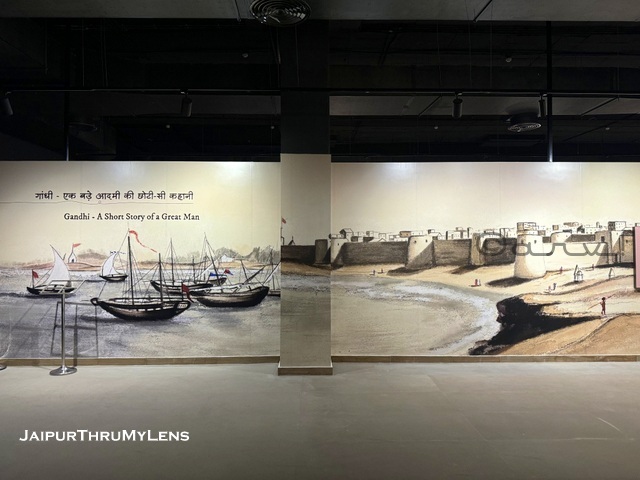
The museum starts from intentionally dimmed, quiet corridors. The focus is on the economic, social, and psychological impact of colonial rule in India. Through subtle audio landscapes and strategic lighting, the space conveys a palpable sense of loss, displacement, and moral crisis setting the stage for why a new philosophy was needed. This section focuses largely on British colonial period in India. This picture conveys how British treated Indians during this period.
2. The Awakening – From Mohandas to Bapu
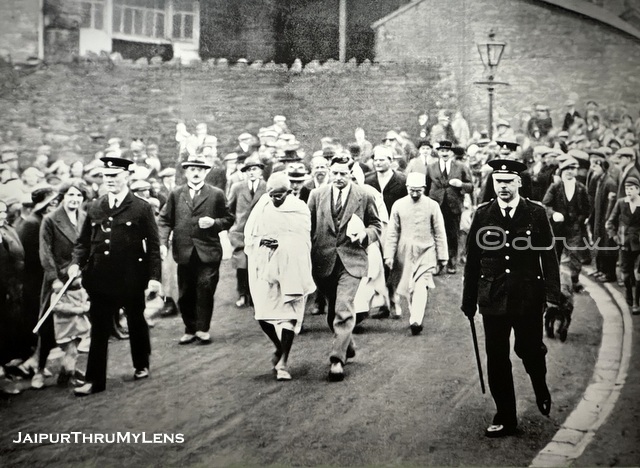
As you transition into the next zone, the narrative shifts toward MK Gandhi – his life and journey. A lot of focus is on his time in South Africa and the formative years of Satyagraha. Instead of relying on static photographs, the museum incorporates dynamic tech elements- holographic projections, multi-layered voiceovers, and interactive digital walls. One can witness the evolution of a young lawyer grappling with systemic injustice into a leader forging a non-violent movement. Here is a pictures from Gandhi Vatika of Gandhi Ji in Lancashire for the second round of confrence in 1931.
3. Swaraj and Modern Relevance
The final stages of the walkthrough bring you back into bright, light-filled spaces overlooking the gardens. This section deals with Swaraj or self-rule, Sarvodaya or the concept of welfare of all, and environmental stewardship. Rather than treating these as closed chapters of 20th-century history, the exhibits challenge visitors to consider their application today.
- How does self-reliance apply to modern consumption?
- What does non-violence mean in a hyper-digital, polarized world?
Stepping out of the final gallery on the 1st floor, back into the park, it doesn’t feel like you have finished a historical tour; it feels like you’ve participated in a quiet conversation with history.
Sections in Gandhi Vatika Museum
Gandhi Vatika Museum in Jaipur comprise three floors.
Basement Floor
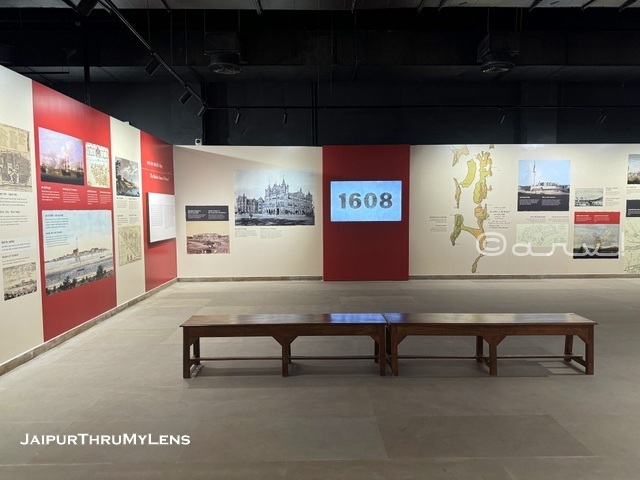
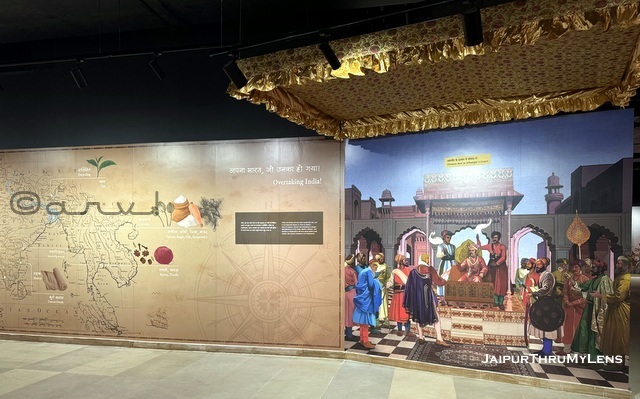
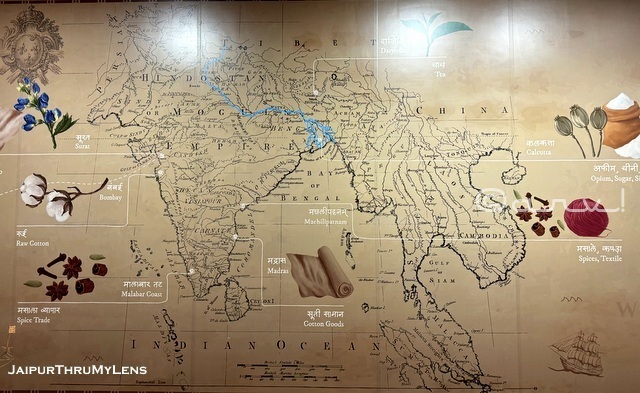
Basemenet covers the period of colonization, freedom movement, the revolt of 1857 casuing panic among the British, the story of MK Gandhi, and his experience and transformation journey in South Africa. Here is a picture showing the arrival of British East India company official in Mughal court and Indian map before colonial rule along with items that India produced and exported across the world.
Lower Ground Floor
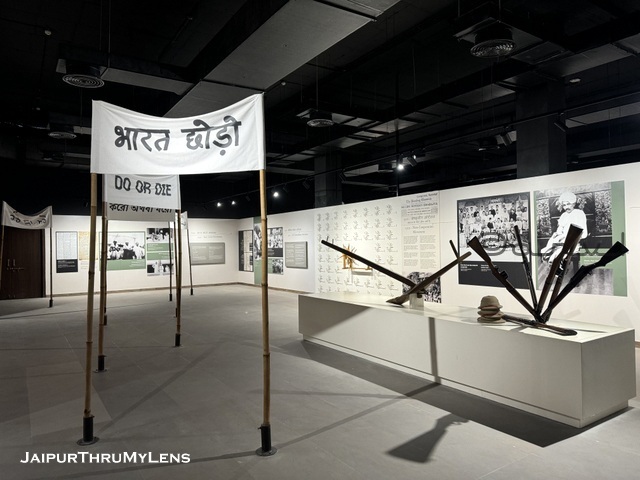
Lower ground floor covers Gandhiji’s Coming back to India, his efforts in freedom of India, 1942 Quit india movement, communal issues durig Indian Independence movement and his last days. Here is a picture from the museum depicting Quit India movement.
Upper Ground Floor
Upper ground floor is dedicated to Rajasthan’s connection with Gandhi Ji, his dreams, his greater than life ideology, and Gandhiji from an artistic lens.
Key moments and events depicted in GandhiVatika Museum
The museum that is spread over three floors woul require around 3-4 hours to explore fully. While each exhibit is important, some of the section that I felt are interesting and important are as follows. These are not mentioned in order.
Entry of trading companies and colonial powers in India – Initial years
This is one of the best parts of museum which beautifully captures and explains why India attracted trading companies like Dutch East India co – Vereenigde Oostindische Compagnie -VOC, East India Company, French East India Company, Danish East India Company –Asiatisk Kompagni, and Portugese East India House. One of the unique things to see here is the section that references map created by Pierre Du duval – “How to reach Surat”. Another interesting display is the areas where traders would source raw materials like cotton, spices, etc. This provides an understanding as to what initially attracted colonial powers to land like India. Also, explore how forts were created by trading companies in all trading ports.Here is a map that shows items India produced and were in great demand across the world.
The growth of East India Company
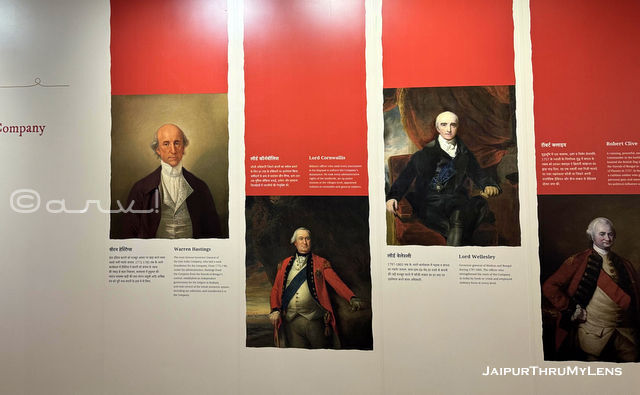
This section provides details of how East India company went to control India starting from smaller parts of India where it was present. The graphic representations are interesting. It provides referenceces to Howrah, Chingalpattnam, and Bombaim. This section also has graphic reprentation of life under colonial rule. While there were many colonial powers in India like French and Portugese, the section focuses on Brtish Colonial rule. This section also has pictures of some of the people who paved way for East India Company’s growth in India like Robert Clive, Warren Hastings, Lord Dalhousie, etc. This wall is called The war lords of East India Company, and rightly so.
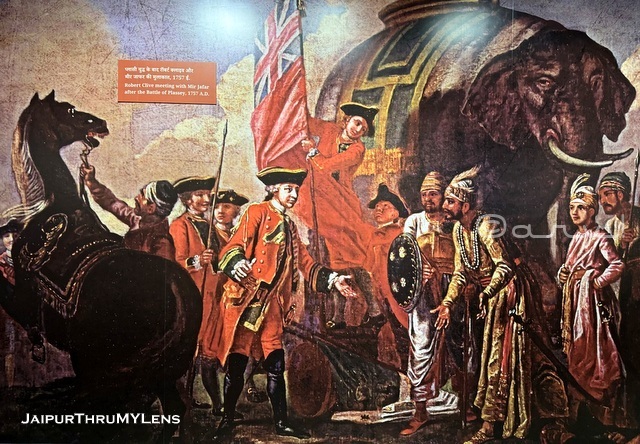
Not mentioned in the museum but important to note is how Robert Clive plundered and looted vast wealth from India and built a museum of this loot collection in the UK. It is called the Clive Museum, also known as Powis Castle in Wales. Over 1000 loot items under Robert Clive and his son Edward Clive rules were taken out of India into his personal collection. Some of the prized loot items include, gold, diamond, and emerald-encrusted tiger’s head finial from Tipu Sultan’s royal throne, and Siraj-ud-Daulah’s Palanquin. This is apart from the official loot items from East India Company’s headquarter museum which were later shifted to Victoria and Albert Museum, London. The reference to this loot and museum has been documented and explained by the writer William Dalrymple in his series of books on East India company histroy and talk shows in Jaipur Literature Festival. A picture of Battle of Plassey which was won by Robert Clive, head of East India Company and turned the tide for East India Company in Indian subcontinent.
Formation of congress in India
This section details how congress was formed in India. I feel this is a very interesting and important part of Indian independence movement because it gave a huge impetus to the movement. It was also something that British did not anticipate.
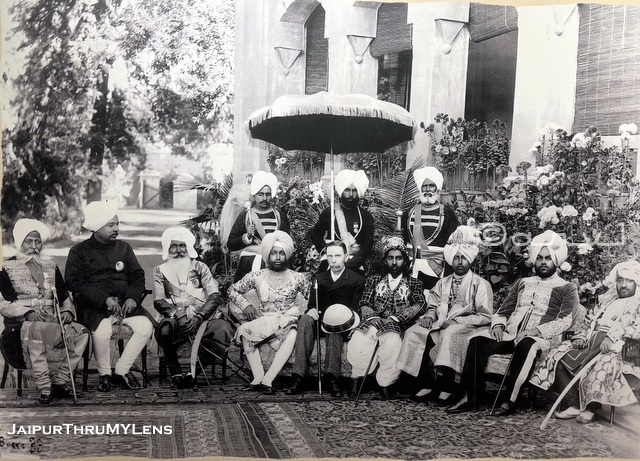
Once India officially became a British colony post the Indian revolt of 1857, the British began reaching out to India’s upper classes and aristocracy targeting people who could speak and write English, admired British culture, and agreed with British political ideas. Influencing this set of people became a key goal. Here is a picture of heads of princely states like Nabha, Kapurthala etc. with a British official.
But one problem remained. Although the British had put down the 1857 rebellion, small pockets of resistance kept popping up. Meanwhile, a new generation of Indian leaders was emerging, people learning about freedom, rights, and how to push back against authority. This worried the British, since it threatened to destabilize their still-young empire.
To manage this risk, they came up with an idea: create a space where educated, elite Indians would feel a sense of ownership; somewhere the British and Indian elite could interact directly. This space would let people raise complaints and hold discussions, but it was really meant to keep things civil and non-threatening.That’s when the Indian National Congress came into being, essentially a social club for the elite. Here is a picture of founders of Indian National Congress – A O Hume, Dadabhai Naorogi, and William Webberburn. Picture credit – picryl.com/
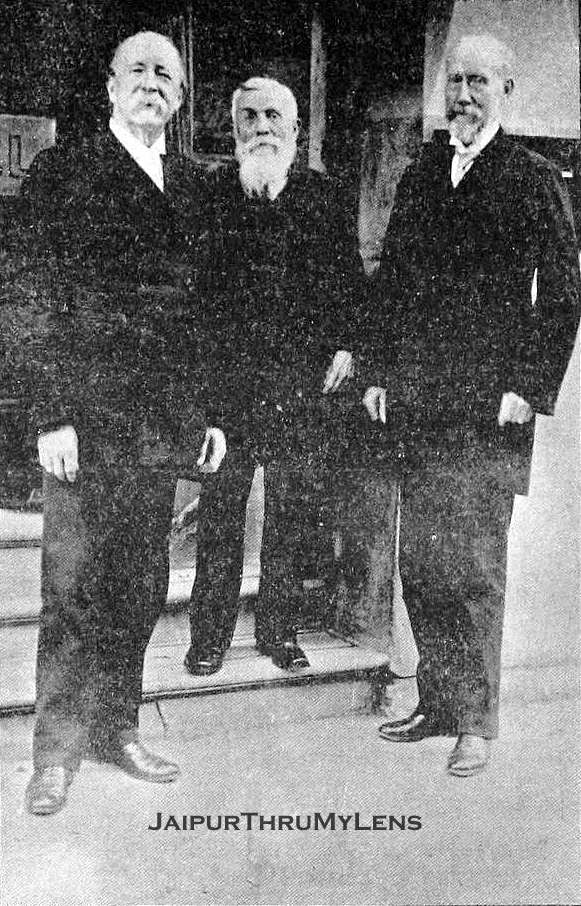
IndianNational Congress- INC was established by Allan Octavian Hume, also called A.O. Hume in December 1887 in Bombay, now Mumbai. In its first few years, the INC was a moderate, loyalist body composed mainly of Western-educated lawyers, journalists, and landowners who passed polite resolutions requesting administrative reforms and civil service opportunities. The British plan backfired within two decades as the organization evolved from a cooperative debating club into an anti-colonial movement.
Gandhi Ji’s Initial years and South Africa
Mohandas Karamchand Gandhi or MK Gandhi better known as Gandhiji studied law in London. He became a barrister in 1891. Finding limited professional success in India, he accepted an opportunity to work in 1893 with a Gujarati merchant firm in Natal, South Africa. The merchant had a specific requirement which Gandhiji easily met. What were those conditions? These are explained in the museum.
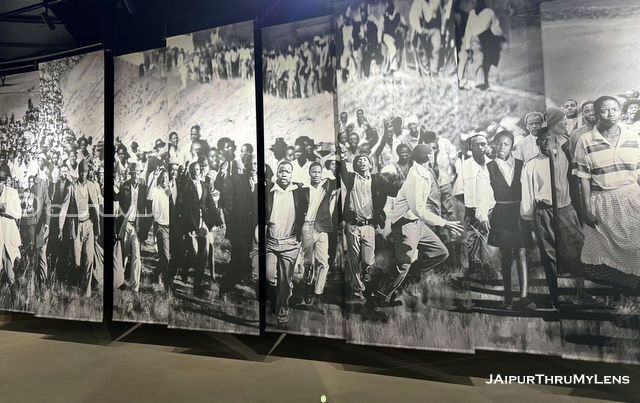
His arrival in South Africa proved transformative. Confronted immediately by pervasive racial discrimination most famously demonstrated when he was forcibly thrown off a first-class train carriage at Pietermaritzburg despite holding a valid ticket. This was a turning point for Gandhi Ji and he chose to oppose racial discrimination. Over 21 years in South Africa (1893–1914), Gandhi Ji evolved into a formidable political leader and social reformer.
Moderates and extremists in Indian independence movement
This section details two different factions of Indian independence movement. Dadabhai Naoroji, GK Gokhale, Surendra Nath Bannerjee are some of prominent names of moderates. Bal Gangadhar Tilak, Lala Lajpat Rai, Bipin Chandra Pal are some of the extremists. There are some sections with mention of Annie Besant.
Information – Gandhi Museum Jaipur
| Main Architect | A Mridul Architects |
| Museum Consuktant | Lokus Design Pvt Ltd Pune |
| Interior Design & Executions | Studio B Projects |
| Timings | 10 AM to 4 PM |
| Location | Cenral Park, Tonk Road, Jaipur |
| Ticket Charges Adult -Indian/Foreigner | Rs 55/Rs 205 |
| Ticket Charges student Indian/Foreigner | Rs 30/ Rs 105 |
| Cafe in Gandhi Vatika | Peepul Jaipur – basement |
Gandhi Vatika also has two exhibition halls, seminar hall, amphitheatre, and prayer hall. These all can be booked for events at a nominal price. It is a shame that people in Jaipur are not aware of these lovely modern exhibition space in central Jaipur. People continue to use small exhibition halls of Jawahar Kala Kendra or the newly built RIC.
Gandhi Vatika is part of composite ticket issued by Department of Archaeology.This composite ticket in Jaipur allows you to visit:
- Nahargarh Fort
- Amer Fort
- Alber Hall Museum
- Sargasuli,
- Hawa Mahal
- Sisodia Rani Garden
- Jantar Mantar
- Museum of Scupltural Art
Summary
Gandhi Vatika is not merely a museum of Mk Gandhi, his life and freedom movement, it is also a well designed museum on Indian colonial and imperial history. While it doesn’t deep dive into French, Dutch or Portugese colonial influence and rules, it does offer a good bite of Indian colonial period – why colonial trading companies came to India and how India came under colonial rule. To summarize, it is a good museum to ponder, reflect on our lives reading Gandhi Ji’s principles to live life. The words like Satyagrah, Anshan, etc might have been lost today in India, but it is good to know how this word impacted the colonial rule some 8 decades ago. While today we live in a fast-paced life where principles are compromised to get ahead, a visit to museum can change our thinking and how we view our lives.
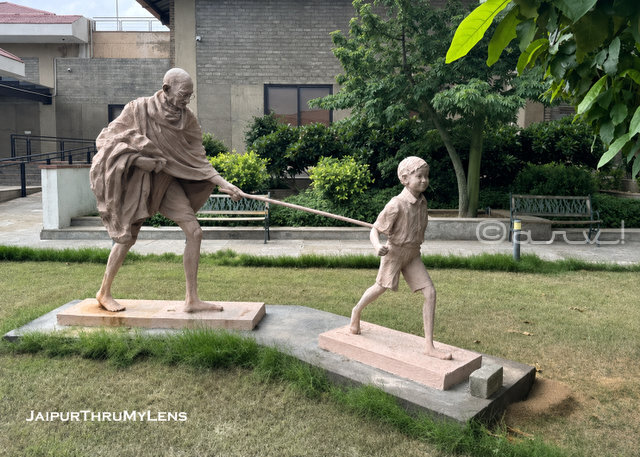
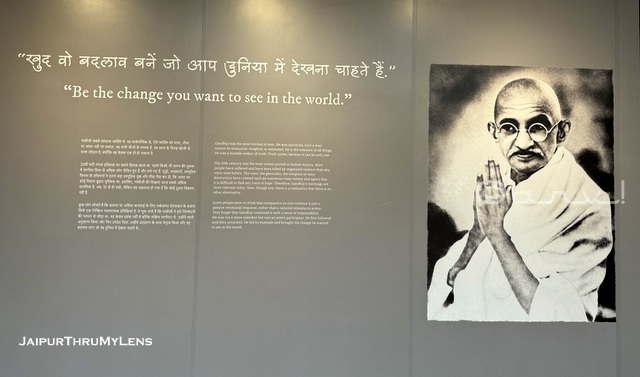
Gandhi Vatika is one of the new age museums in India similar to Partition Museum in Amritsar, Humayun’s Tomb Museum in New Delhi, and Virasat-e-Khalsa Anandpur Sahib, Punjab. While some sections of Albert Hall Museum, Museum of Sculptural Art Jaipur, and Jaipur City Palace are new age, Gandhi Vatika is different. It is definitely worth a visit.
Discover more from JaipurThruMyLens
Subscribe to get the latest posts sent to your email.


I’ve been to the Gandhi Museum in Delhi, about twenty years ago, which I remember as being very good, but this looks to be another level better.
LikeLiked by 2 people
Mick, I haven’t been to Delhi museum that you mentioned. I’m sure it must have been very good for its time. The concept of museum has changed quite a lot, lately. I have been to the new museum in humayun tomb built in the same pattern. These are more contextual and experimental. They are focused on story line.
Hope you are doing well.
LikeLiked by 1 person
Yes, focussed more on stories than exhibits. I like the mixture of both.
All good here, Arv. Hope you’re well, too.
LikeLiked by 1 person
True, a mix between both would be the best option and more interesting one. Everything is great. 🙂
LikeLiked by 1 person
Sounds like a fascinating museum that does full justice to the father of our nation! So glad that the citizens of Jaipur prevailed in getting this beautiful public space instead of a commercial one.
LikeLiked by 1 person
True, it is a lovely place. I wish it could have been expanded to inlcude more than father of nation. It would make a great museum that offers an insight into colonialism and independence.
LikeLiked by 1 person
Thanks for the excellent tour and explanations. This is a creative and high-quality museum.
Neil S.
LikeLike
This is such a fabulous post! Superbly researched. Kudos for putting it together. 🙏
LikeLiked by 1 person
Thank you Rama. 😊
LikeLiked by 1 person
I like what you have done with the blog. Transitioned it into a once a month in-depth post on the offbeat in Jaipur for a deeper understanding of the city.
LikeLike