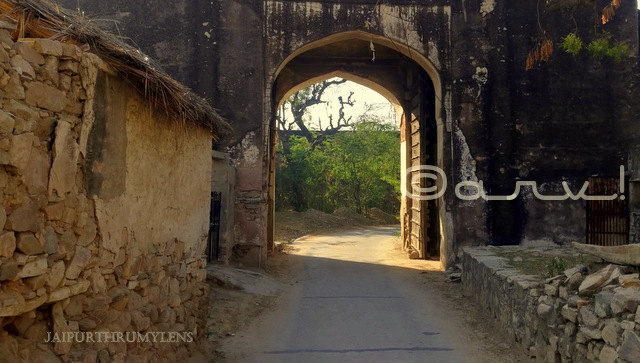
Earlier last year, in the month of April I decided to explore Amer beyond Amer Fort. On a hiatus from trekking in the hills near Jaipur, I was looking for doing explorations in Jaipur. Someone tipped me about an old Digambar Jain temple in Jaipur. I was told that this Jain temple in Amer Jaipur was built around the time Jaipur was founded. It turned out to be a Digambar Jain Nasiyan Mandir. As I approached this Digamber Jain Mandir in Jaipur, the surroundings were reminiscent of the era in which it was built.
Digamber Jain Temple in Jaipur | One of the Oldest & Famous Jain Temples in Jaipur?
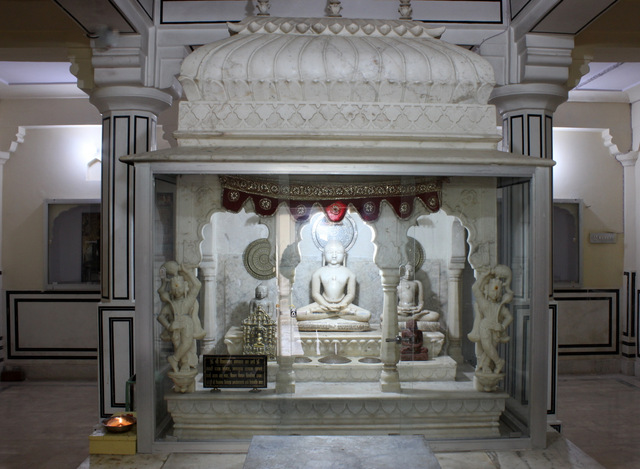
This Digambar Jain Nasiyan Mandir in Jaipur is historic and one of the oldest Jain temples in the Jaipur region but not the most famous Jain temples in Jaipur. It was built between V.S. 1678-91/ 1621-1634 AD. The Digamber Jain Temple is dedicated to the 13th Jain Tirthankar Swami Vimalnath and his idol, dates back to 1585 AD or Samvat 1642.
History
Although the main idol in this Digamber Jain temple is Swami Vimalnath there are idols of other Tirthankars as well. These idols are from 1469 AD or Samvat 1526 to 1599 AD or Samvat 1656. The year mentioned in this temple like all other ancient temples is Vikram Samvat (V.S.) commonly referred to as Samvat. Jump to the bottom if you want to learn more about Vikram Samvat.
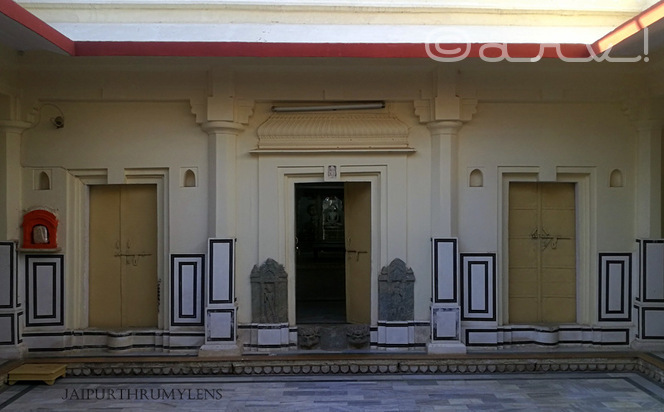
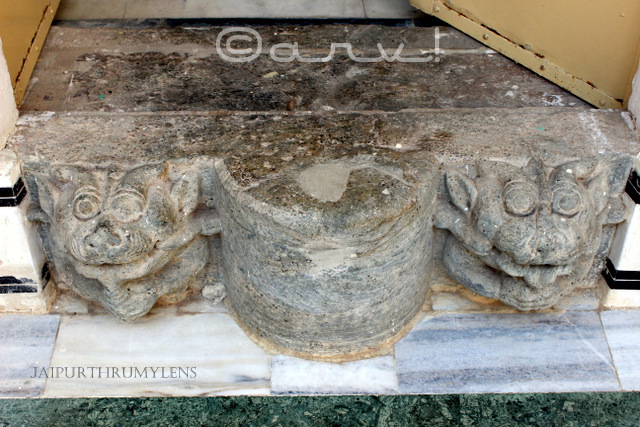
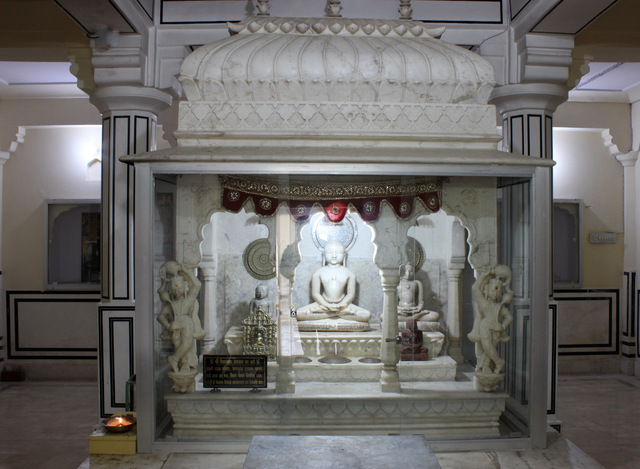
What makes this Digamber Jain Temple in Amer Jaipur so special?
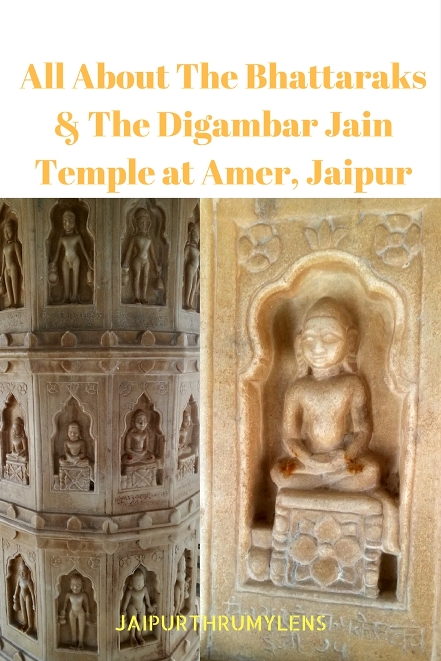
The highlight of this Digamber Jain temple in Amer Jaipur is the beautiful Kirti Stambh made from the white marble of Makrana, Rajasthan.
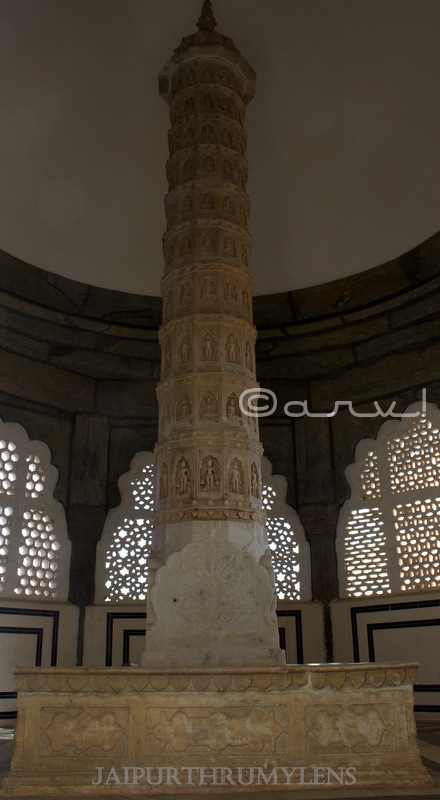
Makrana white marble is one of the best white marble available in the world. It continues to be the most popular choice among sculptors to date. The Taj Mahal, a UNESCO world heritage site is constructed from Makrana white marble. This Kirti Stambh is unlike others as it is housed in a covered canopy. Usually, Kirti Stambh is established in an open area. The purpose of this Stambh is to mark an achievement & allow everyone to witness and register. Quite likely this enclosure must have been built in later years to save it from weathering by natural elements.
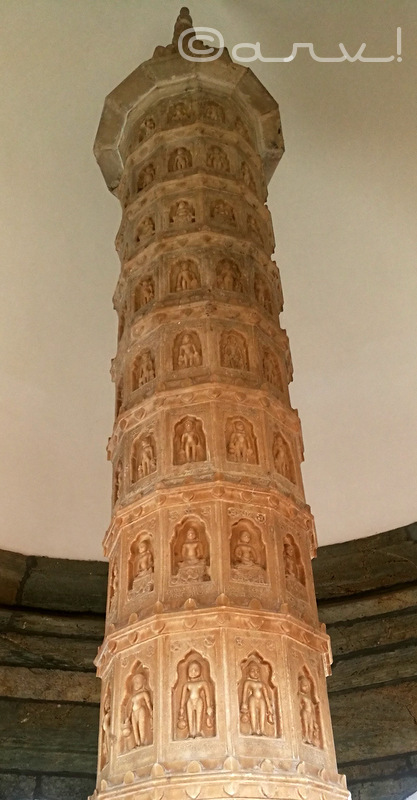
This Kirti Stambh has a dimension of 12′ 6″ by 4′ 7″ and has 10 vertical sections. Each of these sections has 12 units having an idol of Bhattaraka.
There is a pattern followed in this Stambh. The Bhattarakas are depicted in either Padmasana or Khadasana. Bhattarakas in the Khadasana position are holding Kamandalu.
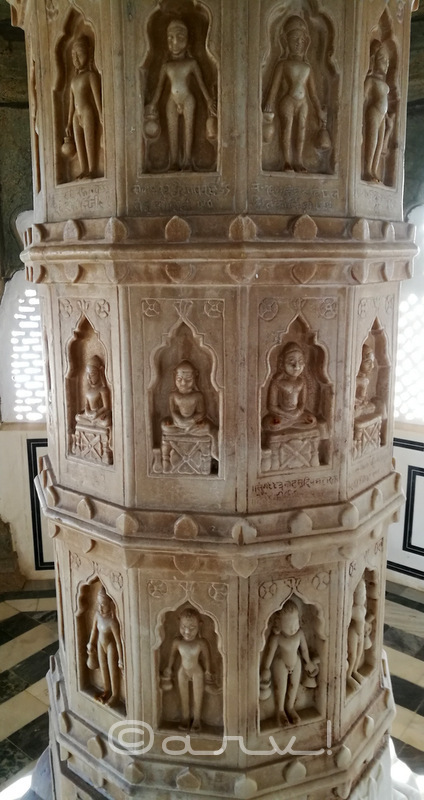
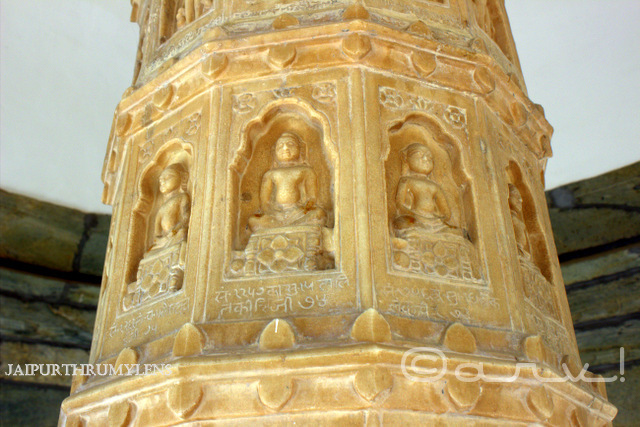
Kirti Stambh depicts Bhattraka from V.S. 4/ 53 BC to V.S. 1883/ 1826 AD. This Kirti Stambh has 101 Bhattarakas starting from 1st Bhattark Bhadrabahu to Devedrakirti. A few units are vacant. This Kirti Stambh charts and documents Digambara Jain Bhattraks in a single stone, it has immense importance from a religious perspective.
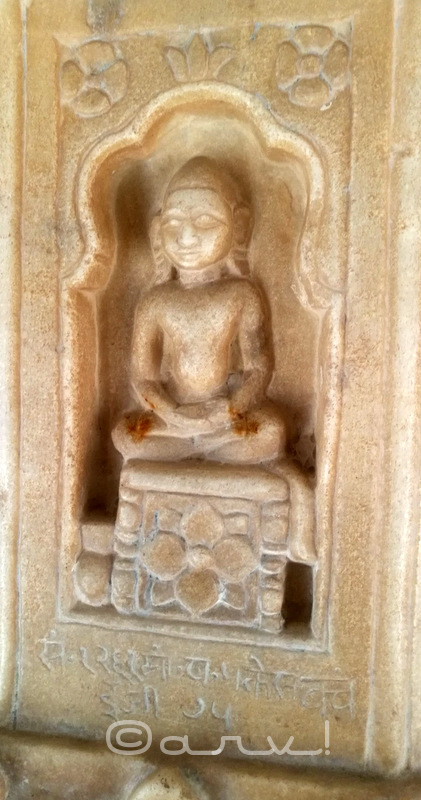
Who Were Bhattarakas?
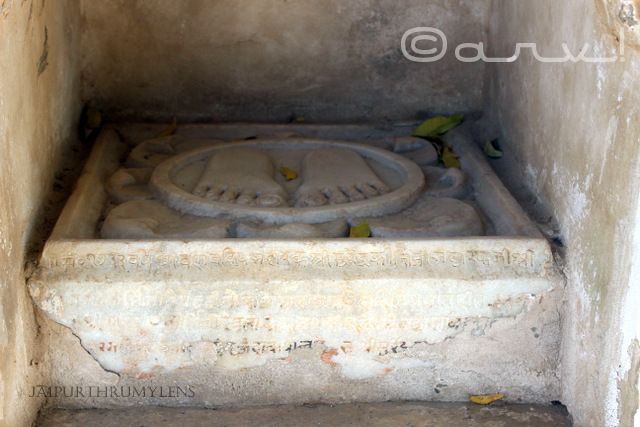
The temple premise houses four Chhatri with Charan Paduka of Bhattarakas or Digamber Jain monks. Bhattaraka is the head of the Digambar Jain sect just like the Pope is for the Catholic Christians. He is responsible for many religious decisions pertaining to the Digamber Jain sect of Jainism as well as provides guidance to his subjects following the religion. In many ways, Bhattaraka is the ultimate authority for issues relating to the religion.
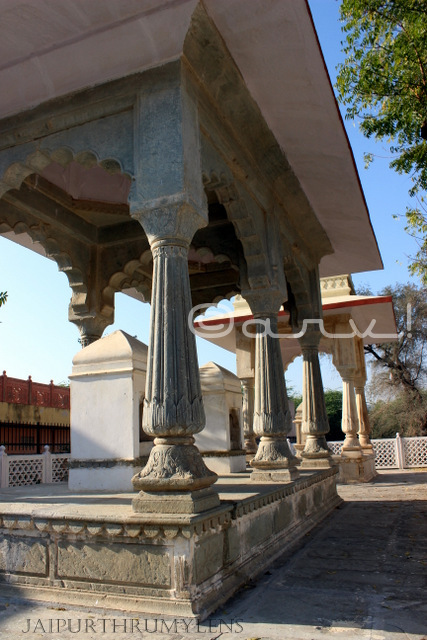
List of Digamber Jain Muni or Monks
First, such Chhatri of Bhattaraka Devendrakirti was established during the reign of Maharajah Jai Singh I of Amer. The second Chhatri having Charan Paduka of Bhattaraka Narendra Kirti was built in V.S. 1722/ 1665 AD; the third Chhatri of Bhattaraka Surendra Kirti in V.S. 1733/ 1676 AD and the fourth Chhatri of Bhattaraka Jagat Kirti in V.S. 1770/ 1713 AD.
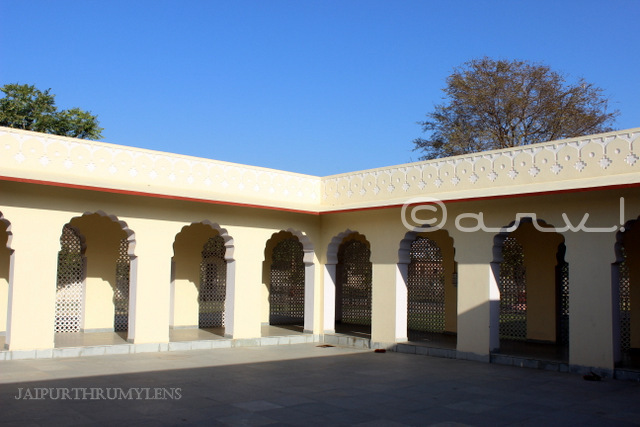
Digamber Jain Dharamshala Mandir in Jaipur
This Digambar Jain Nasiyan Mandir in Jaipur was renovated a few years ago. Ministry of Culture, Government of India provided a financial contribution for enhancing the facilities on the occasion of the 26th birth century of Lord Mahavira. This temple has a Digamber Jain Dharamshala in Jaipur to facilitate devotees. The rooms are basic and there are other Digamber Jain Dharamshala in Jaipur with better facilities. Here is a picture from the Dharamshala section of the temple.
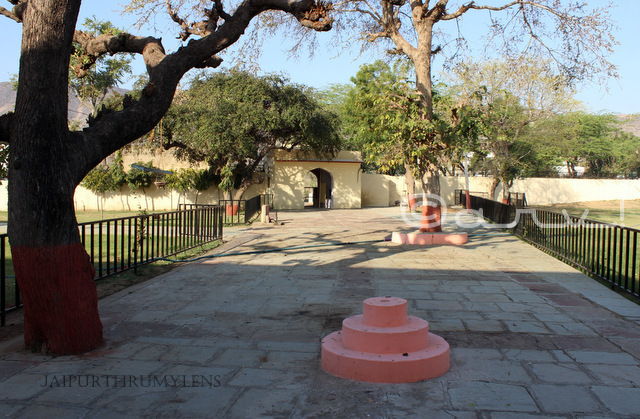
I had no idea that an old Digambar Jain temple with a history of 400 years existed in Jaipur. Digambar Jain community was one the most prominent communities in Jaipur. Some of them were very influential and could alter decisions in the Court of Amer. Digambar Jain Temple Sanwalaji in Amer is considered one of the oldest Jain Temples in Jaipur. It has a large following. Jain temples are well known for being ornate and rich in carvings and detailing.
This Digamber Jain Mandir is not one of the most famous Jain temples in Jaipur. They are one of the most beautiful temples around. Dilwara and Ranakpur are famous the world over for their beauty. This Digambar Jain temple is not impressive from an architectural point of view probably because many changes have been made in recent years. This will interest people from the Digamber Jain community or those who have an interest in history or religion. Please note that it is not a tourist attraction and therefore temple management reserves the right of admission.
Digamber Jainism
What is Jainism?
Jainism was founded in India. Jainism follows the system of 24 Tirthankaras with the first one called Rishabnath and the last one, Vardhman Mahavir, or Mahavir as he is usually called, a prince from the 6th century BC. Many people consider Mahavir as the founder of Jainism which in a way is misleading because there were 23 Tithankaras before Mahavira. In a true sense, Rishabnath is the founder of Jainism. The crux of Jainism is that everything has Jiva or life. People following Jainism are called Jain and form a minority. The essence of Jainism is non-violence, non-possession of materialistic things, and vegetarianism. Mahavira & Buddha, the founder of Buddhism are considered contemporaries. From that reference, Jainism is older than Buddhism. There is historical evidence of the existence of Parshvnath, the 23rd Tirthankara.
Who is a Digambar Jain?
Digambar Jain is one of two sects of Jainism – Shwetambar, and Digambar. There are differences in thoughts on Jainism between both sects even though they agree on the basic tenets. The Digambar sect is named after one particular practice of its monks who follow nudity & do not wear clothes as they feel that elements of nature are their clothes. Literal pronunciation from Sanskrit of the word Digambar is “skyclad”. Another point of difference between both sects is that as per Digambar ideology, women do not attain Moksha or liberation until they are reborn as males.
What is Nasia?
Nasia is a religious place in the Digambar Jain community. It has a temple among other facilities. Nasia or Nasiyan is built away from town so people can channel their energies on religion as it offers peace and silence.
meaning of Bhattaraka?
Bhattaraks are erudite religious heads of Jain centers engaged in promoting the Jain religion. They also ensure the safekeeping of Jain religious text. Bhattaraks continue to hold & maintain important Jain literature & religious works. Many Bhattaraks composed Jain religious treatises. Bhattaraks are credited with protecting Jainism during the years of Muslim rule. They were strong advocators of the Jain principle and way of life – nonviolence & vegetarianism. This system of Bhattaraks evolved as a special institution during the period of Muslim rule that did not allow Digambar monks to move freely across the country as they shunned nudity practiced by monks. Unlike other Digambar monks, Bhattaraka does not practice nudity and lives in a Math/ monastery. The evolution of Bhattaraka is assumed to have developed around the 8th to 13th centuries. Earlier, the Bhattaraka system was prevalent in Buddhism & Hinduism but over the years it gave way. Bhattaraks still hold immense importance in South India especially Shravanbelgola in Karnataka. Some centers exist in North India as well. The Bhattarak Ji Ki Nasiyan in Jaipur was one such center. It is believed in the 17th century some people rejected the Bhattaraka system led to the extinction of the Bhattarak system from North India.
What is Tirthankara?
Tirthankara is the founder of Tirtha. A Tirthankar is not an incarnation of God. He is an ordinary soul, born as a human who attains the state of a Tirthankara because of intense practices of meditation, penance & self-control. Therefore Tirthankar is not an Avatar or reincarnation of God. It is the ultimate pure developed state of the soul which may be termed as God in human form.
What is Vikram Samvat?
Indian Calendar System/ Vedic Time System/ Hindu Calendar System is named after the famous Indian ruler Vikramaditya of Ujjain who started Vikram Samvat 57 years before the birth of Christ. You can calculate it easily by adding 57 to any Gregorian year. It is referred to as V.S. or simply Samvat.
Stay updated with Jaipurthrumylens!! via:
Discover more from JaipurThruMyLens
Subscribe to get the latest posts sent to your email.
 JaipurThruMyLens
Arv! I enjoyed reading about the nearby temple of Amer. I am amazed at how well the temple area is being looked after. You mentioned that you could not publish some photos and wonder whether there were religious considerations, as we know from other ancient religions to have some concern about images.
LikeLiked by 1 person
Happy to hear that you enjoyed reading this post. Many temple do have restrictions on photography. There are some that do not permit taking pictures of idol, while others are okay with that but restrict photography elsewhere in premises. Over the years, some people have realized that they cannot win because everyone carries a camera in form of a phone; it is difficult to police. I guess everyone has right to their own conviction.
Have you ever heard about Jainism?
LikeLiked by 1 person
I did not hear about Janism until I read about it on your blog.
LikeLiked by 1 person
aha! well, can understand since the number of Jain is quite small in India and this never spread like Buddhism.
LikeLiked by 1 person
This is a very nice and informative post, Arv. Amazing wealth in India!! How rich is our culture!
LikeLiked by 1 person
Absolutely Lalitha. I hope to post some more pictures from ornate and beautiful Jain temples here in Jaipur. Have you ever visited any?
LikeLike
No I haven’t though the religion is not foreign to me 🙂 I will look forward to reading more from you 🙂
LikeLiked by 1 person
Sure, Lalitha. I will post more about it soon. Thanks for sharing your views. 🙂
LikeLiked by 1 person
I am a Jain as well and could clearly get everything you wrote, it’s lovely.
LikeLike
Happy to hear this Chahat. I will be glad if you can add something more to it.
LikeLiked by 1 person
I don’t it needs adding.
LikeLiked by 1 person
Ok 😃👍
LikeLiked by 1 person
Nice to Read. Beautiful temple.
Keep sharing.
LikeLiked by 1 person
Thanks Rupam 😊
LikeLiked by 1 person
Looks amazing Arv! So much to see in your part of the world!
LikeLiked by 1 person
I guess all countries and regions with rich cultural legacies have lots to explore Nicole.
LikeLiked by 1 person
Another great post, Arv. I know little of Jainism beyond the bare facts of its birth and its tenets, and have never had the opportunity to visit one of its temples (as far as I know!).
LikeLiked by 1 person
Mick, Jain temples are supposedly one of the most ornate and beautiful temples around. Of course, this is not one of them. The idol is usually made of white/ black stone. Some of the most beautiful and ornate Jain temples are in Dilwara, Ranakpur and Jaiselmer. Jainism is focussed on ahimsa (non-violence) & practising vegetarianism.
LikeLiked by 1 person
I shall have to visit one, Arv. The trouble is, the older I get the more there seems to be to see and do!
LikeLiked by 1 person
Mick when I sit and think I feel the memories we create will be more enriching than anything else. If you can… you should travel.
LikeLiked by 1 person
Oh, as soon as possible, Arv!
LikeLiked by 1 person
Great! 🙂
LikeLiked by 1 person
So much of hard work would have gone in the making of this post I can only imagine for by the time I reached the end of it, there were so many new things I had learnt. It’s not just a travel piece, it’s from the heart of someone who genuinely feels connected with history. Marvellous work☺️
LikeLiked by 1 person
Thank you. You guessed it right. It does take lots of time. To be honest, it’s not a travel guide because itsnot recommended for tourists. This place will be appreciated only by history lovers or explorers. Thanks for reading and appreciating; not everyone can understand the efforts that go in such post. 😊
LikeLiked by 1 person
Yes I agree with you☺️ and thank you for such a detailed post once again!
LikeLiked by 1 person
You are welcome. Your words are surely encouraging. 😊
LikeLiked by 1 person
☺️😊
LikeLiked by 1 person
Beautiful and very informative!
LikeLiked by 1 person
Happy to know you liked it Joy 😊
LikeLike
This is quite an informative post. This temple is not as ornate as other Jain temples but is beautiful, as seen through your pictures. I did visit the famous Dilwara temple and was amazed by its intricate carvings. Here the other interesting point is the Kirti Stambh is not in the open. You have covered every detail of the temple and the religion. It is a nice read.
LikeLiked by 1 person
Thanks Sharmistha for sharing your views. As you also mentioned, it is not an elaborate temple a striking feature of Jain temple but this has interesting history and a kirti stambh which marks all Bhattaraks. There many beautiful Jain temples in Jaipur but getting permission for photography is difficult. Have you explored your home town – Kolkatta?
LikeLiked by 1 person
Yes, I did visit the beautiful Parshwanath Temple in Kolkata. Though I visited it in my childhood, I do remember it very well. I think I missed to mention this on my blog on Kolkata.
LikeLiked by 1 person
Ah! Great. I’m sure there must be many because there is large Jain population residing in Kolkatta, Sharmistha. 🙂
LikeLiked by 1 person
The Parshawanath Temple in Kolkata is for the Shewtambar sect of Jainism.
LikeLiked by 1 person
You will find large number of Shwetambar temples dedicated to Parashwanath.
How about a blog? will get to see pictures and your experience.
LikeLike
Yeah sure I will do one. So on my next visit to my hometown I will be to the Parshwanath temple to get fresh data and also the pictures to write a post.
LikeLiked by 1 person
That’ll be great 🙂
LikeLike
Thank you for sharing your pictures and words with us- I enjoyed your post, very interesting 🙂
LikeLiked by 2 people
Happy to hear that you enjoyed reading this post, Emma! 🙂
LikeLiked by 1 person
I love the juxtaposition between the old and new in this temple. It’s so telling.
LikeLiked by 1 person
you are so observant. Yes, this temple has both these elements. Thanks for sharing your views 🙂
LikeLike
Looks like a very zen place!
LikeLiked by 1 person
It is Susie.Thanks for sharing your thoughts. 🙂
LikeLiked by 1 person
I’ve always found Jainism to be very interesting. Your photos are beautiful! I hope I get to visit places like this someday!
LikeLiked by 1 person
Happy to hear that. How did you come to know about Jainism? Not many people outside India have heard about Jainism.
LikeLiked by 1 person
I’ve read up on a lot of India’s religions. I find them fascinating and I love the idea of karma and the encouragement of kindness and good deeds. I hope dearly to visit India someday.
LikeLiked by 1 person
If you like these concepts than surely Jainism and Buddhism will appeal to you.
I’m hoping you get to travel to India someday and experience it yourself. 🙂
LikeLiked by 2 people
Beautiful ❤️❤️
LikeLiked by 1 person
Thank you 🙂
LikeLike
I had absolutely no clue about this Jain temple in Jaipur. It is so off the beaten track and the marble pillars and chatris are so beautiful. Love the architecture of Jain temples, and while this may not be as illustrious as Ranakpur, it has an old world charm and beauty! 🙂 Lovely read!
LikeLiked by 1 person
Divsi, it is completely offbeat visit. I admit it is not at all ornate, something for which Jain temples are renowned. There are many ornate and beautiful Jain temples in Jaipur. More on those sometime later! 🙂
LikeLike
Hello…can u please help me that how can i use WordPress??
LikeLiked by 1 person
Hi! Let me know how I can help you.
LikeLike
Thanks for your response…
Can you please tell me that what is the purpose of WordPress??
LikeLike
Most sites across the world use WordPress to create and run a site
LikeLike
Very nice read. thanks.
Do also include some points on Women tourist safety matters. That seems to be one problem that is holding back tourist flows into India
LikeLike
Very well writing and articulated. This is extremely informative and great to see how you have put your sol into what you do.
LikeLiked by 1 person
Thanks, Arunasha. To be honest, there are many more places that I have explored but I haven’t been able to put them here on the blog because of the paucity of time. I assume you have also been exploring quite a bit 🙂
LikeLike
You really described it’s beauty in beautiful words😊
Awesome pictures! 🙌
LikeLiked by 1 person
Thanks, Nandini! I’m happy you liked this post. Have you ever been to Jaipur?
LikeLike
Unfortunately no,… but I wish to visit the place soon 😊
LikeLiked by 1 person
Ah! In which city do you reside?
LikeLike
Nagpur ☺
LikeLiked by 1 person
Great! 🙂
LikeLike
Beautiful place, calm and quiet. Glad to know this place has been well kept, unlike some other heritage properties of the country. I have been to Jaipur, but could not catch this beautiful temple.
LikeLike