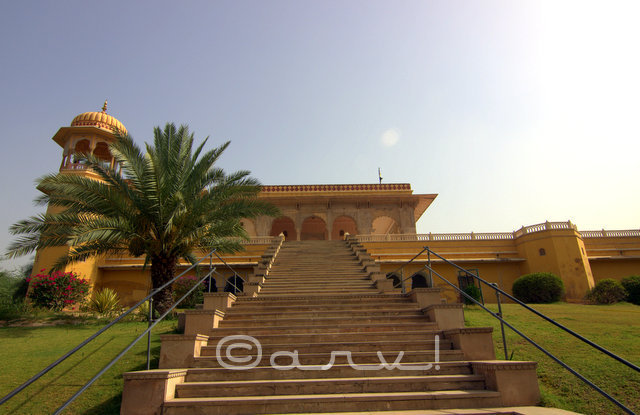
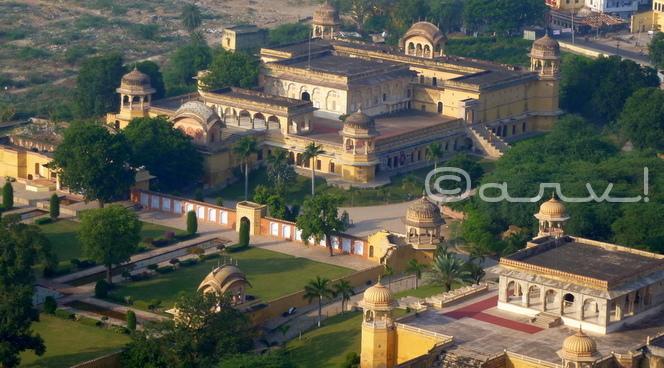
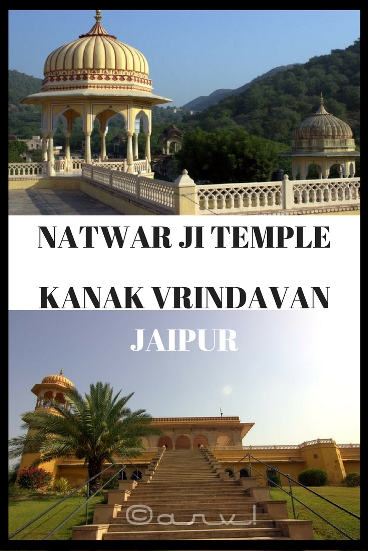
Kanak Vrindavan Garden in Kanak Vrindavan Ghati near Amer Fort has an old temple complex in Jaipur dedicated to Lord Krishna.
History of Kanak Vrindavan Temples in Jaipur
Temples at Kanak Vrindavan Garden were built in 1713 AD. Maharaja Sawai Jai Singh II, the founder of Jaipur ordered the construction of a new temple for establishing the idol of Lord Govind Dev Ji upon its movement from Vrindavana in 1669 AD. Mughal emperor Aurangzeb issued an order to destroy all major Hindu temples across North India. Govind Dev Ji Idol was moved from Govind Devji temple in Vrindavan built by Man Singh I of Amer. Vrindavana is the birthplace of Lord Krishna. More information on Aurangzeb & Mughals, at the end of this post.
This movement of deities from Vrindavana to Amer/ Jaipur was precautionary as the Kachhava rulers of Jaipur were followers of Lord Krishna; Govind Dev Ji temple was built by their forefathers. In part, it was also to save the Hindu religion.
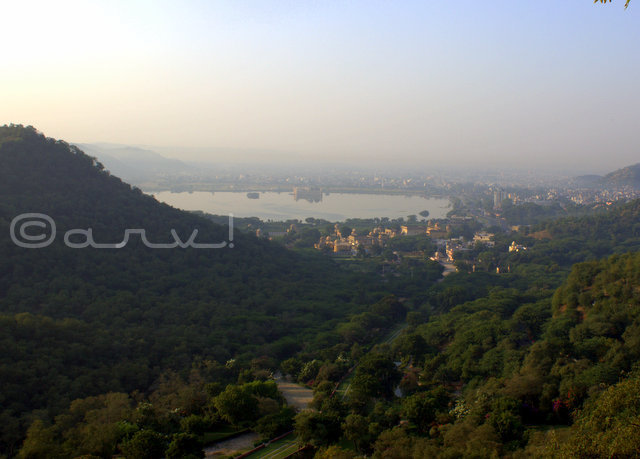
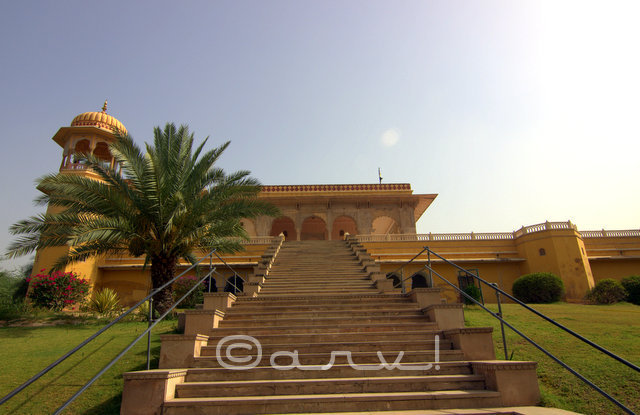
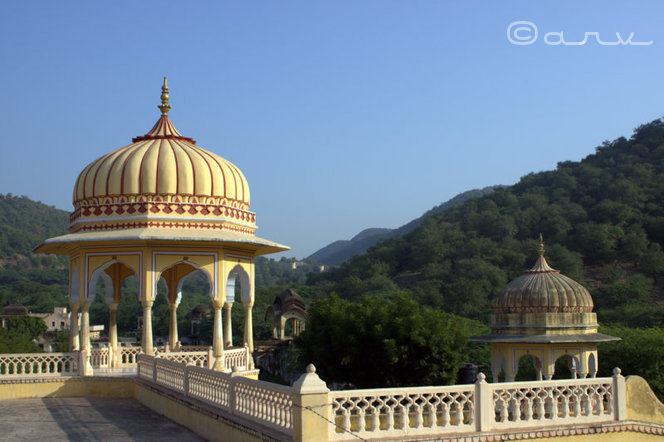
From 1669 Ad to 1713 AD the deity did not have any permanent place as it kept moving from one place to another. The Kachwaha Rajputs ruled from Amber; Jaipur was not founded until 1727 AD. A need for a permanent place was felt to establish Govind Devji’s idol. Kanak Vrindavan Ghati was located on the outer edge of Amber town with Mansagar lake right next to it, making it a picturesque place. Maharajah Jai Singh II found this place most suitable for building a temple. It resembled the beautiful environs of Vrindavana with many Kadambh trees. The following picture depicts the beautiful Kanak Vrindavan Ghati. There is Kanak Vrindavan temple in the center and Mansagar Lake in the background.
Read Kanak Vrindavan Garden -Radha Madhav Temple
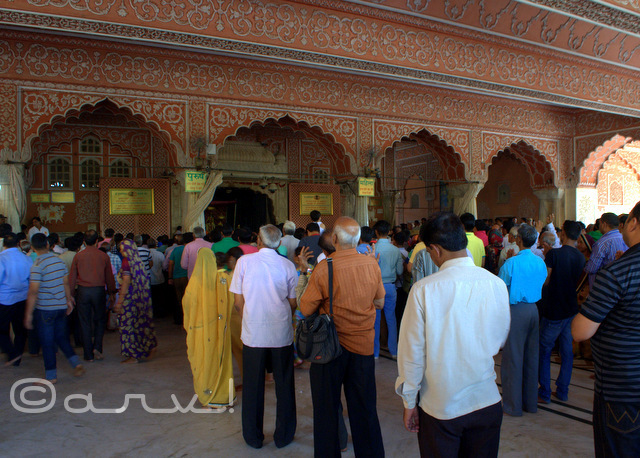
A final round of shifting of Lord Govind Dev Ji’s idol took place from Kanak Vrindavan Ghati to Jai Niwas garden, near Jaipur City Palace around 1716-1720 AD. The new site later came to be known as Govind Dev Ji temple. Hence the relationship of Lord Govind Devji with Kachhava rulers changed to a family deity. Here is a picture of Govind Devji Temple in Jaipur.
After moving Lord Govind Devji to new temple premises at Jai Niwas in Jaipur, the Kanak Vrindavan Garden complex fell into oversight, neglect, and disrepair. This situation prevailed for years until it was renovated by the Hindustan Charitable Trust, a few years ago.
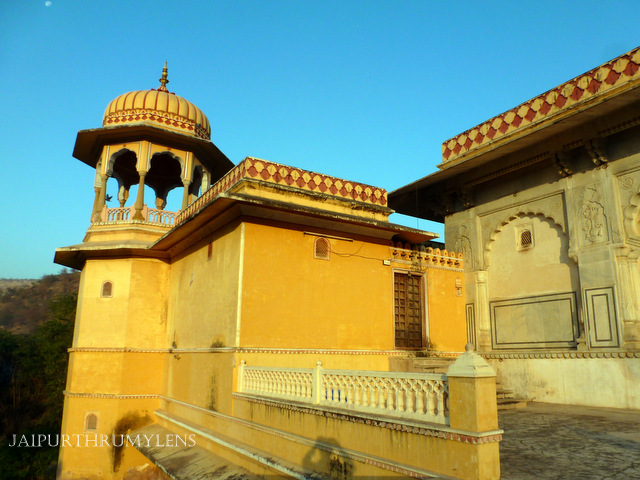
Kanak Vrindavan complex consists of two temples. Natwar Ji temple is supposed to be built by Maharaja Sawai Jai Singh II’s sister – Amar Kanwar in 1707 AD. Lord Govind Dev Ji deity was established in Radha Madhav Temple before moving it to Govind Devji temple in Jaipur.
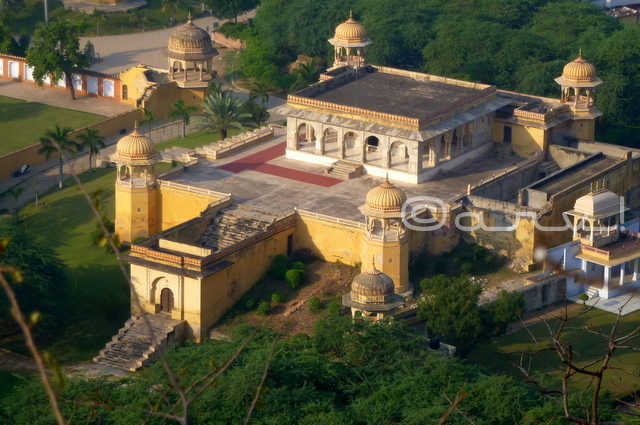
Natwarji Temple at Kanak Vrindavan Garden in a monochrome picture.

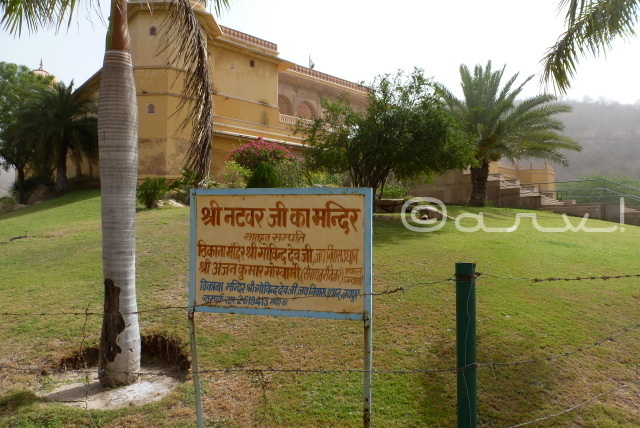
The temple is managed by Govind Devji temple trust.
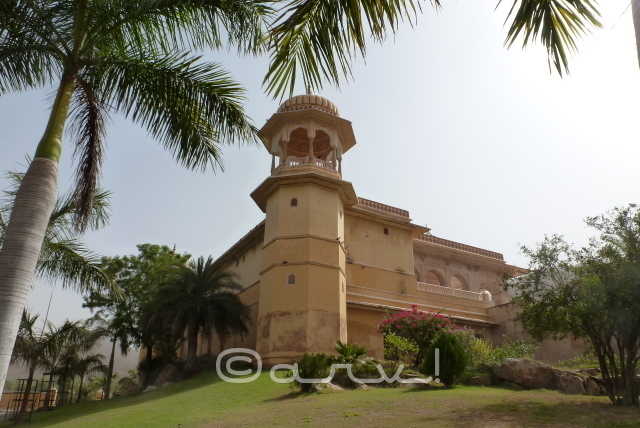
The sanctum of Natwarji Temple is beautiful and displays similar workmanship as Sheesh Mahal in Amer Palace. Here is a picture of Sheesh mahal from Amer fort.
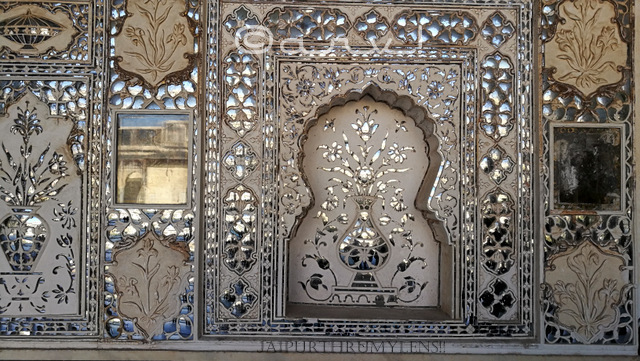
Of course, all this has been restored as the place was in shambles for more than a century. Everything has been restored beautifully as per the prevalent restoration practices; this effort needs to be appreciated.
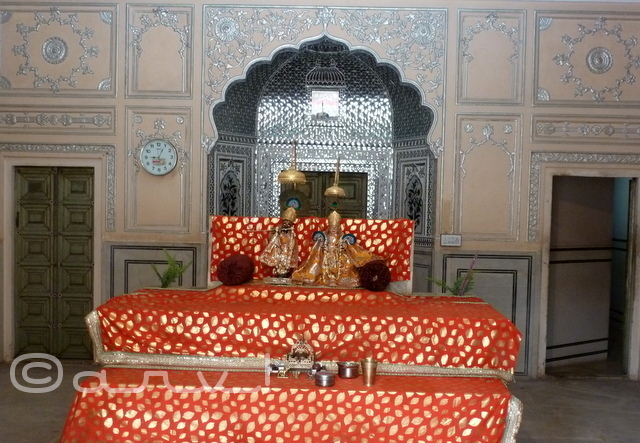
There is a prohibition on photography in the temple complex. I could only photograph places where this rule is not followed.
This is one of the early Haveli temples of Jaipur, an architectural style unique to Jaipur. These temples are masterpieces with beautiful architecture devoid of ostentatious elements. A regal style without going overboard; an understated elegance.
You must visit Kanak Vrindavan Garden for its beautiful environs and lovely architecture. This is much more than a temple.
Read Kanak Vrindavan Gardens | Radha Madhav Temple
Who was Mughal emperor Auranzeb?
Aurangzeb was the third son of Mughal emperor Shah Jahan who ruled over a vast Indian subcontinent. Shah Jahan built the famous Taj Mahal, a UNESCO world heritage site in Agra. Aurangzeb is ill-famed in Indian history as he imprisoned his father Shah Jahan; executed his brothers in a struggle for the throne. He was a Muslim fanatic who after ascending to power in 1659 AD started a systematic program to destroy all popular Hindu temples and deities from 1666 AD on-wards across India. This is what most historians believe. Aurangzeb was a self-proclaimed defendant of Islam imposing the rule of sharia. He imposed Jizya, a tax on non-Muslims & was a cruel ruler, hated by the masses for his policies which led to the downfall of Mughal rule in India. Mughals were Muslims originating from central Asia who invaded India, ruling over a period reigning from 1526 AD to 1707 AD, after which their rule weakened.
Stay updated with Jaipurthrumylens on Facebook Twitter Instagram
Discover more from JaipurThruMyLens
Subscribe to get the latest posts sent to your email.
 JaipurThruMyLens
I find your photography and your description of the places amazing @arv 😍
LikeLiked by 1 person
Surbhi…I always find it difficult to “write well”. Transferring thoughts to the words has always been quite tough for me. As for photography, there are quite many things which I need to upgrade on…software being one of them. While everyone uses LR and PS, I still belong to old world – I don’t have either of these! Thank you for your kind comment Surbhi! 🙂
LikeLiked by 1 person
With whatever you write and click, you exhibit it well. 😊 I also find it difficult framing what I actually want to write, but when people appreciate it, there’s no better motivation for me!
LikeLiked by 1 person
Right Surbhi..there is always a different take by other people on your creation/ work. It’s true that appreciation is the best motivation. 🙂
LikeLiked by 1 person
Looking forward to Pt. 2 Cheers Jamie.
LikeLiked by 1 person
Sure Jamie! Looking at my previous track record, I do take my own time! 🙂 Will try to post asap!
LikeLiked by 1 person
No problembo … speed is not an issue here. Just enjoyed the first part. Looking forward to the next. Best wishes, Cheers Jamie.
LikeLiked by 1 person
Thanks Jamie! that’s kind of you. will try to speed up…ASAP 🙂
LikeLiked by 1 person
This is amazing insight. Great work Arvind.
LikeLiked by 1 person
Thanks Vaibhav! 🙂
LikeLike
Great post. I went to amer Palace but didn’t see this temple
LikeLiked by 1 person
It’s not surprising Sukanya. Given many options among tourist sites and paucity of time, it never features among top places to see in Jaipur. Probably its a blessing in disguise. 🙂
LikeLike
Awesome. Whenever I cross Kanak ghaati I wonder whats there….. Now I know 🙂 all thsnks to your post….. On my list to see in Jaiipur whenever I visit next
LikeLiked by 1 person
That’s great. Do visit. Do you often drive down from NH11 ?
LikeLike
Oh, this is so lovely. Adding this to the must visit list while we are Jaipur!!
LikeLiked by 1 person
Surely you must. do let me know how you found it. 🙂
LikeLike
Excellent pictures with an equally complementing write up! Enjoyed it thoroughly! I actually gazed at these pictures!
LikeLiked by 1 person
Thank You Mana! I’m happy that you enjoyed it. I just love it’s architecture, I can sit there just admiring it all. 🙂
LikeLiked by 1 person
These old architectural structures mesmerizes me beyond words. They are made with such patience! Every nook and corner of them are given attention to. Just like you, I too can sit and admire each aspect of them one by one for hours. Or entire structure as a whole and the visual treat it gives.
LikeLiked by 1 person
Mana, in my opinion, the architectural heights achieved by our predecessors is had to replicate. each region had it’s own hallmark style. Looking at current architectural pattern and style, it seems we are merely aping west. we have nothing of our own…looks like the epitome of art and architecture was achieved long back and it’s heading nowhere now! 😦
LikeLiked by 1 person
“The epitome of art and architecture was achieved long back”, I completely agree with this! Even if we’d copy our own architecture rather than aping west as you say, our building would be more weather friendly!
For instance the building I am sitting in right now. It is an institute and is built by a very famous architect, who has been student of another famous french architect. Architects from all over the world come to see it, but hardly anyone knows how unsuitable it is for the purpose it is built and how suffocating it is for us to sit and work.
LikeLiked by 1 person
It’s a problem we all are facing -cut copy paste! If it’s a glass building that’s in trend now, everyone wants that. Not realising that it might suit cold and overcast weather, sunny weather out here doesn’t require it. Local sensibilities have been thrown out! Well it’s a multinational mafia who needs to profit, architects are it’s instruments! Even in west, old architecture is forgotten. it’s a sin to even think about it. Unfortunately, we are made to believe that everything new is good.
LikeLike
Feel as tho have been on a tour …Thankyou arv…great post:):):)
LikeLiked by 1 person
I’m happy you enjoyed it, Fijay! Thanks for liking and commenting 🙂
LikeLike
Are these temples always so empty ?
LikeLike
Hi! These temples are not empty, it’s a pre-decided style of my photography. You’ll find people also in temple, you can check out Govind Devji temple posted in response to weekly photo challenge. It depends on what I’m focusing on. Do you prefer pictures of temple with people?
LikeLike
Frankly I find pictures with people more meaningful but that’s my personal choice. Our temples have a life of their own not seen in any other place of worship – noisy ,colourful,irreverent even , sometimes with monkeys or stray dogs hanging around . ….
LikeLiked by 1 person
Sure! You have a point here which I will agree with. My perspective here is different as I focus on it’s history and architecture. there were post like Govind dev ji temple and ramchandra temple where you’ll see lots of devotees. I usually visit temples when it’s less crowded. Another thing is that I write about many heritage temples which are not very popular but they have rich history. So there are various factors. But you will see devotees in some of the future posts. Thanks for writing your views, gives me a fresh perspective. 🙂
LikeLike
🙂
LikeLiked by 1 person
Beautiful shots, particularly the layout and the chatri. The haveli architecture of the temple is so elegant, but not ostentatous, as rightly pointed out by you.
LikeLiked by 1 person
Somali, as per old vastu shastra there can be many layouts for temples, Haveli style architecture and layout is the most common one among the heritage temples of Jaipur commissioned by the royalty. 🙂
LikeLiked by 1 person
Beautiful photos as always! 🙂
LikeLiked by 1 person
Thank You. When you write “as always” it shows that you notice so much and you have good memory! 🙂
LikeLiked by 1 person
Great work…. lovely photos Arv…..
LikeLiked by 1 person
Thank You for appreciating Sudhir…I’m happy that you liked it. 🙂
LikeLiked by 1 person
Superb post. Loved the picture and details both. I have been to Jaipur but after reading this I want to feel lie going again
LikeLiked by 1 person
Thanks for reading and appreciating. There are many such places which are beyond standard tourist circuit, all it needs is interest and time to explore. Let me know whenever you are in town, will help you plan and visit. 🙂
LikeLike
Loved the images and your vivid description!
Amazing!!
😊😊😊
LikeLiked by 1 person
Thanks. I’m happy you liked it. 🙂
LikeLiked by 1 person
I want to be here…………Nice, marvelous, beautiful…….
Visit to my blog……….. and give your valuable comments and likes, if my blog is good so don’t forget to share……..I am looking forward for Content writing project I working as a freelancer……
LikeLike
Thank you for sharing your views.
Please note that this is not a place for advertising. Kindly solicit content writing work at the right place/forum.
LikeLiked by 1 person
This is the response I got when I tried to visit your most recent post: Oops! That page can’t be found.
LikeLiked by 1 person
Sorry to hear this.Apologies. Pls do try again. I think this should not be a problem now! 🙂
LikeLike
Indeed beautiful! Definitely wish to visit it whenever I am in Jaipur, the photographs are captivating enough.
LikeLiked by 1 person
I’m sure you’ll like the place. 🙂
LikeLiked by 1 person