
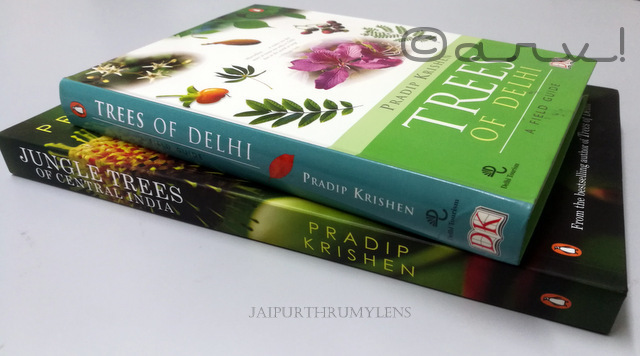
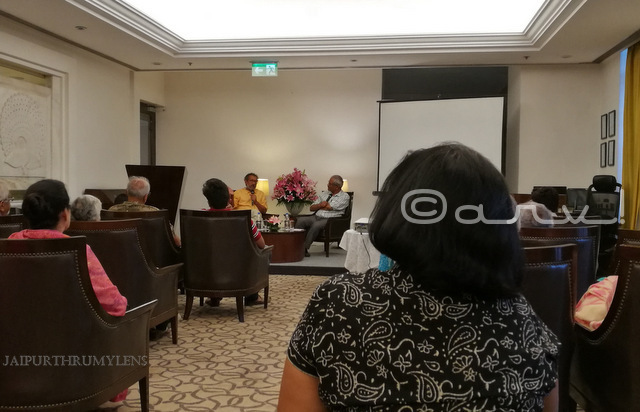
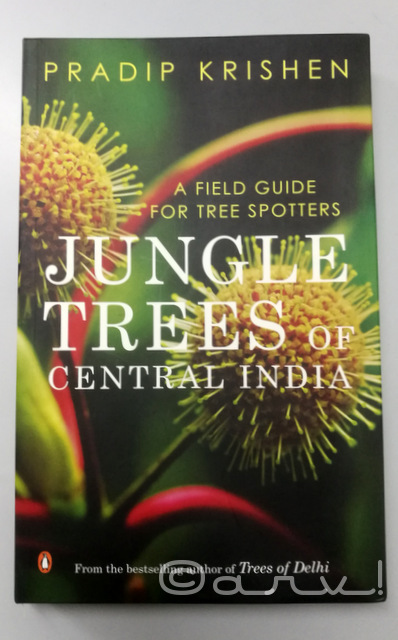
Recently, I attended a talk show of Pradip Krishen. Pradip Krishen is the author of the famous book The Trees of Delhi and Tres of Central India.. He is well-known for his ecological restoration of Rao Jodha Park in Jodhpur and Kishan Bagh in Jaipur. The talk show was at ITC Rajputana. The event was hosted by The Write Circle in Jaipur and it was a deep-dive into urban forestry, the danger of exotic plant species in India, and immense value of India’s native trees. The Write Circle Jaipur organizes talk shows featuring famous writers, authors, and notable personalities in Jaipur. The show was moderated by Arijit Banerjee, a forester in the Indian Forest Service. I have read & enjoyed one of the books written by Pradip Krishen – Trees of Delhi, a field guide.
Pradip Krishen & Trees Of Delhi | A Journey into India’s Indigenous Flora
The book Trees of Delhi is one of the most popular books on trees in India. It is one of its kind books and one of the most selling books on trees in India. The author of the book is Pradip Krishen. As someone who is not a trained botanist, Krishen’s journey into environmentalism and his practical approach to identifying nature is deeply inspiring. So when the opportunity presented itself to attend Pradip Krishen’s event in Jaipur, I decided not to miss it.
What is Trees of Delhi book about?
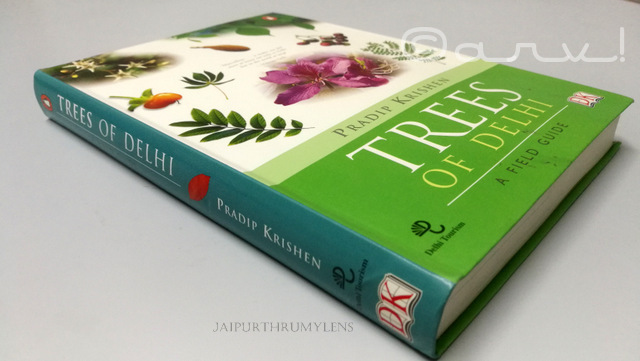
Trees of Delhi is an accessible, highly visual field guide that categorizes trees by leaf type, making tree identification easy for non-botanists. It is one of its kind book on trees of Delhi providing histroical context and where one can find these trees.
Who Is Pradip Krishen?
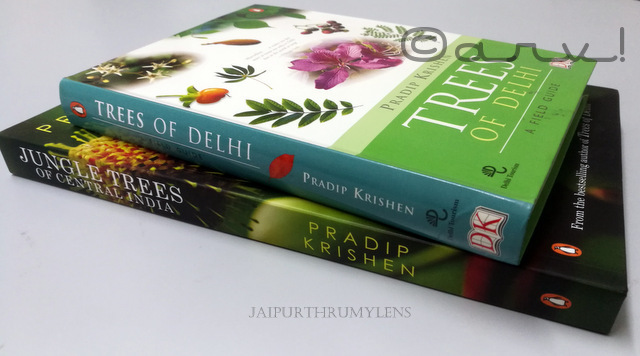
Pradip Krishen is a tree lover, author, environmentalist, and filmmaker. He made a few documentaries and films during the initial years of his career. The most famous film he directed was Massey Sahib. The famous Pradip Krishen books are Trees of Delhi and Jungle Trees of Central India. The former earned great reviews and was an instant hit. The first wife of Pradip Krishen is Arundhati Roy. Arundhati Roy is a famous writer, environmentalist, and political activist -.
It is interesting to note that Pradip Krishen made a switch in his career during his mid-life. From a documentary maker to an ardent tree lover is quite a journey. Krishen spoke at length about his years in Delhi and Panchmarhi in MP, during which he started noticing and paying attention to trees. During the few years, Krishen spent in forests in Madhya Pradesh, he would often walk with his friend which he termed a “Latin walk”. Krishen and his friend would try to identify a tree and his friend would come up with their name in Latin. He simply fell in love with trees. Krishen is not a botanist but his knowledge about trees is no less than one! Pradip Krishen has led many tree walks in Delhi.
How Rao Jodha Park in Jodhpur was restord by Pradip Krishen? The story of Prosopis Juliflora – Bavaliya Tree
Pradip Krishen spoke about his experiences during the development of Rao Jodha Desert Park in Jodhpur in 2006. He was a catalyst in developing this project at the invitation of the royal family of Jodhpur. The entire rocky area of this desert park was dominated by “Bavaliya” trees, a nickname coined by Jodhpur locals for Prosopis Juliflora also called Kikar. Prosopis Juliflora is also known as Junglee Kikar.

Prosopis Juliflora, an invasive tree introduced in India by British during the 1920 and the 1930s, a native of South America. The tree is known as a tough fighter and suvives even in the harshest conditions. How this tree was planted in Jodhpur during the 1930’s is an interesting story shared by Krishen. The Maharajah of Jodhpur, Umaid Singh while flying a 2 seater aircraft over the region dispersed seeds of Prosopis Juliflora in the air. Umaid Singh is called flying Maharaja; he is remebered for his passion for flying planes. Little did Maharaja know that his action of planting the seed of this tree would kill all native trees in the vicinity. Krishen shared this tree can grow even in the crevices of hard volcanic rocks with a little moist soil; it outcompetes to chokes all native vegetation. Even when the locals uprooted the tree, its deeply wedged roots would regrow again. How Pradip Krishen removed these trees is a story in itself. Removing Prosopis Juliflora completely from the terrain required a lot of manual chiseling of the rock. In its place, the team planted many local species like Thor Danda, a painfully slow process. He showed pictures of Rao Jodha National Park before and after the removal of Prosopis Juliflora. It’s a great job indeed. Here is a picture of Thor, also known as Euphorbia Caducifolia.

The Debate – Native Vs ExoticTrees | Pradip Krishen’s Take
Pradip Krishen supports the planting of native and indigenous species of Indian trees. Even in his books, he strongly advocates for choosing local trees over imported fancy or exotic-looking trees. He has reasons for his support of native trees. Trees of India are well suited & adapted for the local region & environment. The entire ecosystem supports and depends on such trees like birds, bees, animals, etc. Imported fancy trees are known to have caused extensive damage in many regions, Eucalyptus trees in India, imported from Australia is one such example. Local trees need very little care except for the initial few months. Among all the trees, he specifically writes about the Dhau or Anogeissus Pendula tree which is a naive tree of Rajasthan & Haryana; it can be easily found in the Ridge area of Delhi. Anogeissus Pendula is one the well-known trees of Aravali hills.
Read related post: World Forestry Arboretum Jaipur
Why do Forest department choose to plant decorative trees over native trees?
A question was thrown by one of the listeners to the panel. Why did the forest department or the Van Vibhag in Rajasthan choose to plant more decorative trees like Gulmohar and not Neem which is more suitable to this region. To this, Arijit Banerjee,a forester replied that the department usually chooses an easier way out!
Kishan Bagh in Jaipur
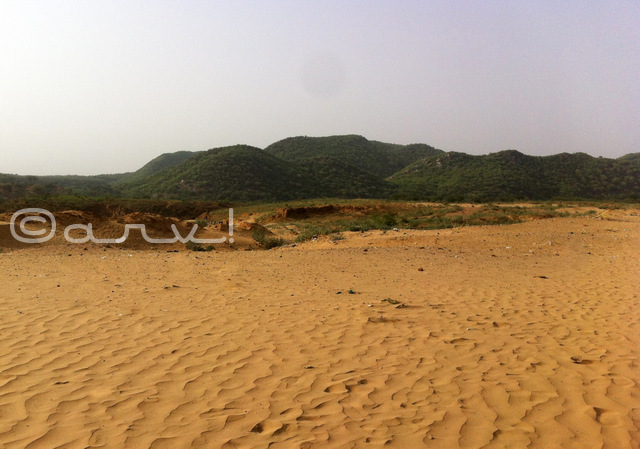
Pradip Krishen is working on Swarnjayanti Park in Kishanbagh, Jaipur which involves redeveloping the entire landscape. He chose this project because it was challenging. Local administration could not do much despite putting in a lot of effort because it is a tough area to work with. Pradip Krishen enjoys working on challenging projects. JDA has created cactus park but failed misreably. I have been to Kishan Bagh in Jaipur as I have hiked in the surrounding hills in Jaipur. Read the post-Kishan Bagh in Jaipur | The most scenic places in Jaipur
Even though I enjoyed reading his book Trees of Delhi attending this conversation was even more interesting. I absolutely had no idea how interesting this talk session of Pradip Krishen turned out to be. I was unaware of his efforts and involvement in Rao Jodha Desert Park, Jodhpur, and Kishan Bagh in Jaipur. I’m sure Pradip Krishen will come up with something interesting in Kishan Bagh. If you are a tree lover and haven’t read any of his books, you are missing out. Pradip Krishen is the best author and resource on trees in India. I highly recommend nature lovers’ Pradip Krishen books, Trees of Delhi and Jungle Trees of Central India.

Book Review – Trees of Delhi – The Ultimate Field Guide
Trees of Delhi book is an excellent resource for the tree and nature lovers in Delhi. I’m impressed with his work on this book considering he is not a botanist.Even though I don’t live in Delhi many of the trees listed in his books can be found in Jaipur and Trees of Delhi has some relevance for a Jaipur resident too. And it has not just the decorative trees but also indigenous trees and shrubs like Peepul, Salai Guggul Tree, and Khejri Trees.
Trees of Delhi is one of its kind of book. Even though attempts have been made to list the trees found in Delhi earlier too but they haven’t been so successful and well-attempted. The book is published by DK and Penguin Books. The information is well presented as the book starts with describing a tree, its parts with names, Delhi’s natural ecology, a little bit of its history in the context of trees, etc. The author describes how the British changed the whole concept of planting trees with the aim of beautifying the landscape. This kind of information is unique and has been attempted for the first time.
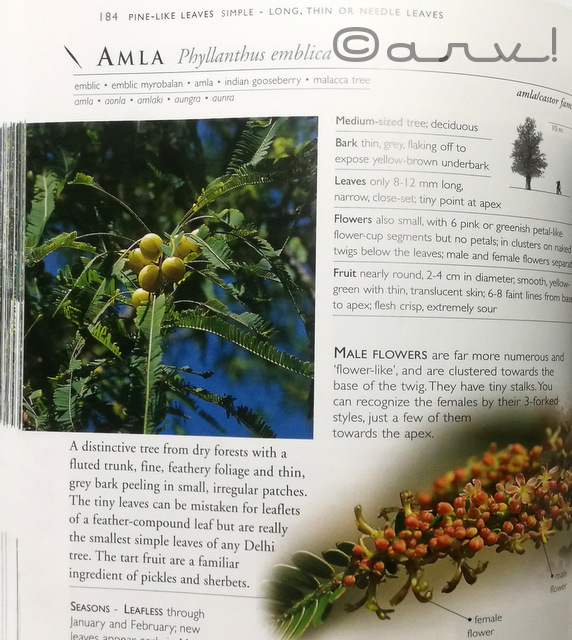
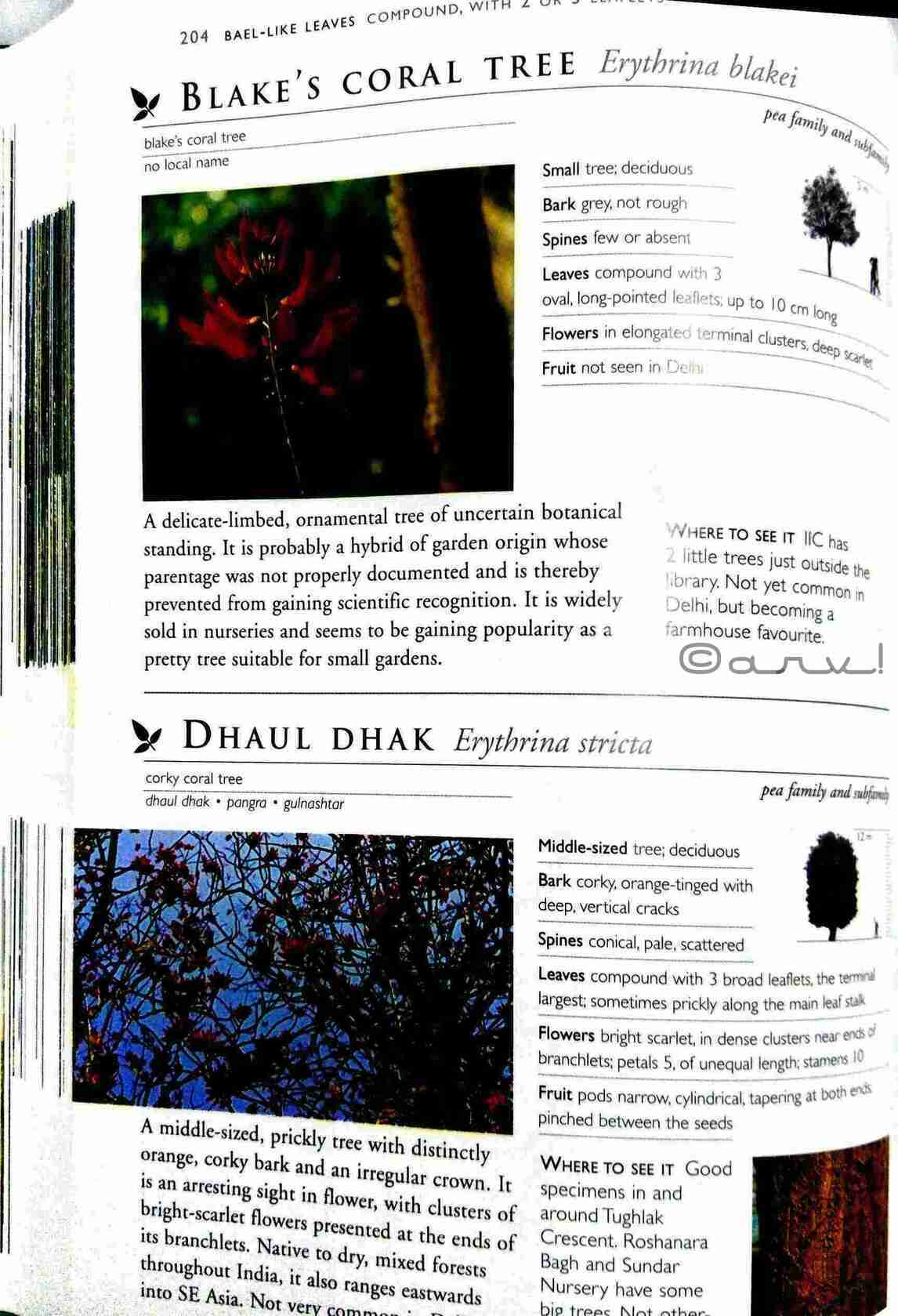
One of the chapters provides a guide on how to use this book for identifying trees. The book approaches the subject by listing the leaves in 10 broad categories. The information is extensive yet crisp. It lists the scientific name along with local names, and unique characteristics of the trees with respect to size, shape, leaves, bark, flowers, etc. along with pictures and illustrations. It has been printed to act as a field guide. And it is truly so considering that the size has been kept in such a way that one can carry it along. This is what the page from the book looks like.
One of the most interesting parts I enjoyed is the section called “Back of the book” which has a variety of information that is hard to come by. For example, one of the topics talks about the flowers of the Peepul Tree. It discusses in detail where one can find flowers in Peepul trees. Similarly, one of the topics it discusses is the medicinal uses of the Bael tree.
Why Trees of Delhi Book wins?
- Beginner Friendly Identification- Ease of use for a layman. The book ingeniously categorizes trees into 10 broad leaf types, making field identification visual.
- Crisp, Visual Data – It provides scientific names, local names, bark textures, and flower shapes, all paired with high-quality illustrations and photographs.
- Perfectly Sized – The book is printed specifically to function as a pocket-sized field guide you can carry on forest exploration.
- Fascinating Trivia- One of the book section hais a treasure trove of rare information, detailing things like exactly where to find the trees, or the traditional medicinal uses of trees.
I highly recommend buying this book if you intend to find out more about trees around you or explore your nearby garden or forests. It is totally worth your money.
Read related post: World Forestry Arboretum Jaipur
Check out other stories in the Trees of Jaipur.
Follow Jaipurthrumylens on Facebook, Twitter, Instagram
Discover more from JaipurThruMyLens
Subscribe to get the latest posts sent to your email.


Hare pad kat rahe h log
LikeLike