
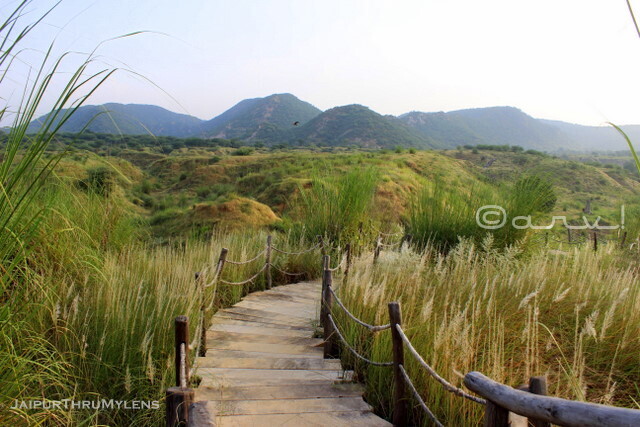
Kishan Bagh is a restored sand dune ecological park in Vidhyadhar Nagar, Jaipur, developed by naturalist Pradip Krishen and the Jaipur Development Authority (JDA). Spread across barren sand dunes at the base of Nahargarh Fort hills, it is Jaipur’s only native desert landscape park featuring Thar Desert plants, ancient rock habitats, desert birds, guided nature walks, and panoramic views of the Aravali Hills. Entry: Rs 50 (adults), Rs 25 (students). Timings: 8:30 AM – 5:30 PM (winter) / 6:30 AM – 6:30 PM (summer). Phone: +91 787 701 5189
| Kishan Bagh Jaipur – Quick Facts | Details |
| Location | Vidhyadhar Nagar, Jaipur, Rajasthan 302039 at the base of Nahargarh Fort Hills |
| Entry Fee | Rs 50 (Adults) | Rs 25 (Students with ID) | Rs 5,000 (Pre-wedding shoots) |
| Winter Timings | 8:30 AM to 5:30 PM (October to March) |
| Summer Timings | 6:30 AM to 6:30 PM (April to September) |
| Best Time to Visit | October to February | Early mornings for birds |
| Guided Walk | ~1 hour | Request at ticket counter | Ask for current fee |
| Phone | +91 787 701 5189 | +91 966 446 8477 | +91 889 077 6554 |
| Developed by | Pradip Krishen (naturalist) + Jaipur Development Authority (JDA) |
| Notable Features | Sand dunes, Roee habitat, Granite & Dhok habitats, Machaan viewing deck, pond |
| Wildlife | Green Bee-eater, Indian Robin, Grey Francolin, Peacock, Desert Fox, Nilgai |
| Last Updated | March 2026 – verify timings by calling ahead |
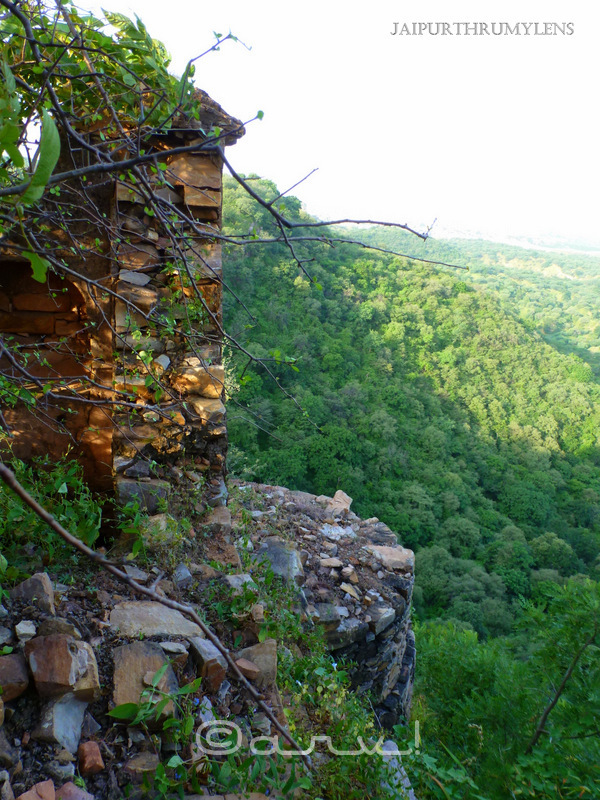
Kishan Bagh in Jaipur? Most people have never heard about this place. I initially heard about Kishan Bagh Sand Dune Park with the story of Prince Jagat Singh Of Amer and Mariam Mahal. Jagat Singh was the son of Mirza Raja Man Singh of Amer. He married Mariam, a foreigner. She resided in a palace built amidst scenic surroundings called Kishan Bagh.
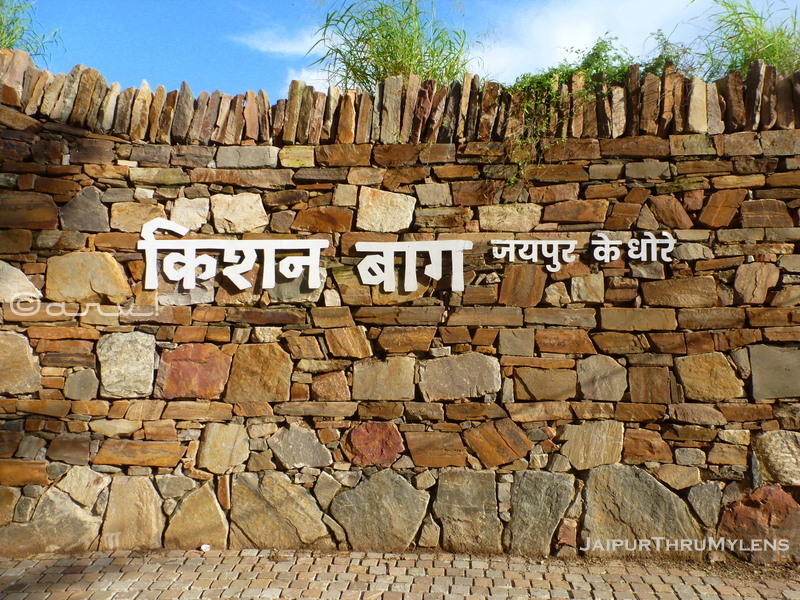
Here is a picture of the ruins of Mariam Mahal in Jaipur.
Kishan Bagh Jaipur | A Complete Guide
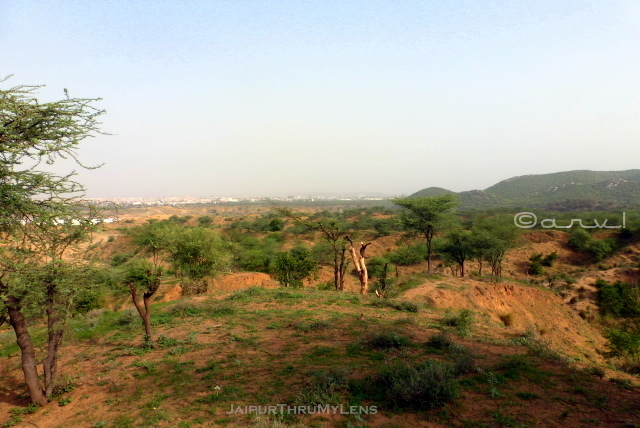
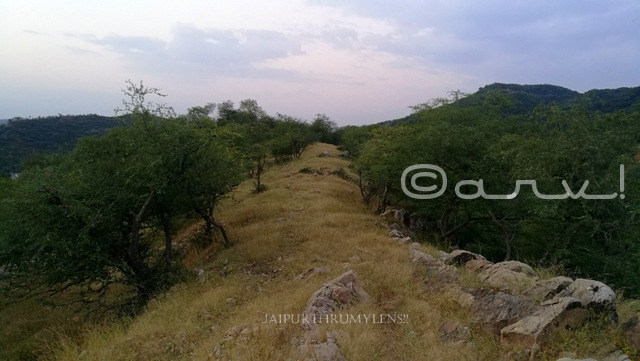
Kishan Bagh is in Vidhyadhar Nagar at the foothills of the Nahargarh Fort hill. I have traversed through Kishan Bagh dunes while hiking in Jaipur, a few times. Here is a picture from one such hike in Jaipur.
A couple of years later, I heard of the Kishan Bagh being developed by Pradip Krishen and JDA in Vidhyadhar Nagar. Pradip Krishen remains a familiar name in India when it comes to trees and the local ecology. He was instrumental in the building of Rao Jodha Desert Rock Park in Jodhpur, and he is the author of the acclaimed book, Trees of Delhi.
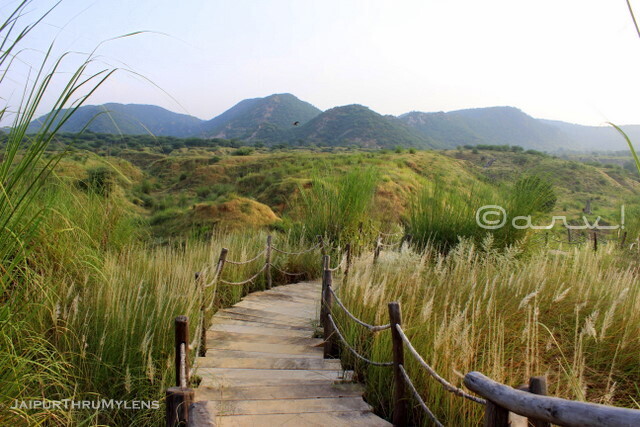
History Of Kishan Bagh | The Story so far
The history of Kishan Bagh started when in January 2016 Jaipur Development Authority(JDA) showed Pradip Krishen a vast barren land at the base of Nahargarh Hills in Vidhyadhar Nagar, Jaipur. They sought his opinion on reshaping it into a public park. JDA had already worked on this landscape, and their park project was a disaster. They had created a cactus garden in Kishan Bagh a few years before but the project failed. Having worked on Rao Jodha Rock Park in Jodhpur, Pradip Krishen thought of restoring Kishan Bagh dunes into a natural desert landscape.
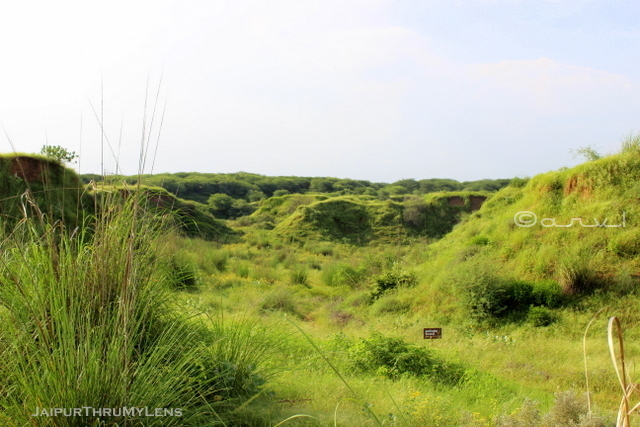
The inspiration for this idea came from his explorations into the desert landscape of western Rajasthan which is called Roee by the locals. Roee landscape is dominated by small shrubs like Seenio (सींणीओ ), Bui (बुई), and Kheemp (खीम्प).
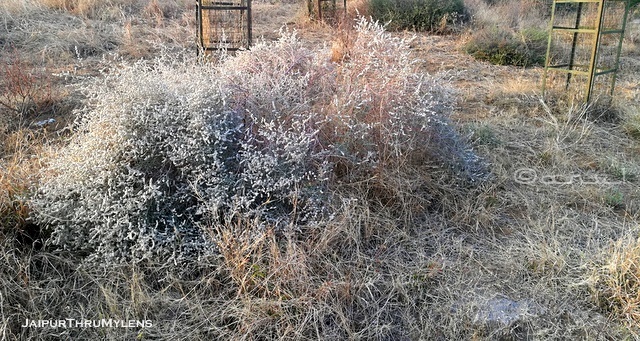
Seenio is a preferred food for Chinkara deer. This becomes dry during the dry months and when the moisture returns to the air, it becomes green again. This is very similar to the monsoon forests of Aravali Hills. Kheemp grows in and around the sand dunes and grows 7-10 feet. But, on the other hand, has white cotton-like growth and is from the Amaranthus family. One can find all this information on boards installed on either side of the walkway.
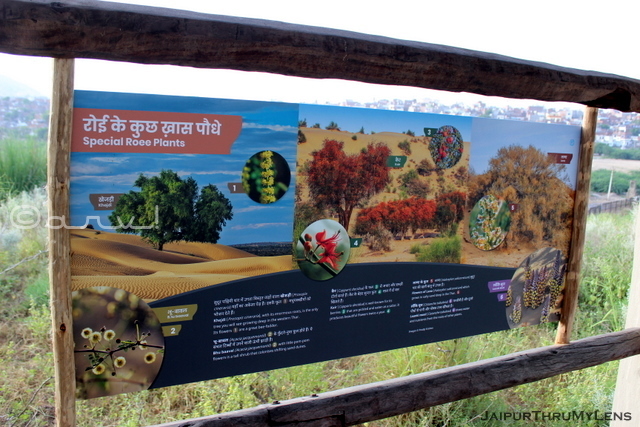
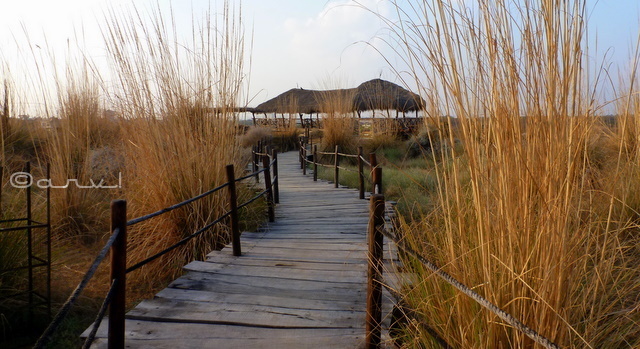
Amidst all this, one can’t ignore the Munj grass found in the semi-arid landscape. Since my ancestors hail from Western Rajasthan, I have seen locals using dried shrubs in villages for lighting a fire stove – Seenio/सींणीओ. There is more to the flora of western Rajasthan than the ones listed above. There are trees like Khejri, Rohida, Kumatiyo, Akada, and Dhatura to name a few. Some of these have made it here; each contributes in their own way to the ecosystem in the desert
What makes Kishan Bagh Sand Dune Park Unique?
From the outset, Kishan Bagh Sand Dune Park is impressive. It is fascinating to note how unutilized barren sand dunes can be transformed into such a magnificent place. The park uses natural materials & resources found here in Rajasthan.
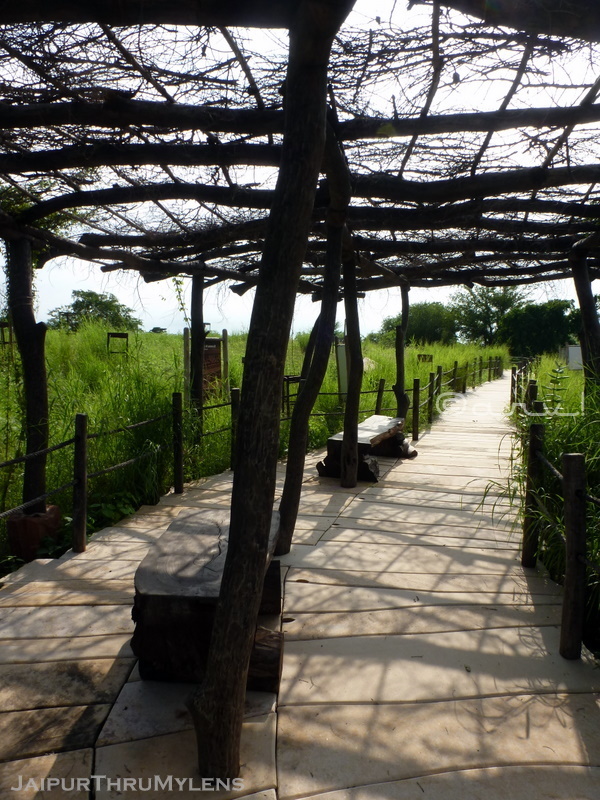
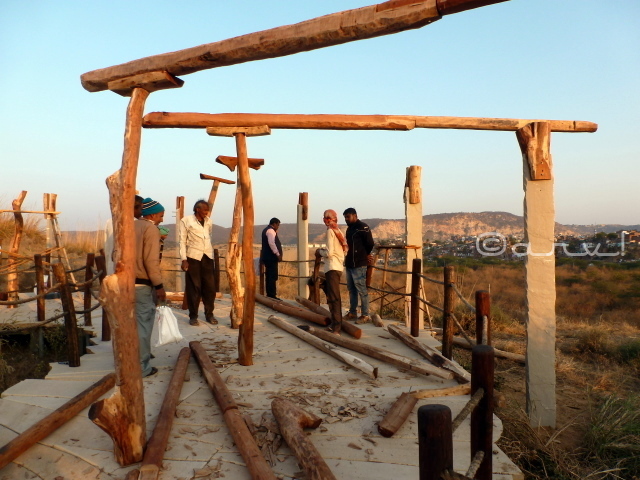
We have many parks in our cities like Central Park with decorative trees and plants devoid of indigenous ones. Pradip Krishen has invariably been an advocator of local trees and plants. Indigenous trees support local fauna. They are much more hardy as they are best suited for local climatic conditions. Each and every part of indigenous trees find use in one or another way.
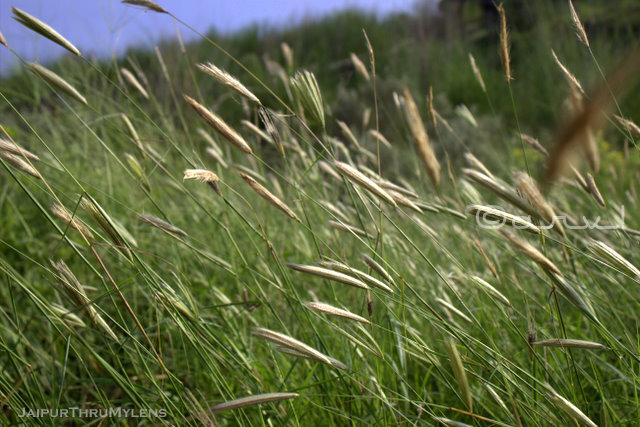
The experience has proved that imported tree variants have caused havoc to the local ecology. We have an example of Vilayati Babool which provides no perceivable benefits and remains an invasive species. Prosopis Juliflora, its scientific name is also called Vilayati Keekar in Hindi. It is hard to uproot this tree because it regenerates from the slightest trace of roots. Initially from South America, it has caused immense problems because there is no natural way to check its growth. It was introduced in India by the Britishers during the late 19th century under colonial rule. Then between the 1920s and 40s, it was planted in huge numbers in many areas, especially in Rajasthan. Here is a picture of Vilayati Keekar planted by the forest department in Aravali Hills in Jaipur.
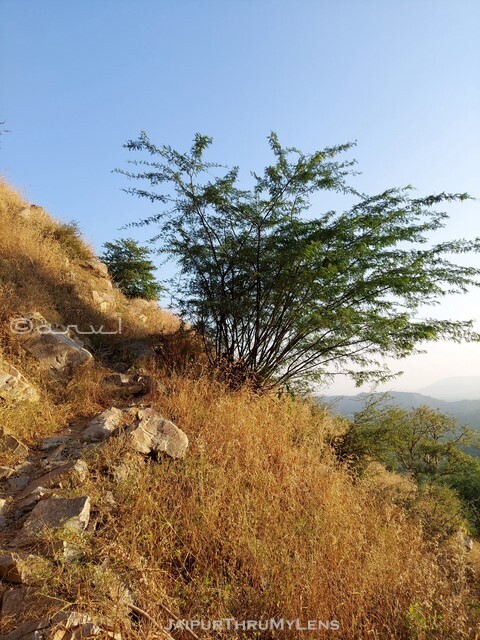
Similarly, the Eucalyptus plantation promoted by the Forest department in the 1970s & 80s was a disaster. Originally, from Australia, its ill effects were visible within a few years. The farmers & environmentalists protested that this tree made soil infertile and required an enormous quantity of water. Kishan Bagh is a step in the right direction. It celebrates the gift of nature -the local ecology.
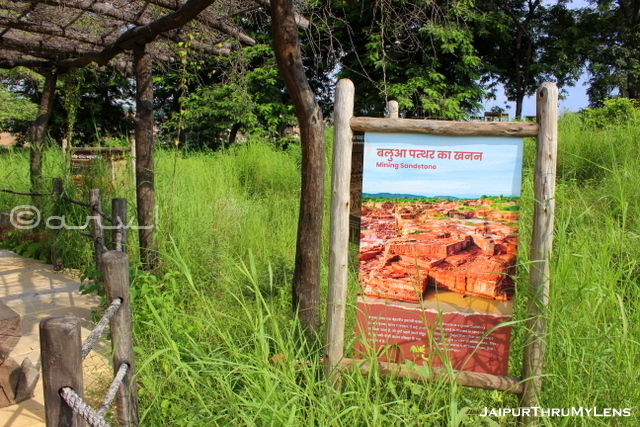
Kishan Bagh provides a breath of fresh air because it still preserves its native form, unlike most parks that change the topography entirely with landscaping. Instead of Gulmohars, one will only see Dhok trees and Sarkanda or Munj grass in its natural glory.
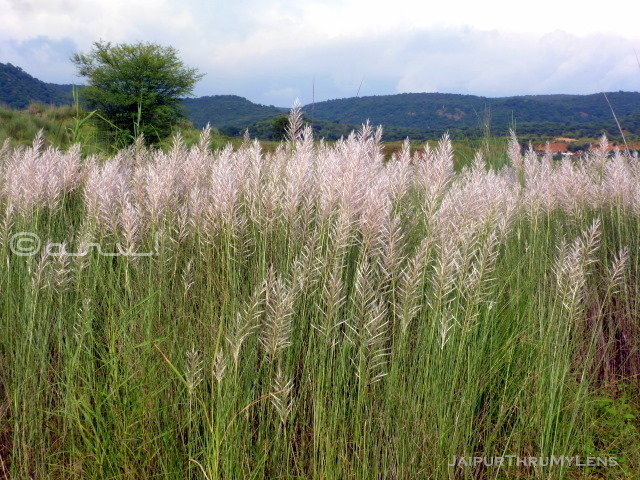
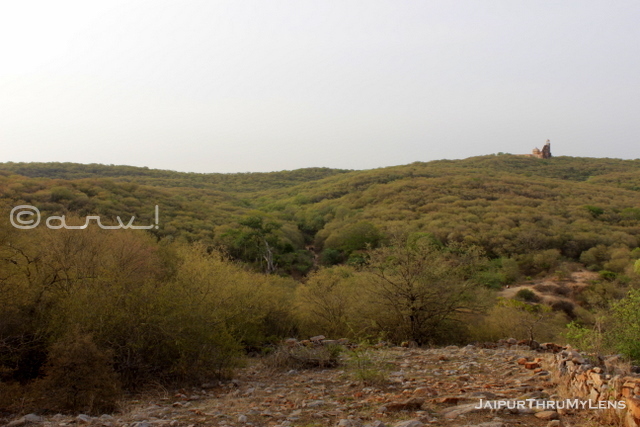
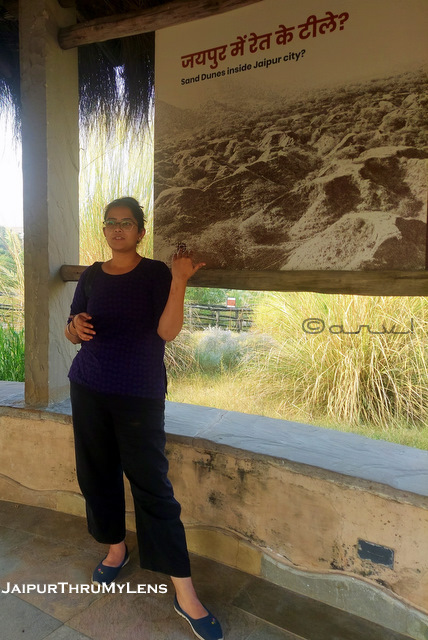
Jaipur is technically not a desert, and it is considered a semi-arid region. In the past, it was effortless to spot sandy areas near the city. Owing to the growing urbanization, all that has changed. Many travel accounts from the mid-1800s to early 1900s of travelers mention huge sandy areas at the foothills of Galta Hills and Nahargarh Fort Hills. One can still see a bit of the latter but not the former. Here is a picture of the sand dunes at the base of Nahargarh Fort.
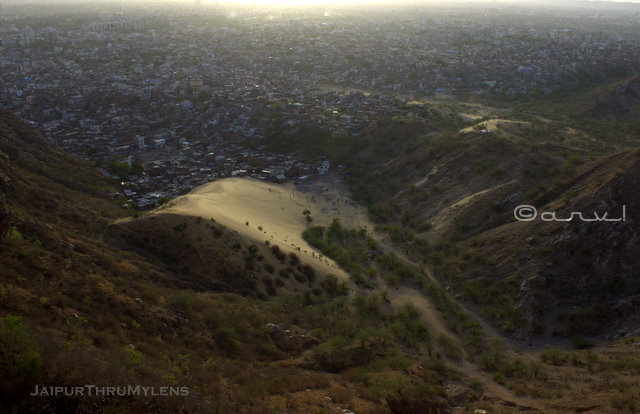
Kishan Bagh sand dunes from one of my previous hikes in this area at the base of Nahargarh Hills.
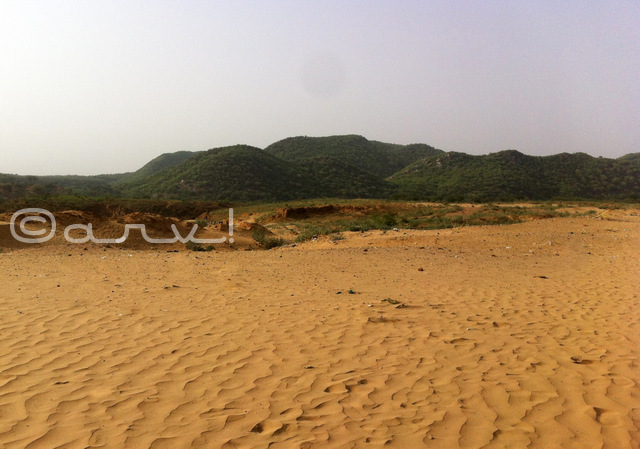
The Kishan Bagh sand dunes slowly turned into ravine-like structures resembling the ones found in the Chambal River. The Chambal region in the Dholpur & Morena has a similar ravine landscape. The wind and water created channels & ravines. The current project aims at preserving ravines and avoiding any further damage.
The Layout of Kishan Bagh Sand Dunes Jaipur
Kishan Bagh has recreated micro-habitats of desert land. Among the numerous things, one can spot fossil rocks, sandstones, quartz rock, Munj grass, and Kheemp thatched roof. Recreating this space is a laborious process & taken a few years.
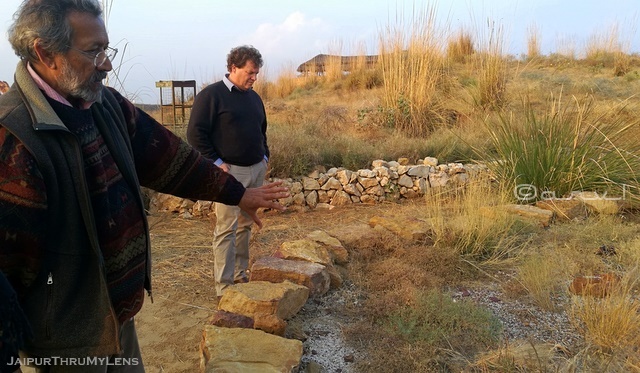
During my first visit during its making, Pradip Krishen explained there has been a long learning curve behind the current landscape. At times, the solutions were improvised to suit the requirements.
Some island zones explain the habitats of desert topography. Here are some of those:
- Granite Habitat
The granite landscape is part of the Aravali Hills. Granite is a rock formed due to the cooling of magma from a volcanic eruption. In that respect, this rock is millions of years old. Aravali Hill range is much older than the Himalayas and runs South to North from Gujarat to Delhi.
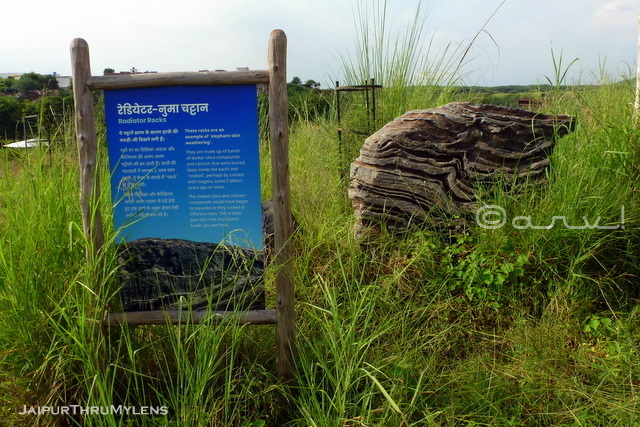
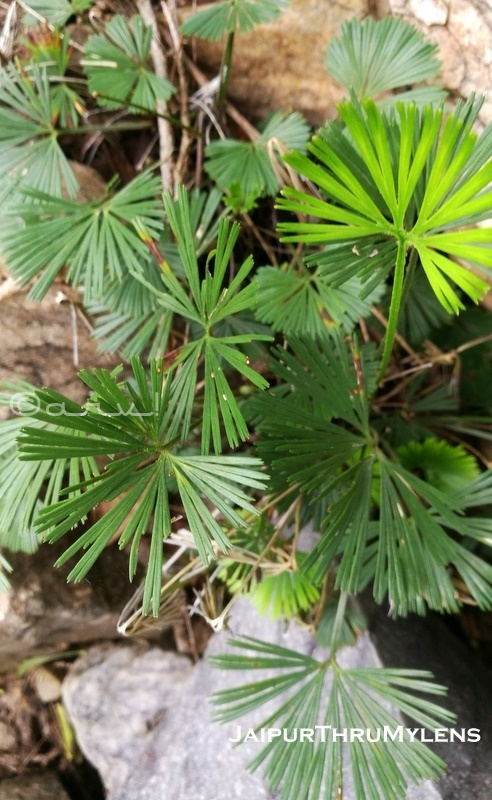
Many plants like Chasmophytes grow in the crevices of these rocks. These are strong plants that have learned to grow with little resources – tight space and very little soil. Here is a picture of one such Chasmophyte from my hikes in Nahargarh Hills.
- Dhok Habitat
The Dhok tree also known as Anogeissus Pendula Tree is a resident tree of the Aravali Hill around Jaipur. These hardy trees are one of the few that survive in the harsh conditions of the Aravali Hills. They can adapt well to the steep slopes and lack of water. Dhok is part of the monsoon forest. Dhok trees are usually interconnected through underground roots.
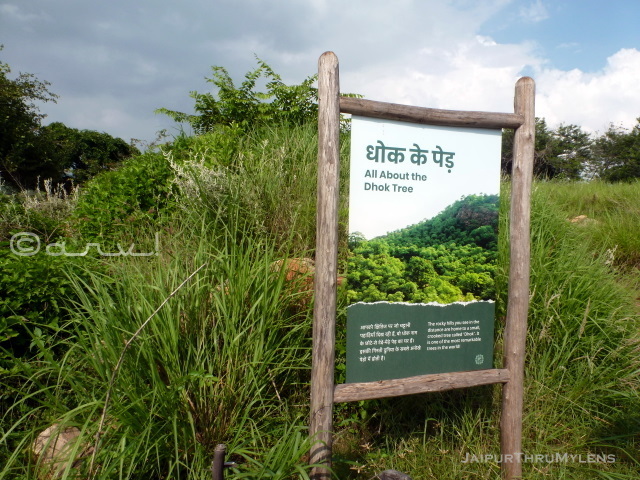
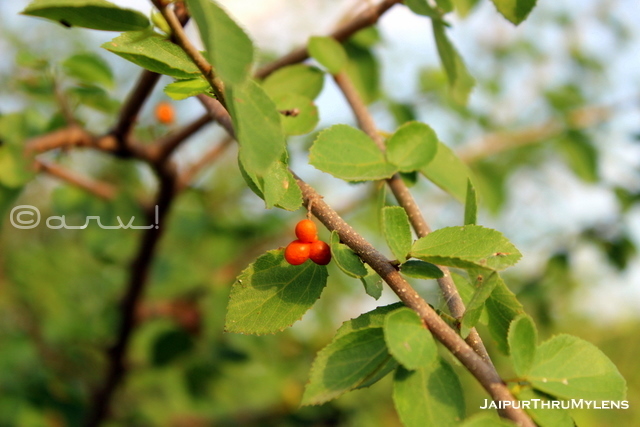
Here is a picture of the Dhok tree that one finds in abundance on the hills of Nahargarh Fort.
I’m happy to see the Dhok tree in Kishan Bagh because this is the most common tree I see in the hills near Jaipur. It is like an instant connection.
If you haven’t read this in-depth post on the Dhok tree, check it out – Anogeissus Pendula tree The resident tree of Aravali Hills
- Desert Rocks
This habitat is spread around the start of the boardwalk that takes visitors to the farthest end of the Kishan Bagh eco-park. It contains a variety of rocks from the Aravali hills. Out of these sandstones are one of the most prominent stones.
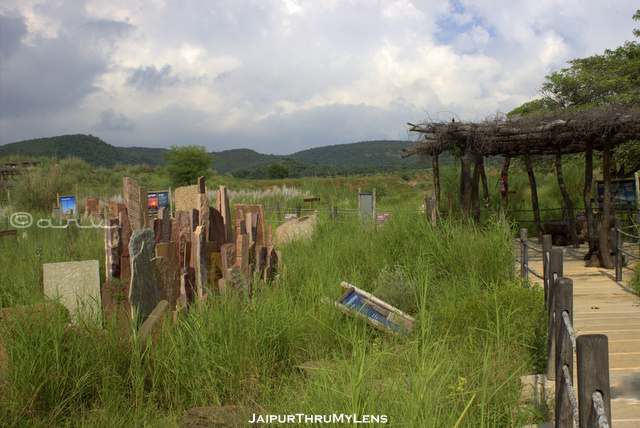
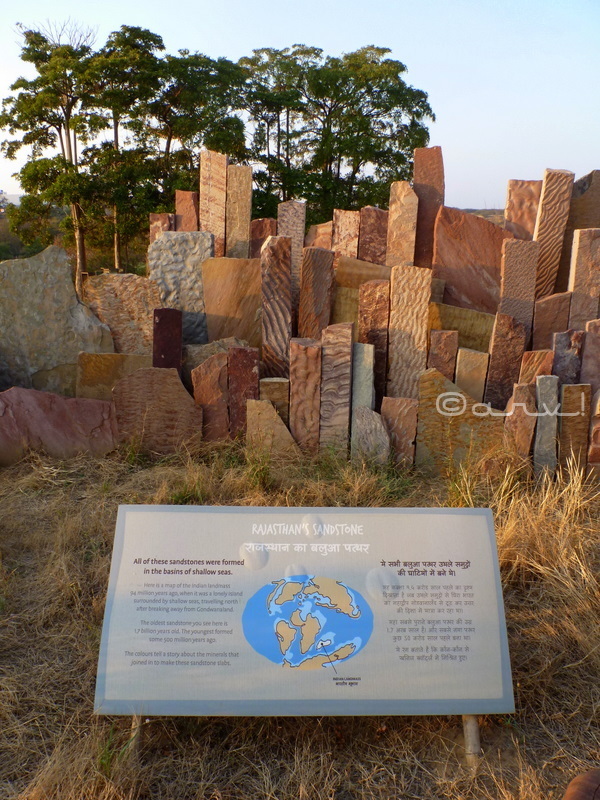
Sandstones from Rajasthan are popular all across the world. The most popular sandstones from Rajasthan can be found in Dholpur and Karauli. One of the most sought-after sandstone is the newly founded Bidaser. An installation replicating the high-rise buildings celebrates the sandstones of Rajasthan. Other notable stones are Quartzite and Rhyolite. The Aravali hills near Jaipur have rocks containing quartz.
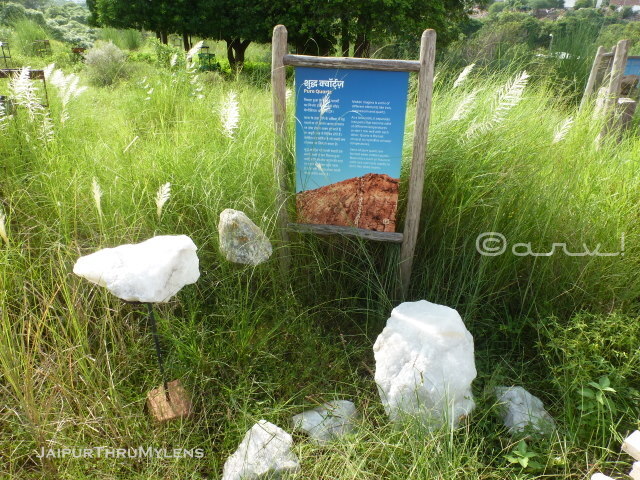
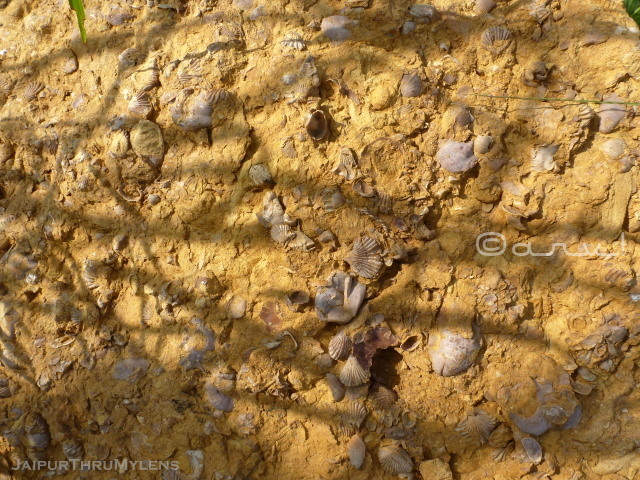
One of the least known stones from Rajasthan is Stromatolite from Udaipur which is a fossil-bearing rock. Here is a picture of a fossil-bearing rock sample from Kishan Bagh.
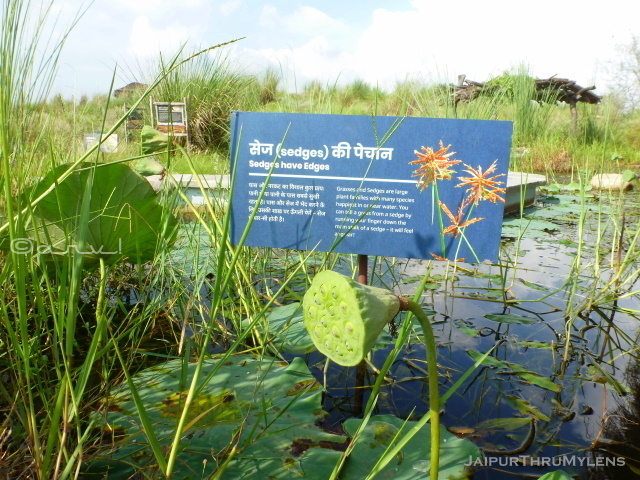
- Roee & other micro-Habitats
This habitat recreates the ideal conditions for various shrubs and plants to grow. One of the most important of which is the soil. To recreate this zone, the top layer of soil from western Rajasthan was sourced.
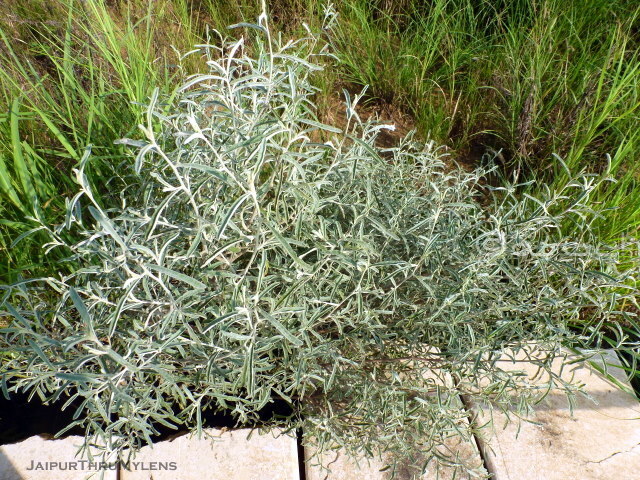
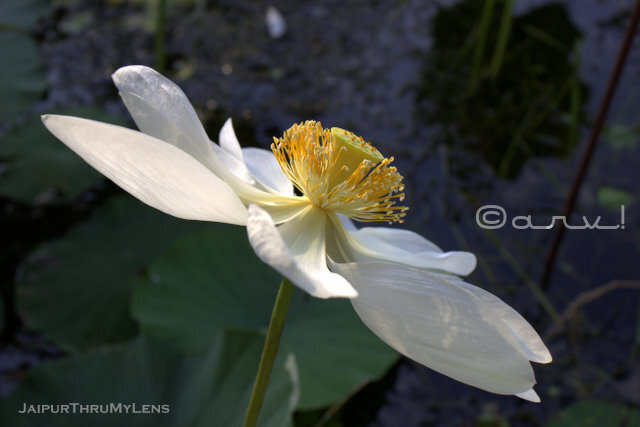
Kishan Bagh also has some special habitats found in the desert landscape. Here are a few pictures of the same.
- Viewing Deck
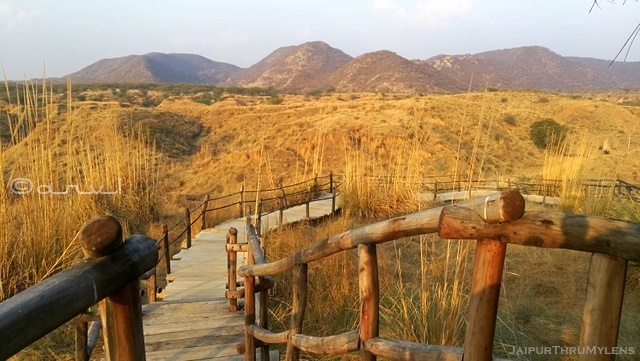
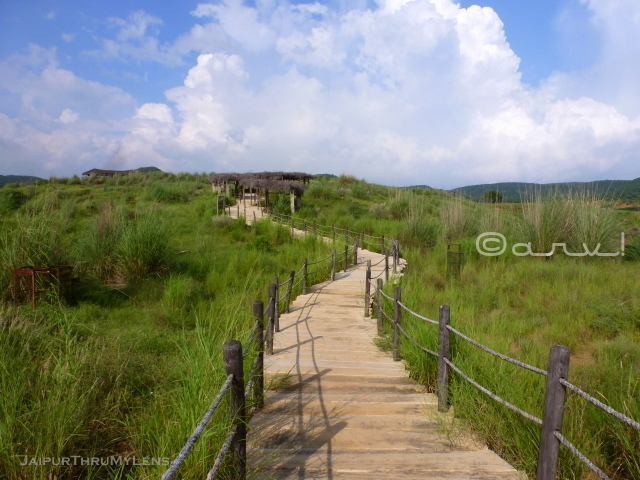
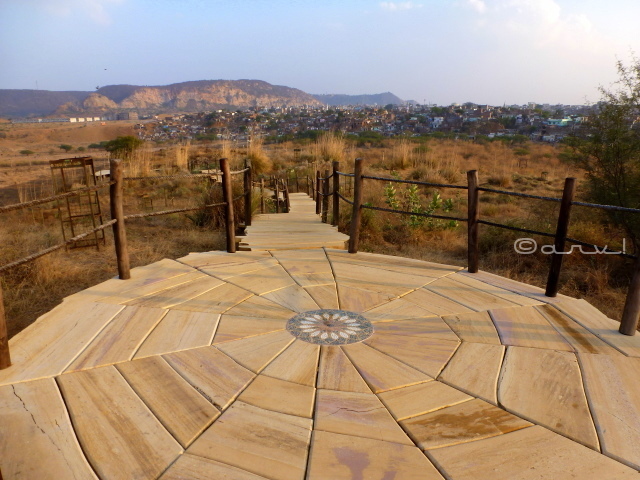
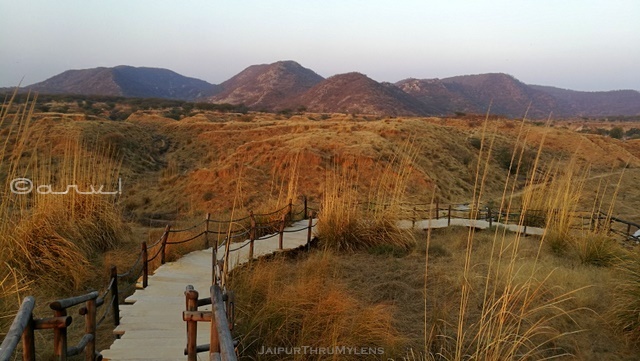
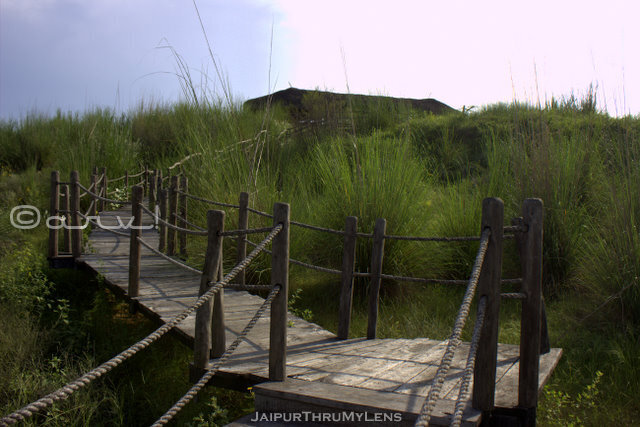
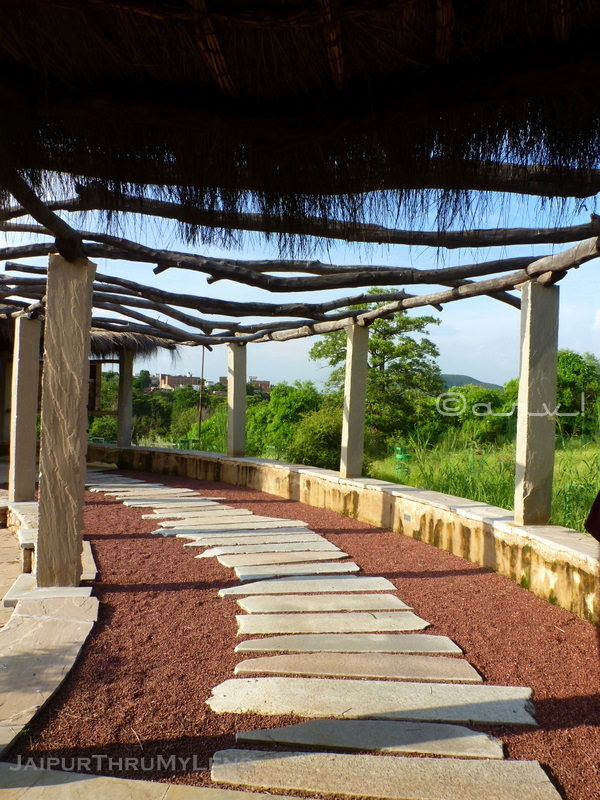
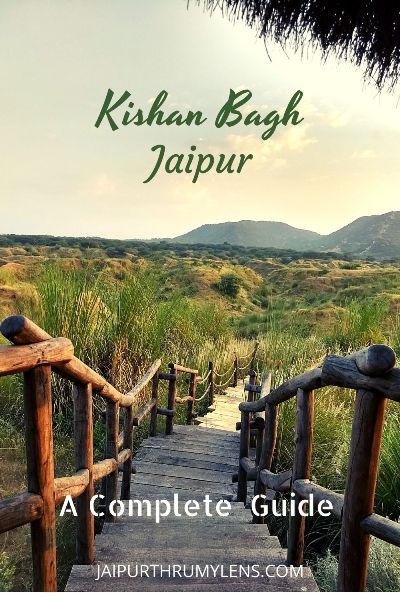
The boardwalk made from Jaisalmer stone snakes through the park and leads one to the viewing deck – The Longhouse or Machaan. There is another viewpoint called Maidan Lookout. Here is a picture of the path that leads to Maidan Lookout.
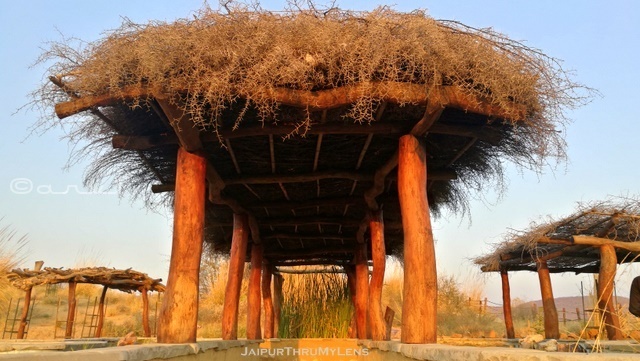
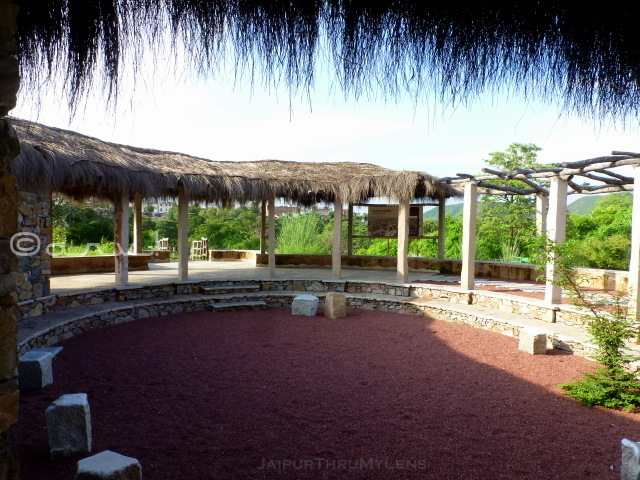
The viewing deck of this ecological park is where every nature lover would love to be. It gives a panoramic view of the entire area including the western slopes of Nahargarh Hills. Here are a few pictures of the Machaan.
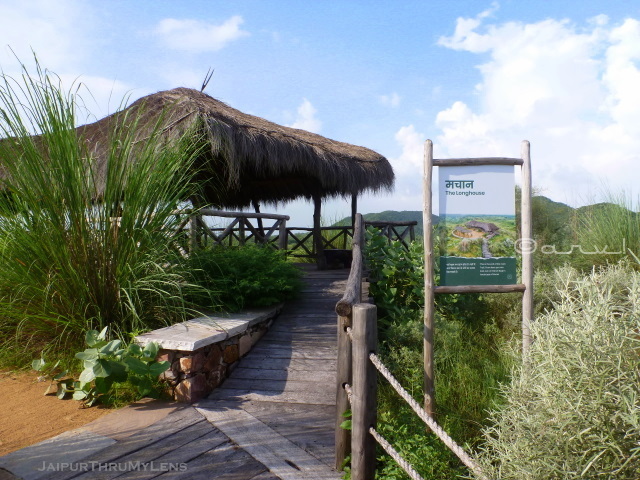
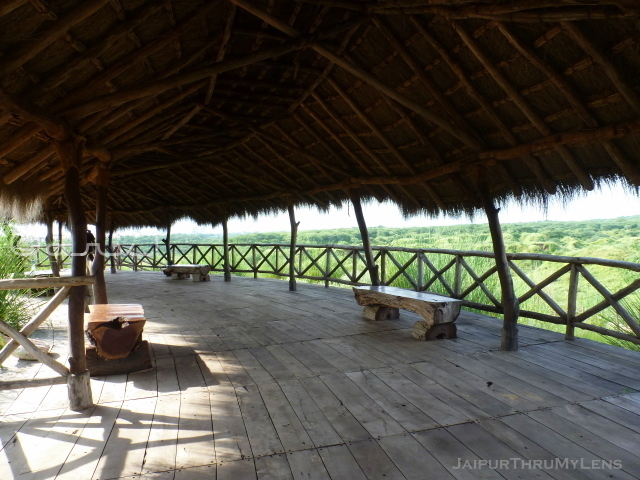
It reminds me of the African Safari resorts and this deck seems to be a fusion with the rural huts of Rajasthan. An elongated structure like this is hard to find in Rajasthan as most huts using Kheemp are tiny. One can then choose to descend to a small pond and get lost in the wilderness around.
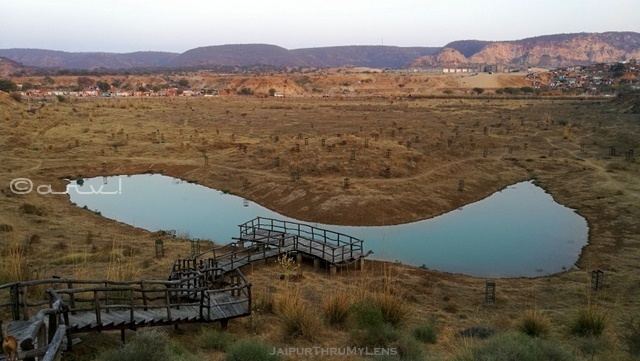
It was a naturally occurring water body but has been reshaped during the making of the park. It is an oasis for nature lovers.
- Wildlife and Birds at Kishan Bagh
Kishan Bagh’s ecology supports many birds, insects, and animals. Some of them are Grey Francolin (Teetar), Indian Roller, Myna, Indian Robin, Bee Eater, Peacock, Desert Fox, and Neelgai to name a few. List of wildlife and fauna at Kishan Bagh Jaipur.
| Category | Common Name | Scientific Name | Local/Hindi Name |
| Bird | Grey Francolin | Francolinus pondicerianus | Teetar / तीतर |
| Bird | Indian Roller | Coracias benghalensis | Neelkanth |
| Bird | Green Bee-eater | Merops orientalis | Patrinaga |
| Bird | Indian Robin | Copsychus fulicatus | Kali Chidiya |
| Bird | Common Myna | Acridotheres tristis | Shalik / मैना |
| Bird | Peacock | Pavo cristatus | Mor / मोर |
| Mammal | Nilgai (Blue Bull) | Boselaphus tragocamelus | Neelgai / नीलगाय |
| Mammal | Desert Fox | Vulpes vulpes pusilla | Lomdi / लोमड़ी |
| Plant | Kheemp | Leptadenia pyrotechnica | खीम्प |
| Plant | Bui / Safed Wool Plant | Aerva javanica | बुई |
| Plant | Seenio (Camel thorn) | Alhagi maurorum | सींणीओ |
| Grass | Munj / Sarkanda grass | Saccharum munja | मूंज / सरकंडा |
| Tree | Dhok / Button Tree | Anogeissus pendula | धोक |
| Tree | Khejri | Prosopis cineraria | खेजड़ी |
Here are a few pictures.
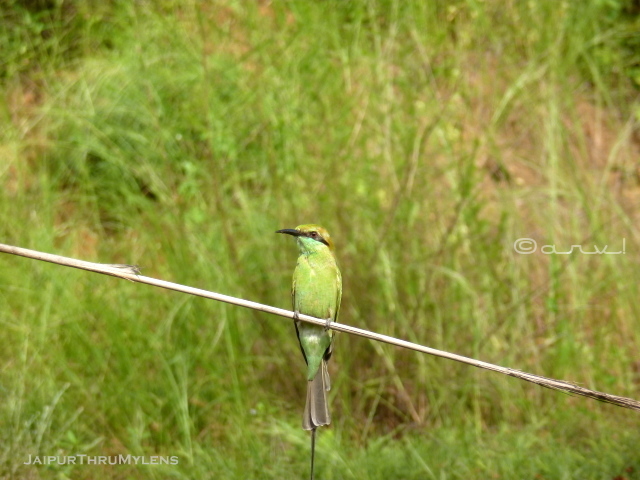
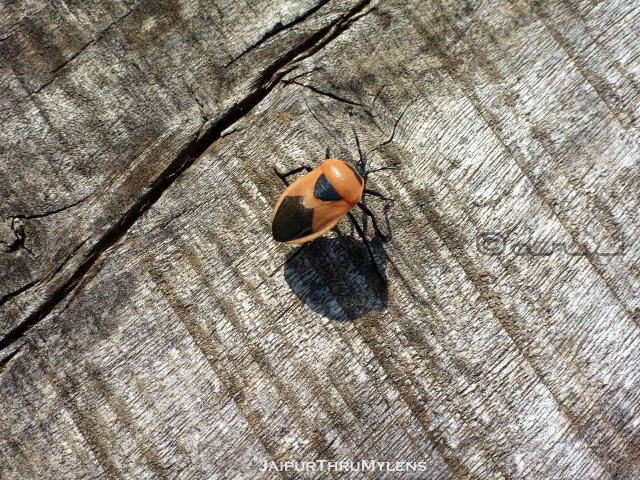
Visiting Kishan Bagh is like reconnecting with nature and taking time off to unwind. Not many places in Jaipur are so peaceful. I definitely recommend a visit to Kishan Bagh in Jaipur, at least once.
Frequently Asked Questions
Is Kishan Bagh open today?
Kishan Bagh is open every day of the week. Winter timings (October to March) are 8:30 AM to 5:30 PM, and summer timings (April to September) are 6:30 AM to 6:30 PM. Call +91 787 701 5189 to confirm on public holidays.
Is photography allowed at Kishan Bagh?
Yes, regular photography for personal use is allowed with the standard entry ticket. A separate fee of Rs 5,000 is charged for pre-wedding and professional photoshoots. Tripods and DSLRs are generally permitted — confirm at the ticket counter.
How to reach Kishan Bagh Jaipur?
Kishan Bagh is located in Vidhyadhar Nagar at the base of Nahargarh Fort hills. It is approximately 8 km from Jaipur Railway Station and 10 km from Sindhi Camp bus stand. The nearest landmark is the Vidhyadhar Nagar police chowki. Autos and cabs are easily available from any part of Jaipur.
What is the best time to visit Kishan Bagh Jaipur?
The best months to visit Kishan Bagh are October to February when the weather is pleasant. Early morning visits (within 1 hour of opening) offer the best birdwatching opportunities and golden light for photography. The monsoon season (July–September) turns the dunes green and the park comes alive with insects and wildlife, making it equally rewarding.
What birds and animals can I see at Kishan Bagh?
Kishan Bagh is home to Grey Francolin (Teetar), Indian Roller, Common Myna, Indian Robin, Green Bee-eater, Peacock, and various desert insects. Lucky visitors may also spot Desert Fox and Nilgai (Neelgai). The best time for birdwatching is early morning.
Is a guided walk available at Kishan Bagh?
Yes, Kishan Bagh offers guided nature walks with trained naturalists. The walk lasts approximately one hour and covers the park’s flora, habitats, geology, and ecology. Request a guided walk at the ticket counter when you arrive. It is highly recommended for first-time visitors.
Can I bring food and water to Kishan Bagh?
Bringing your own water bottle is strongly recommended as the park has limited food or beverage facilities. Single-use plastic is discouraged inside the park. There are no restaurants within the park premises; nearby eateries can be found in the Vidhyadhar Nagar market.
Who built Kishan Bagh eco park in Jaipur?
Kishan Bagh was developed jointly by the Jaipur Development Authority (JDA) and eminent naturalist-filmmaker Pradip Krishen, author of Trees of Delhi. Pradip Krishen, who also created Rao Jodha Desert Rock Park in Jodhpur, transformed barren sand dunes into a functioning desert ecosystem starting in 2016.
What is Kishan Bagh Entry Charges?
The Kishan Bagh entry charge is Rs 50 per person. The Kishan Bagh entry charge for a student is Rs 25. To avail discounted student ticket, a valid student ID card is necessary.
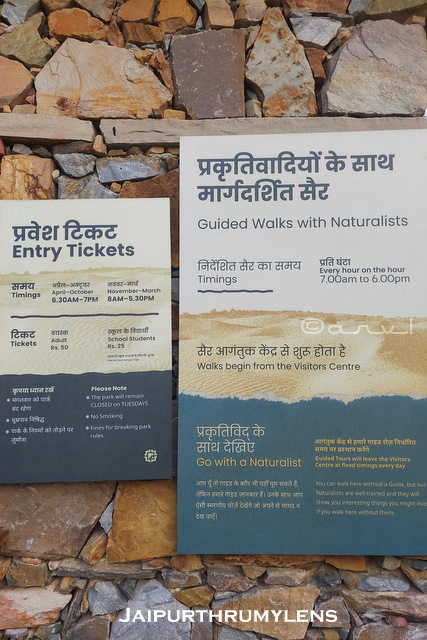
How to reach Kishan Bagh Sand Dunes Jaipur?
Kishan Bagh is located in Vidhyadhar Nagar, at the base of the Nahargarh Fort hills in northern Jaipur. It requires significant time to reach here from most of tourist attractions in Jaipur. Here is how to reach it:
| From | Distance / Time | Recommended Mode |
| Jaipur Railway Station | 8 km / 20-25 min | Auto, cab, or Ola/Uber |
| Sindhi Camp Bus Stand | 10 km / 25-30 min | Auto, cab, or Ola/Uber |
| Jaipur Old City | 6 km / 25-40 min | Auto, cab, or Ola/Uber |
What are Pre-wedding photoshoot charges in Kishan Bagh?
Rs 5000 is charged for a pre-wedding photoshoot in Kishan Bagh. It is no surprise why so many young couples prefer to get photoshoots in Kishan Bagh.
What are things to know about Guided Walk With Naturalist?
Kishan Bagh Sand Dune Park offers a guided walk with naturalists who are keen to share all that the park has to offer. The duration of the walk with the naturalist is around one hour. The request for the Kishan Bagh guided walk can be made at the ticket counter. I highly recommend this walk.
What are Kishan Bagh Phone Number?
Kishan Bagh Jaipur’s contact numbers are +91 787 701 5189 / +91 966 446 8477/ +91 889 077 6554
Discover more from JaipurThruMyLens
Subscribe to get the latest posts sent to your email.
 JaipurThruMyLens
Great stuff! Not carried by any other travel site probably.
LikeLiked by 1 person
Thanks. Hope you get to visit it someday!
LikeLike
can we collect plant samples from here for study??
LikeLiked by 1 person
They do have a nursery. You can contact them
LikeLike