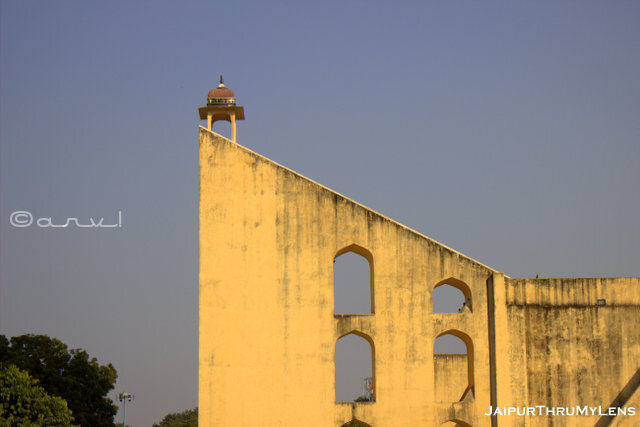
Among one of the most unique and interesting tourist attractions in Jaipur, I always recommend travelers to visit Jantar Mantar in Jaipur travel guide blogs. I’m not sure if it interests everyone but for sure it is a fascinating place one can visit. It is hard to imagine that almost 300 years ago, the founder of Jaipur Maharaja Sawai Jai Singh II created precise and accurate instruments to calculate time, position of celestial bodies, to name a few.
Why do I recommend visiting Jantar Mantar in Jaipur?
Jantar Mantar is one of the most visually compelling monuments in Indian architectural history and records. The Jaipur solar observatory breaks from the traditional architectural language of Indian temples, palaces, and other building structures of its time. Before Sawai Jai Singh II built the solar observatories in India, astronomers relied on small hand-held instruments. Jaipur observatory is the largest, most perfect, with the greatest degree of precision and best preserved among these five. The Rashivalaya Yantra is found nowhere else except here.
Solar observatories built by Sawai Jai Singh II in other Indian cities have ceased to exist or are in a dilapidated condition. In that respect, Jaipur is the best opportunity to experience the advancement and precision in astronomical observation and knowledge at the start of the 18th century. This is a reason for me to recommend Jantar Mantar.
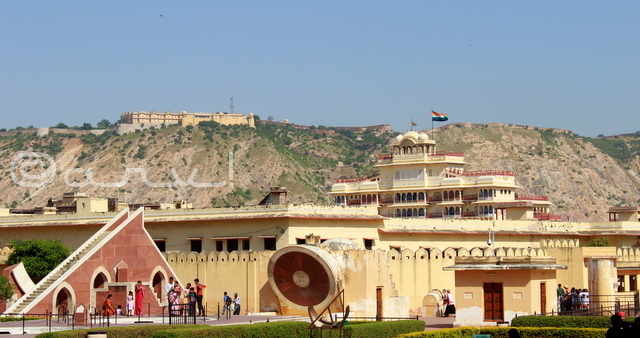
- A Guide to Jaipur Observatory | Jantar Mantar
A Guide to Jaipur Observatory | Jantar Mantar
Jaipur boasts a few UNESCO World Heritage sites in its feathers. Among the list are Jaipur’s walled city, Amer Fort, under the category of Hill forts of Rajasthan, and Jantar Mantar. It is one of the most unique and one of a kind solar observatories in the world. After reading this blog, you can conclude if Jantar Mantar is worth visiting.
What is Jantar Mantar?
Jantar Mantar is a celestial observatory in Jaipur constructed in the early 18th century. The astronomical observatory consists of large geometric devices for measuring time, tracking constellations and observing orbits around the sun. The solar observatory complex comprises 18 instruments. These were designed to observe and track celestial phenomena with a very high accuracy. If you are wondering what is meaning of Jantar-Mantar, Jantar means instruments and Mantar means calculations.
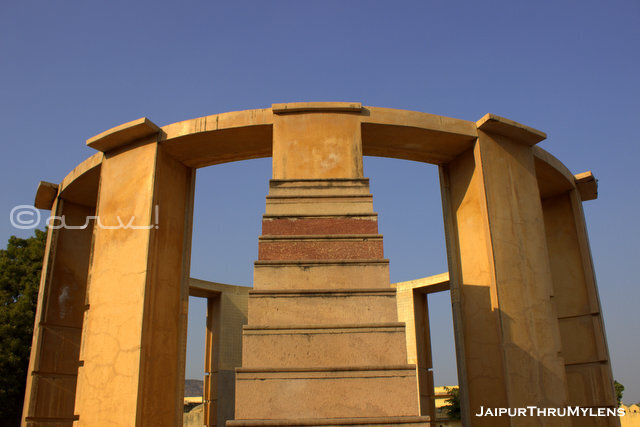
The Jaipur observatory is a remarkable achievement showcasing Maharaja Sawai Jai Singh II’s astronomical knowledge and skill. It reflects the astronomical understanding and beliefs of the late Mughal era. It also symbolizes the interest & authority of Maharaja Sawai Jai Singh II over astronomy. The imposing scale, precision, and predictive capabilities depict its significance. Jantar Mantar is a convergence of political, scientific, and religious elements and had a profound impact on society. Jantar Mantar was accorded the status of UNESCO World Heritage Site on 31st July 2010.
History
Most people are amazed to see a solar observatory. They are curious to know the history of Jantar Mantar. Jantar Mantar observatory, built by Maharaja Sawai Jai Singh II, was a focal point of the new capital, Jaipur. He built Jaipur, underlining the link between scientific capacities, urban planning and social control. Construction of the Jaipur observatory commenced in the 1720s and concluded around 1734, although some historians suggest completion in 1738. The observatory was actively used during the reign of Sawai Jai Singh II. Some historians claim the presence of 20 permanent astronomers at Jaipur observatory during this period. After his death, the observatory ceased to function on a regular basis. There were periods when it was closed due to low activity, interest, or abandonment.

Sawai Jai Singh II & Jaipur Observatory
Maharaja Sawai Jai Singh II (1688-1743), the founder of Jaipur, built five solar observatories in India for observing the positions of celestial objects above the horizon.
- Delhi (1724)
- Jaipur (1728)
- Ujjain (1734)
- Benaras (1737)
- Mathura (1738)
Mughal Emperor Muhammad Shah especially appointed Sawai Jai Singh II to reform the calendar and to correct the astronomical tables. After 7 year’s hard work, Sawai Jai Singh completed his tables in 1723. They were known as “Zil-i- Muhammad Shahi”.
Here is a picture of the statue of Sawai Jai Singh II at Statue Circle Jaipur. Do note how his love of astronomy and Jantar Mantar has been incorporated. Read: An evening at Statue Circle

What makes Jantar Mantar unique?
Constructed primarily from brick rubble and plaster, a select few solar instruments at Jantar Mantar were crafted from bronze. Intended for naked-eye astronomical observations, their monumental proportions allowed for remarkable accuracy. For its time, this solar observatory was advanced and accurate.

Solar Instruments at Jantar Mantar
These are some of the prominent Yantra at Jantar Mantar Jaipur. A brief information is provided about how instruments at Jantar Mantar work and the science behind it.
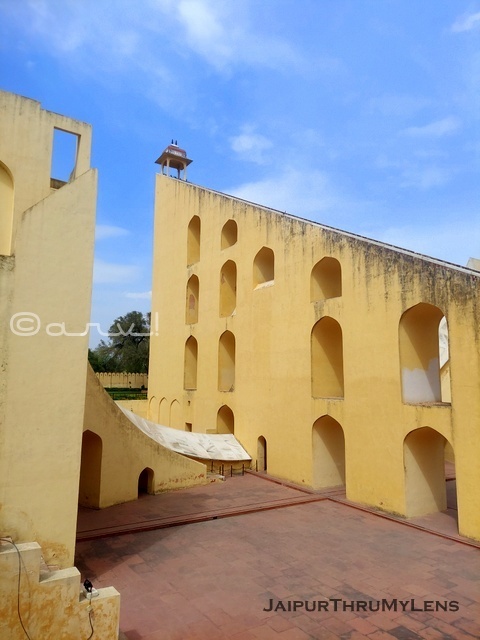
Vrihat Samrat Yantra
Vrihad Samrat Yantra is identical in theory and function to the Laghu samrat Yantra but this instrument helps to calculate local time up to two seconds precision, meridian pass time, zenith distance, declination and celestial latitude & longitude of the heavenly bodies by the shadow of the gnomon. The calculations can be made during night time also with the help of a thread. On Guru Purnima, astrologers study the movement and direction of the wind to forecast the upcoming weather and monsoon conditions.
Nadivalaya Yantra
This is an equatorial sundial to measure the local solar time at the latitude of Jaipur and position of Sun. The instrument is divided into two parts – Northern hemisphere (22st March-22rd Sept.- summer solstice) & Southern hemisphere (24th Sept.- 20th March-winter solstice). The instrument is composed of a slender, rod-shaped gnomon fixed at a right angle to the equatorial dial. The gnomon is aligned to point directly towards the celestial pole, either north or south
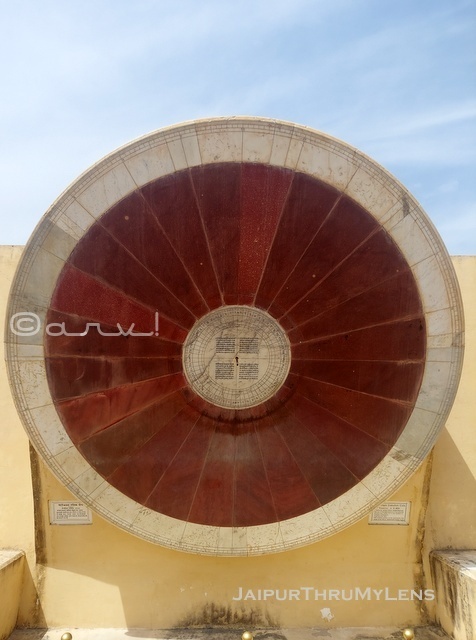
Yantra Raj
This is also known as the great astrolabe. This instrument is virtually a celestial map neatly engraved on a huge seven alloy metal disc of about 2 meter diameter. The hole at the center is Pole Star. We can calculate the position of various constellations at different intervals, speed of rotation of a particular planet, dates of Sun and Moon eclipses, Sunset & Sunrise timings with this instrument.
Laghu Samrat Yantra
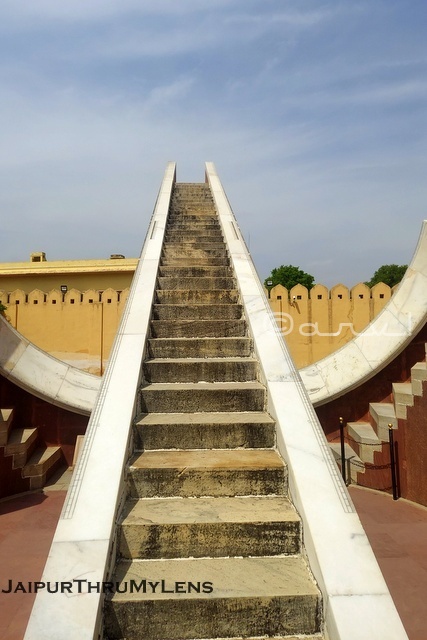
This is also known as sundial. This is seen as a triangle based in the plane of local meridian and a quadrant on either side, which are inclined by 27° in the plane of celestial equator, equivalent to the geographical latitude of Jaipur on the earth. The quadrants are graduated in the time scale of hours, minutes and seconds, 6 to 12 O’ clock towards west and 12 to 6 O’ clock towards east. With this instrument, we can measure the local time of Jaipur up to 20 seconds precision. The difference between local time and Indian Standard Time or IST varies from 10.25 to 41.06 minutes. The difference in time is added to the local time to find IST. We can find the declination of the Sun also through this instrument.
Krantivritta Yantra
It is also known as ecliptic instrument. It rotates on a masonry base. The stone circle or Nari circle is graduated in 60 Ghattikas and two metal frames are graduated in 360°, 12 Zodiac signs with their degrees are also inscribed on the metal frame. Ghattika is a Sanskrit term referring to the division of time. A metal sighting bar is fixed in the hole at the center for measuring celestial latitude & longitude in the sky. This instrument can be used at any time of day and night.
Yantra Raj
This is also known as the great astrolabe. This instrument is virtually a celestial map neatly engraved on a huge seven alloy metal disc of about 2 meter diameter. The hole at the center is Pole Star. We can calculate the position of various constellations at different intervals, speed of rotation of a particular planet, dates of Sun and Moon eclipses, Sunset & Sunrise timings with this instrument.
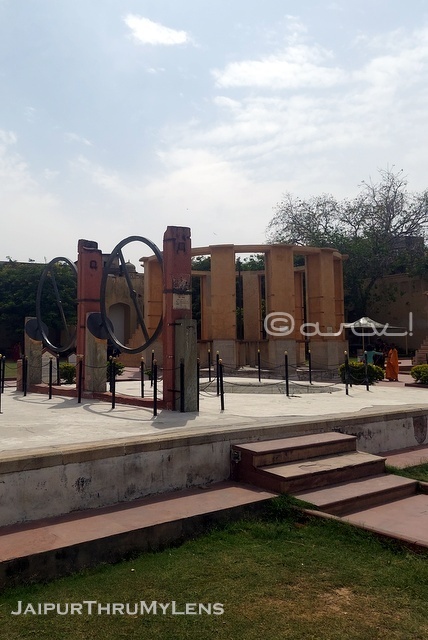
Unnatamsha Yantra
It is a big metal circle of about 5 meters diameter hanging in vertical plane on a massive masonry support. The circle has two cross beams, one vertical and the other horizontal. At the center of the beam, there is a hole for mounting a sighting tube. The entire circle of four equal segments of 90° each, and is thus graduated in 360°, each of 10 parts. This instrument is used to find the celestial altitude of heavenly bodies at any time during day and night.
Rashivalaya Yantra
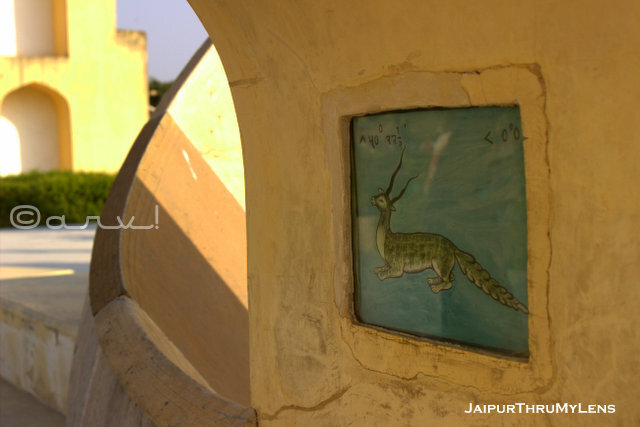
It is a group of 12 instruments representing all the 12 Zodiac signs. The quadrants of Rashivalaya represent the ecliptic at the moment of observation. The pole of the ecliptic is not a fixed point, but it defines as a circle of 23° 27″ radius around the pole. The angles of the gnomon of all the instruments are different from each other, because each Zodiac sign is situated at a different position from the ecliptic.
These instruments are used for observing celestial latitudes and longitudes of the Sun and Planets. Each instrument can be used for 2 hours, when each sign of Zodiac reaches the local meridian.
Chakra Yantra
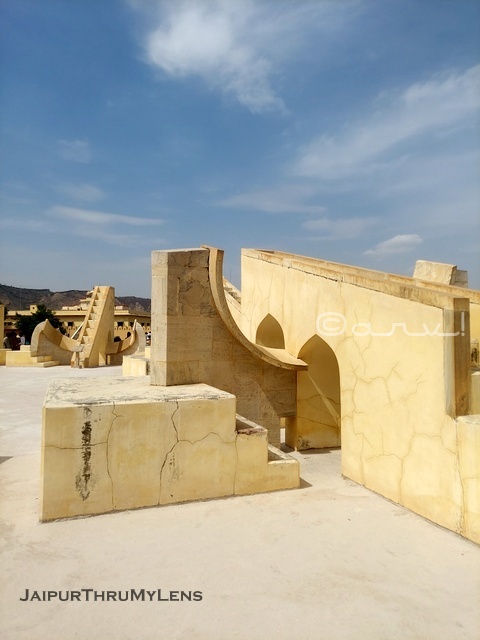
It is divided into two identical parts, each bearing 360° graduations. The metal bar is parallel to the celestial equator (27°) and has a hole at its center, where a brass tube is attached at the time of the celestial observations. The Sun or a planet is observed through the brass tube whose both ends touch and move on the graduated circle. The coinciding readings on the circle represent the declination of the celestial object and the position on the southern disc will indicate meridian pass time.
Ram Yantra
This instrument is divided into two complementary parts. Each part is used for one hour alternatively. This is mainly used for calculating altitude and azimuth of the celestial bodies during day as well as night. This Yantra represent the celestial sphere in inverted form, horizon on the top and zenith at the bottom of a centrally situated metal post.

Digansh Yantra
This Azimuth instrument of three circular construction, one inside the other, made in the plane of horizon. Top of the three circles are precisely graduated in 360° as they represent the horizon circles. Two metal wires are tightly stretched across the outermost circle and they represent north-south and east-west directions. At the center, supported by these wires is a metal knob. Digansh Yantra is the most accurate instrument for determining azimuth of the sun. Sunrise and sunset times can also be calculated by this instrument. We can calculate azimuth of planets during night also.
Sasthamsa Yantra
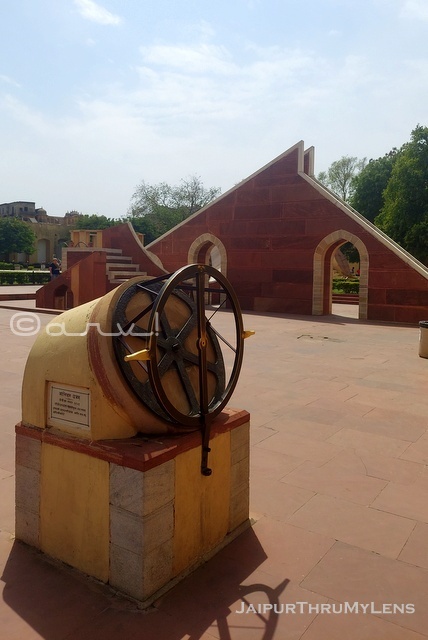
It is a sextant which is used for finding out the zenith distance, altitude and declination of the Sun. It consists of two arcs of 60° each, made adjacent to the eastern and western walls of the dark rooms situated below Great Samrat Yantra. The arcs lie north-south in the plane of the local meridian. This instrument is used at mid-day(local time), when the Sun crosses the local meridian and its rays fall on the graduated arcs through two tiny orifices provided in the roof for this purpose.
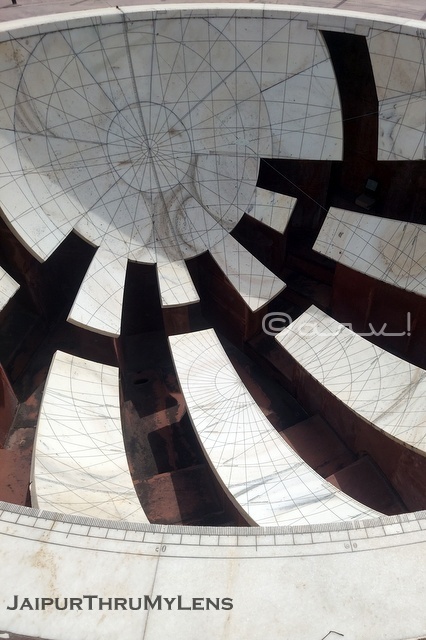
Jaiprakash Yantra
The Yantra is divided into two parts, representing the celestial hemispheres, complementary to each other. These two cavities are divided into six marble slabs representing one hour, each one divided into minutes and seconds. They also bear inscriptions of 12 Zodiac symbols. The outer circle is graduated in 360°. In the middle, hangs a ring which is representative of the Sun. The shadow of Sun fall through the time, altitude, azimuth, meridian pass time, zenith distance and metal ring on the graduated surface. We can calculate the local declination of the Sun as well as its longitude with this instrument. This is also used for celestial observation during the night.
Restorations at Jantar Mantar
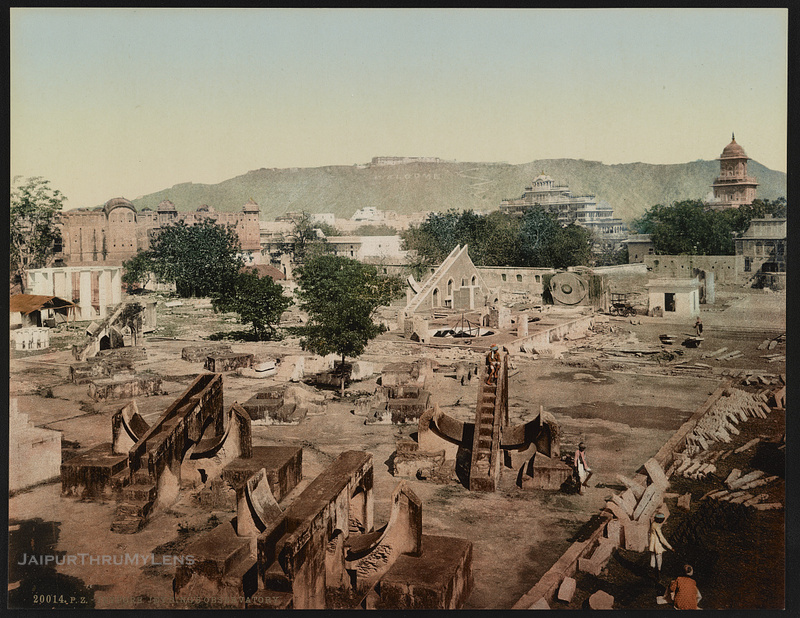
Maharaja Sawai Madho Singh II restored Jantar Mantar in 1901 under the supervision of Pandit Gokul Chandra Bhawan, Pandit Chandradhar Gulari and Pandit Kedar Nath Maharaj. Restoration was done by state engineer Lieutenant Arthur Ffolliott Garrett.
It will be relevant to share with you a photo catalogued by the Library of Congress depicting restoration of Jaipur observatory, Jantar Mantar. The only available information is that it is from 1890. This was during the reign of Sawai Madho Singh II. On a close observation, this looks more like a painting than a picture.
Jantar Mantar Timing
Jantar Mantar timings are 9.30 am to 4.30 pm.
Tickets and Entry Fee
Jantar Mantar entry fees are as follows:
Indians – Rs 50
Foreigners – Rs 200
Indian students – Rs 15
Foreign students – Rs 100
Jantar Mantar contact and phone number
Jantar Mantar phone number: +91-141-2610494
Should you visit Jantar Mantar in Jaipur?
In my opinion, you must visit and explore Jantar Mantar because it is one of the few surviving solar observatories like Ulug Beg’s solar observatory in Samarkand, Beijing ancient observatory, and Stonehenge, among others. I hope this Jantar Mantar Jaipur blog will inspire you to travel and experience it in person. I’m sure now you know what is special about Jantar Mantar.
Discover more from JaipurThruMyLens
Subscribe to get the latest posts sent to your email.
 JaipurThruMyLens
What a fascinating post about Jantar Mantar being one of the few surviving solar observatories. Certainly a worthwhile visit for those into astronomy and an interest in the skies. It does sound accurate, and a lot of precision would have gone into constructing the instruments back in the day. Interesting some of the instruments capture the planets and points, measuring the celestial sphere to speak. And others detail the positions of the zodiac signs. Fascinating that there is an equatorial sundial – measuring best of both worlds.
Didn’t know you had an interest in astronomy, Arv. It’s been something I’ve been getting into over the last few years. I hope you are doing well 😊
LikeLiked by 1 person
Thanks Mabel. Yes, it took a lot to build an observatory like this almost 300 years ago. It was one of its kind. These instruments still work with precision. Good to know you love astronomy. Do you use telescope to observe planets? or do astro photography?
LikeLike
It does take a long time to build an observatory of that magnitude. I don’t use a telescope or do astro photography. I do have friends who are into astro photography and like to look at the stars, planets and fixed stars on a clear night sky. Where I am there is too much light pollution to have a very clear sky. But I’ve seen Venus and Jupiter in the sky at times 😊
LikeLike
Great read and beautiful captures!!
LikeLike
Wow. I would love to see this. There is so much history in your country that has been preserved. Your country is definitely on my travel bucket list. Your photography is awesome as always!
LikeLike