
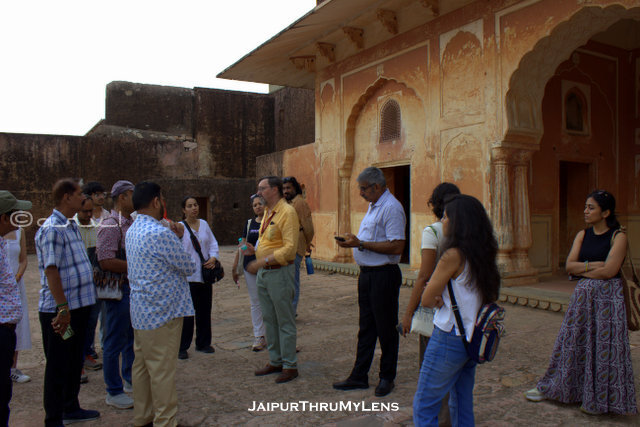
Recently, Jaigarh Fort organised a curated heritage walk called “Beyond the Bastion” on a Sunday afternoon. The walk took visitors through the palace section of Jaigarh Fort, one of the forts overlooking Amer Fort and Amer town. It was led by Giles Tillotson. Who is Gildes Tillotson? Giles Tillotson is a historian and author of several books on Jaipur’s history and Indian architecture. Initially, a visitor to India, he now lives in Gurgaon. He was previously Reader in History of Art at School of Oriental and African Studies, University of London, and served as Consultant Director at the Jaipur’s City Palace Museum from 2011 to 2020; he remains an honorary consultant today. He’s currently Senior Vice President at DAG, a well-known art gallery in Delhi. Among his well-known books are Jaipurnama, Rajput Palaces, and Building Jaipur, to name a few. The walk was organised to mark Palace Days, an occasion widely celebrated in Europe but not so well known in India. Palace Days is an annual initiative that opens royal residences and heritage palaces to the public, encouraging people to explore the history and stories behind these landmarks with guided tours and events. You can also read my previous post on a talk show with Giles Tillotson – Travel Photo Jaipur at Jawahar Kala Kendra
From a legendary cannon and a rumoured hidden treasure to secret water tanks and a Zenana wrapped in silence, Jaigarh Fort has more stories tucked into its walls than most visitors ever get to hear and walking it with a historian like Giles Tillotson brings all of it to life.
Read the complete Jaigarh Fort Guide – Jaigarh Fort in Jaipur
It’s rare to walk through a fort with someone who is a true expert on the subject. I had a similar experience at Jaipur City Palace back in 2019, walking with museum curators Aparna Andhare and Sania Galundia. This was only the second time I got to take part in a walk like this. Read City Palace Jaipur with Museum Curators
Jaigarh Fort isn’t new to me. I have visited it many times over the years, usually with guests visiting Jaipur. I have also done many treks around Jaigarh Fort. But honestly, my past experiences here were not very pleasant, partly because of neglect and partly because of how the security guards behaved with visitors. The fort used to be poorly maintained, and it felt like the authorities weren’t investing much in its upkeep or presentation. The exhibit galleries were basic at best, and the guards weren’t really trained to interact well with tourists. Here are pictures of Jaigarh Fort from one of my treks in Jaipur.
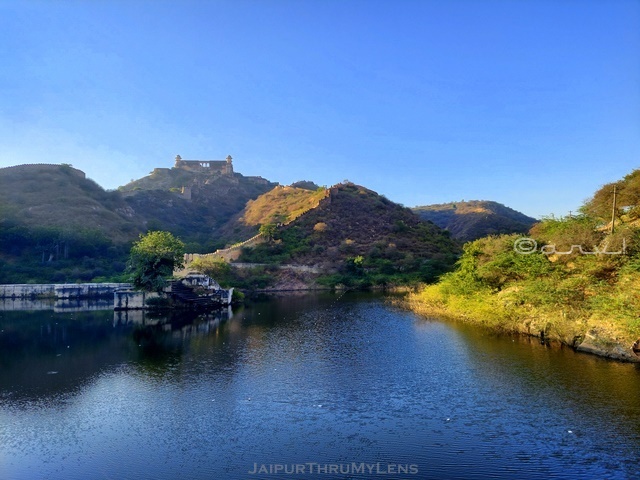
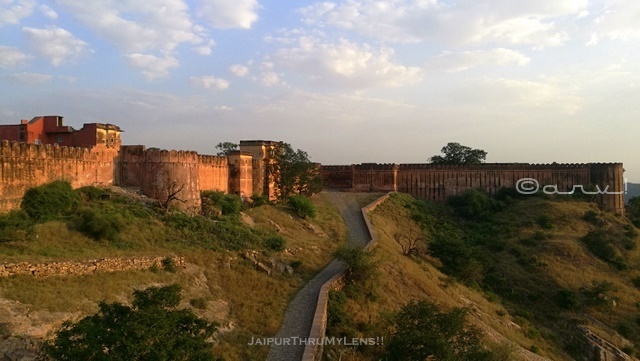
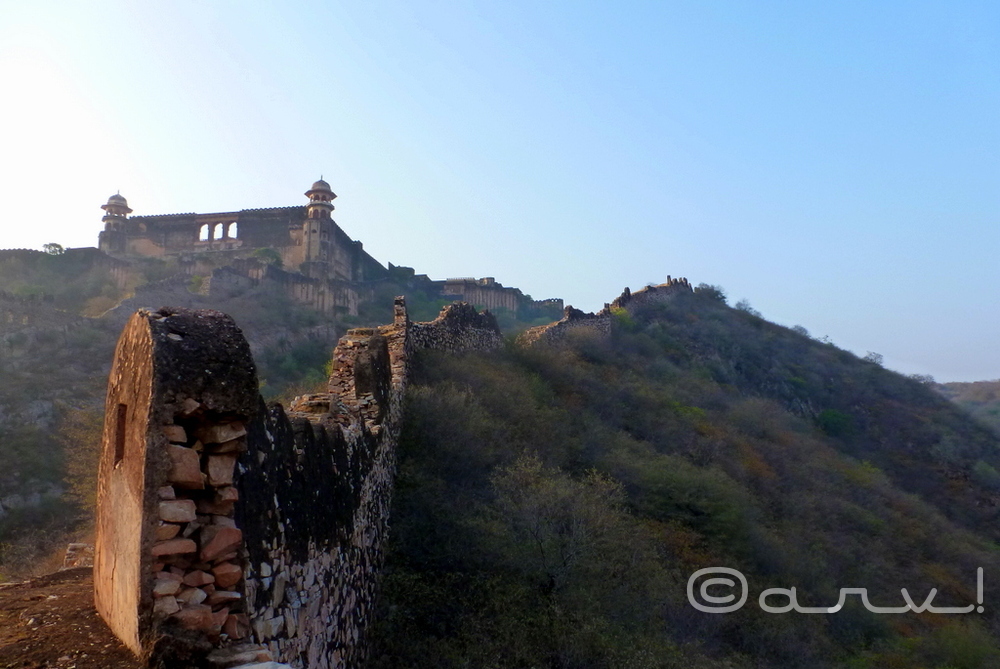
Until a few years ago, there was even a fee to click pictures inside the fort. Guards would check “camera tickets,” and many visitors who used their phones to take pictures wouldn’t buy this ticket, yet the guards would still insist that photography needed a paid ticket, for a fee of less than Rs 50. It’s a little ironic, really; in the age of social media, wouldn’t authorities want more people sharing pictures of the fort to attract more tourists? Thankfully, this rule has been done away with. When I visited last in 2023, the change was clear, Jaigarh Fort felt far more welcoming with guards not insiting to show camera ticket at Jaivan canon!
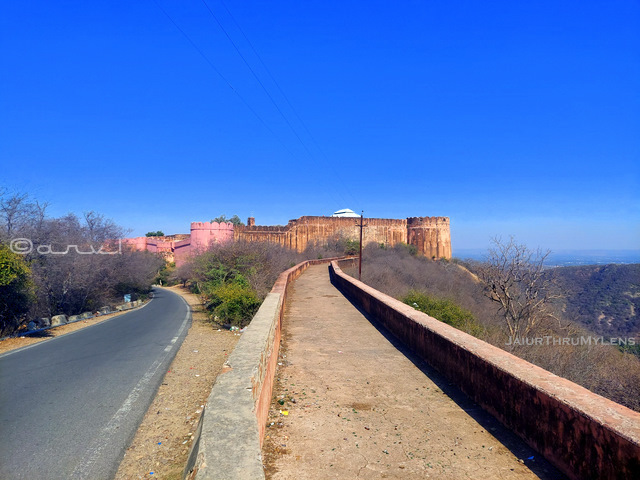
The Untold History of Jaigarh Fort | From Garrison to Guarded Secret
The walk began at the Tanka parking area, just before the entrance to the palace section. Tanka, in fact, refers to the underground rainwater storage tanks that Jaigarh Fort is quietly famous for; an old but highly effective water harvesting system that once supplied the entire fort, and still holds water today. Have you wondered how the water was colelcted and stored in forts of Jaipur? Read Heritage water walk.
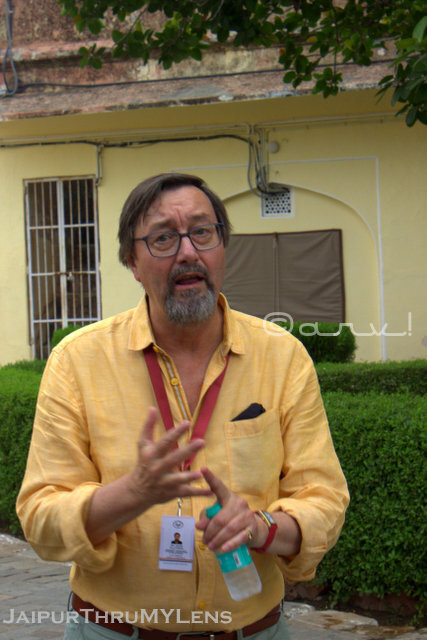
Giles opened with a simple question: what does “Jaigarh” actually mean?
Jaigarh Fort over the years
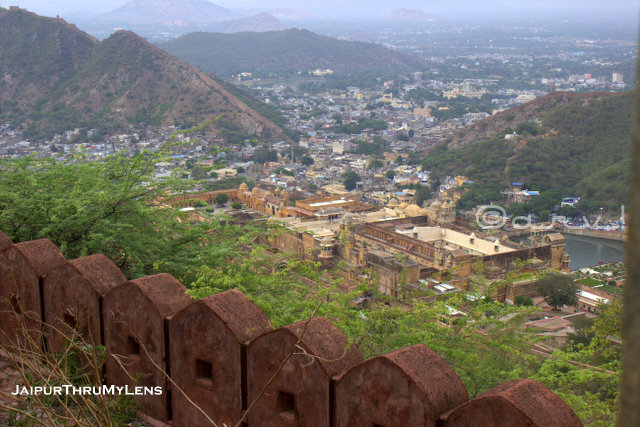
Jaigarh was originally built as a garrison fort to protect Amer, standing on a hill once known as Cheel Ka Teela. This much is fairly well known. Like many Rajput cities named after their rulers, Bikaner after Rao Bikaji, for example, Jaipur too follows this tradition, named after its founder, Maharaja Sawai Jai Singh II. Sawai Jai Singh II is remembered for far more than Jaigarh, though he’s the same king who planned the city of Jaipur itself and built the Jantar Mantar observatory, making him one of history’s few ruler-astronomers. Giles made a reference to Sidney Toy’s book, The Strongholds of India, which documents the old town of Amber and its defence systems in detail. Here is a picture of Amer from Jaigarh Fort.
According to documents Giles has studied, a large part of Jaigarh Fort was built by Sawai Jai Singh II. Some parts, like the water storage systems, are older. One of the strongest indicators of this, Giles explained, is the architectural style and layout of the palace.
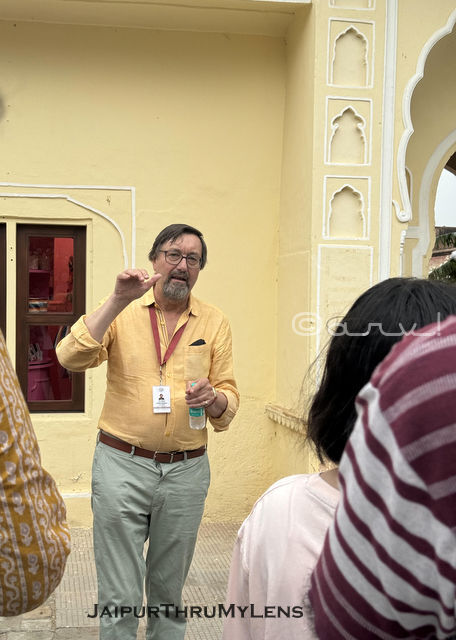
Since Jaigarh was a garrison fort, it stayed heavily guarded through the reigns of several rulers, right up to the time of the last king, Sawai Man Singh II. In fact, until 1971, no outsider was permitted inside Jaigarh Fort. This secrecy is also what fuels one of Jaigarh’s most famous legends.In 1976, the Indian government, under Prime Minister Indira Gandhi, ordered a massive, months-long search of the Jaigarh fort’s water tanks. She was convinced that a hidden Mughal treasure lay buried inside. The official story was that nothing was found in the search, but people find it hard to beleive; they question why fort was sealed for so long? You can find more information on this topic in my earlier post on Maharani Gayatri Devi – The Enduring legacy of Gayatri Devi. When Jaipur’s rulers signed the accession treaty with the Government of India, they chose to retain Jaigarh Fort while giving up Amer Fort and Nahargarh Fort. Giles poses a question to visitors as to which this decision was taken? Jaigarh Fort finally opened to visitors in 1983 under the Jaigarh Public Charitable Trust, formed in 1982. He also made a reference to Brig. Bhawani Singh, son of the last ruler of Jaipur – Sawai Man Singh II.
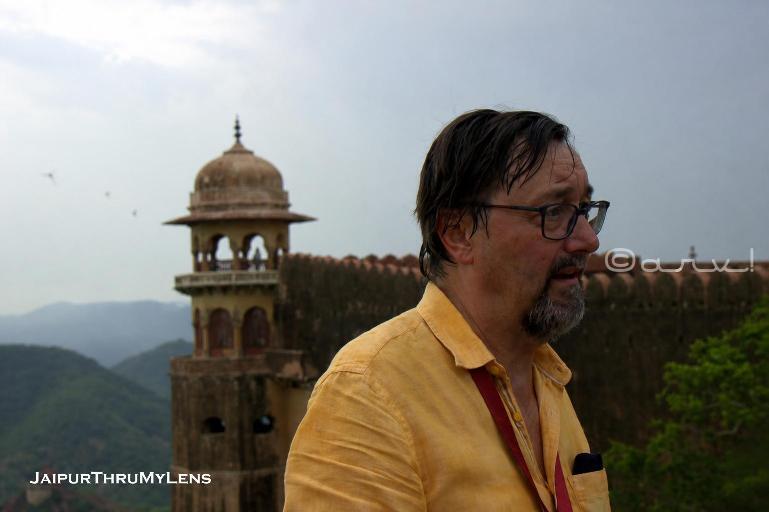
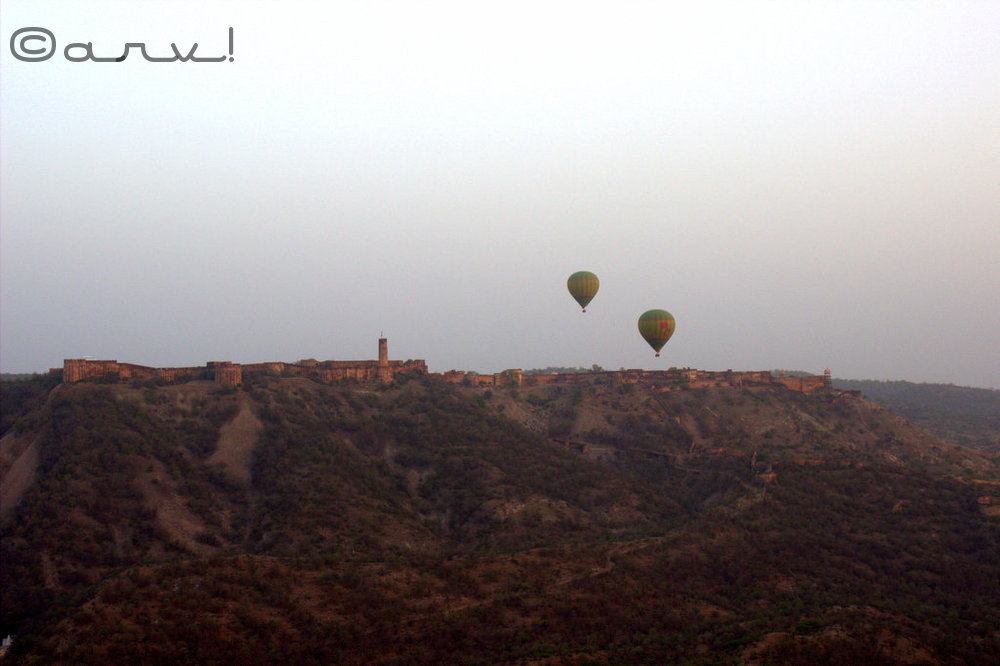
Jaigarh Fort stretches about 3 kilometres from north to south.
Here is a picture of Jaigarh Fort from one of my previous blog posts from hiking in Jaipur – Hot air balloon ride in Jaipur, that depicts the entire length of Jaigarh Fort.
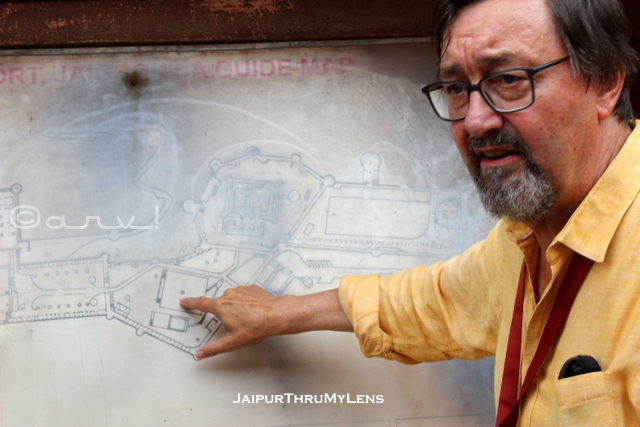
Giles spoke at length about how different sections of the fort were built under different rulers. Several changes and additions made even after the 18th century, when a lot of construction activity took place in the fort.
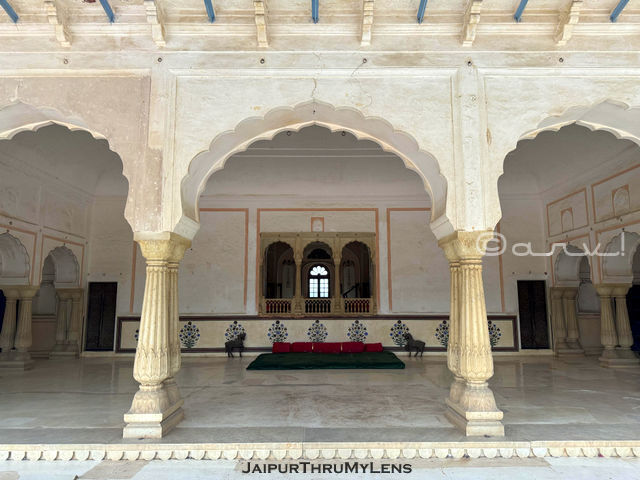
Subhat Niwas – Jaigarh’s Grand Public Courtyard
This is the first and largest courtyard on the walk. Giles pointed out that while most Rajput palaces have their public hall (Sabha Niwas) at the centre of courtyard, here the public hall sits in a corner, facing east. He explained that this is likely because the rulers of Amer and later Jaipur, Kachhwaha dynasty considered themselves Suryavanshi, or descendants of the Sun. The courtyards, gateways, and even city layouts were often oriented with the sun’s path in mind, not just for symbolism but for practical reasons like light and airflow. Most such halls across Rajasthan are called Sabha Niwas, but here it’s called Subhat Niwas. It is probably named after a great military hero, or perhaps because this is where military leaders met.
Laxmi Niwas (Diwan-e-Khas) – Where Royalty Once Relaxed
This is a large courtyard with a covered sit-out facing east, in the same alignment as Subhat Niwas. Giles explained that this space was likely used by the men of the royal family to relax or watch dance performances. Right next to it is a Hamam, or bathing area similar to the layout at Amer Fort, where the Hamam sits close to the Diwan-e-Khas. This section is currently closed to visitors.
Lalit Mandir – Panoramic Views and Vanished Exhibits
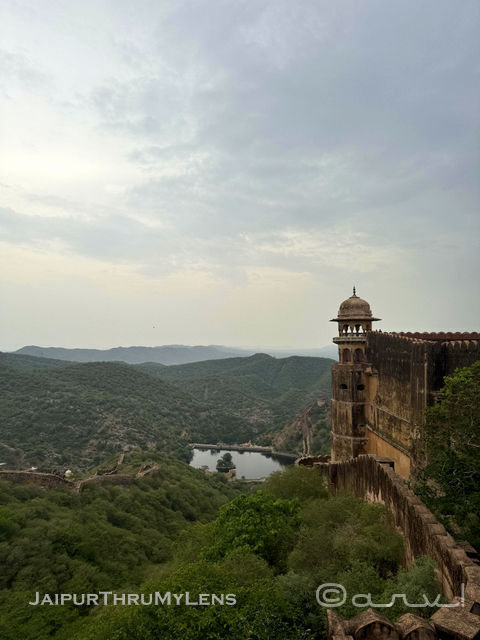
Giles led the group to Lalit Mandir, which offers stunning, panoramic views of the Aravalli hills and Sagar Lake. At one point, this section had puppet displays depicting scenes of food being prepared and served, added during Chandramani Singh’s time overseeing Jaigarh Fort. These exhibits have since been removed, likely reflecting changing ideas about how heritage spaces should be presented.
Aaram Mandir – The Most Beautiful Part of Jaigarh Fort
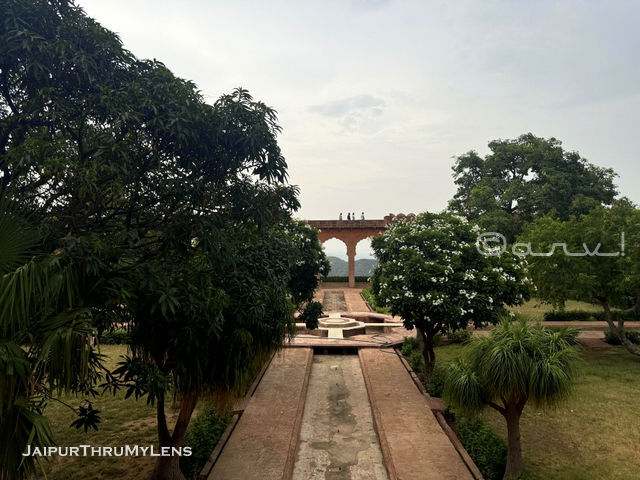
Aaram Mandir is, without question, one of the most beautiful parts of Jaigarh Fort. It’s a Tibara, a pavilion with three arched openings overlooking a charbagh-style garden, with the garden in turn overlooking Amer town, Amer Palace, and the surrounding hills. Who could have thought of a Charbagh style garden in a fort? Charbagh used to be one the sections which was leased out for the events like music shows, weddings and also Jaipur Literature Festival. Some of Jaipur Lietrature Festival events are exclusive and invite only, meant for the authors, speakers, and guests; these events are held at Jaigarh Fort, Amer Fort or hotels like Rambagh Palace. Leasing out a place like Jaigarh Fort is quite expensive. Giles noted that Aarambagh is the lowest point in Jaigarh Fort, which is why the garden and its trees were planned here.
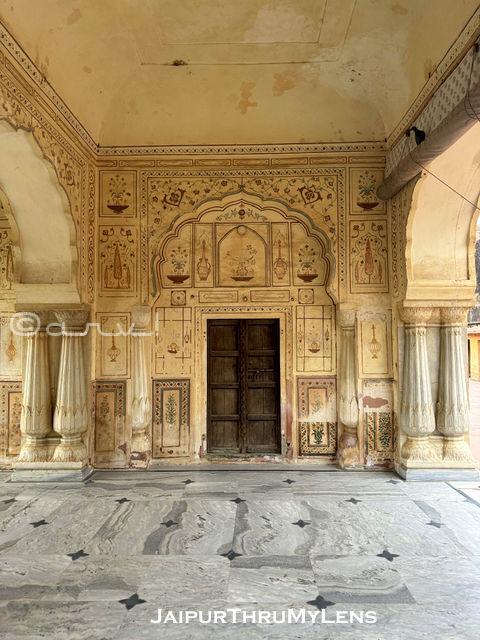
Unlike most palace sections, which are strictly divided between male and female quarters, Aaram Mandir could be used by both; it has entrances connecting to the male and female sections, and was used by either depending on the occasion and need. The space features beautiful Mughal-style wall paintings and elegant marble pillars with intricate carvings. Giles pointed to a bridge connecting two “Burj” (viewing-point canopies) on either side, noting that it was built later, during the reign of the last king, Sawai Man Singh II.
Vilas Mandir – A Glimpse into the Zenana
On the way to the cannon foundry, Giles made a brief stop at Vilas Mandir, once part of the Zenana, or women’s quarters. Not much is documented about exactly how these sections were used day to day, but we do know they were closely guarded, private spaces where outsiders were not allowed.
Jaigarh Cannon Foundry and the Legendary Jaivana Cannon
Here, Giles explained how the foundry functioned and walked us through its two major sections. He shared the history of how cannons and gunpowder first arrived in India, tracing it back to the Mughal ruler Babur, and how Mirza Raja Man Singh during the reign of Akbar later brought this technology to Amer. This same foundry is where the Jaivana Cannon was cast in 1720, under Sawai Jai Singh II. It is recognised today as the largest cannon on wheels ever built. It was reportedly fired only once, as a test, and the sound is said to have been heard for miles around. The cannon still sits at Jaigarh Fort and is one of its biggest draws for visitors. He also raised an interesting question: why was the cannon foundry located inside the Zenana or female section of the fort? Giles offered his own theory to answer this, drawing on the political and practical realities of the time.
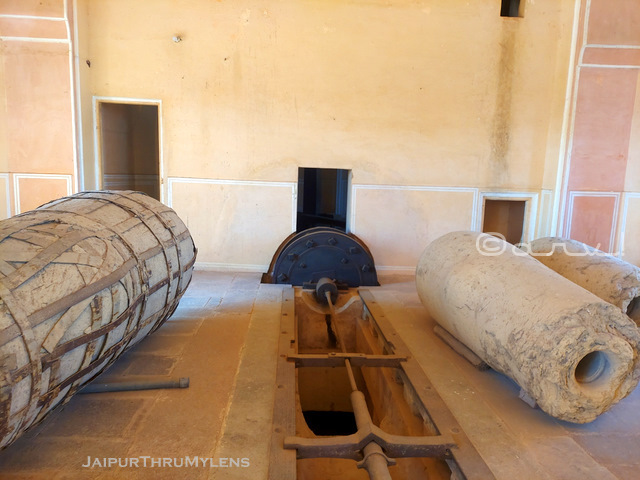
Surya Mandir – The Women’s Quarter and Its Simple Elegance
This was the final stop on the walk. A large courtyard with a beautiful Peepul tree, enclosed on all sides. Like Vilas Mandir, this too was part of the Zenana. On my last visit, this space held a display of arms and ammunition, but that exhibit has since been removed. During the open discussion here, Giles along with Dr Mrinalini Venketswaran, Deputy Dir. Jipur City Palace pointed out that while the architecture of the Zenana is quite simple, rich block printed textiles and fabrics were likely used to make the space feel beautiful and comfortable. He went on to explain the historical reasons why Zenana sections were kept architecturally simple, even in a fort like Jaigarh.
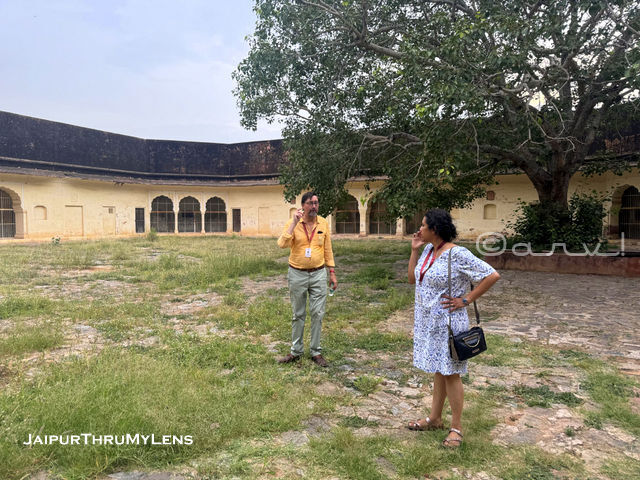
Jaigarh Fort – Jaipur’s First Chapter
As the walk came to a close, Giles Tillotson shared a thought that stayed with me: Jaigarh Fort was, in many ways, “Jaipur 1.” Several sections of Jaigarh were built even before Sawai Jai Singh II decided to found the city of Jaipur. Giles also touched on the difficult political climate of the time; the challenges Jai Singh II faced in the years building Jaigarh Fort, long before Jaipur itself came into being. This walk was two hours long and not everything could have been covered in this blog.
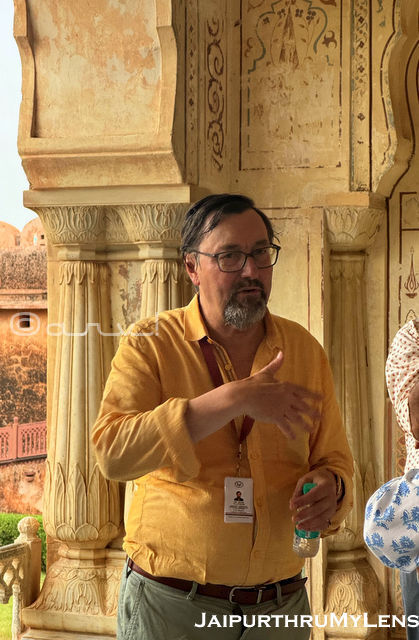
If you’re planning a visit to Jaipur, walks like these are a wonderful way to go beyond the usual tourist trail and understand the real history behind places. Unfortunately, walks by Giles Tillotson are rare. However, heritage walk in Jaipur are available for travalers. Keep an eye out for expert-led heritage walks – they add a whole new layer to how you experience Jaipur.
A Few Practical Questions & Answers Before You Visit Jaigarh Fort
What are Jaigarh Fort’s timings and entry fee?
The fort is generally open daily from around 9 am to late afternoon, and entry tickets are inexpensive for Indian visitors, with a higher fee for foreign tourists. Rates and hours do shift from time to time, so it’s worth checking the current fee at the counter or on the its official site on the day of your visit.
How do you get to Jaigarh Fort, and can it be combined with Amer Fort?
Jaigarh sits on the hill directly above Amer Fort, about 20-25 minutes by road from Amer town and roughly 30-45 minutes from central Jaipur by car or auto-rickshaw. Since the two forts are so close, most visitors combine Jaigarh with Amer Fort, and often Nahargarh Fort as well, in a single half-day trip. There are many view points on the way and one can stop and enjoy the panoramic views of the Jal Mahal. These view points are on the road bends, one needs to be careful at these spots while driving.
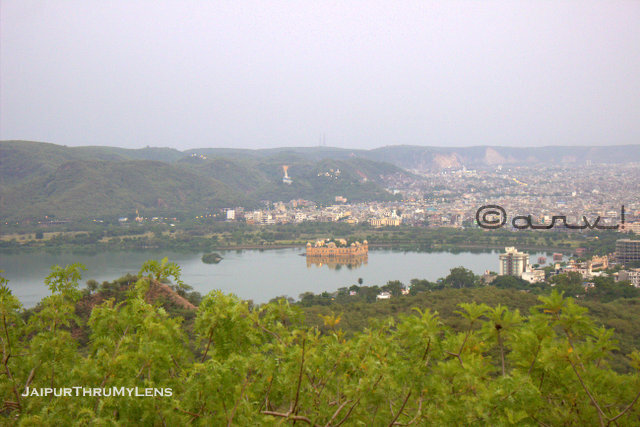
Is the drive to Jaigarh Fort easy and is it uphill?
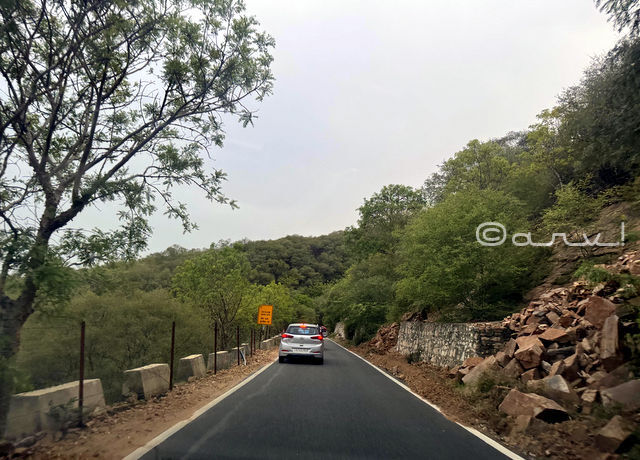
The drive to Jaigarh Fort is uphill and in many sections the road is narrow. The road starts from Kanak Ghati near Kanak Vrindavan Garden. One needs good driving skills. Accidents are common on this road and so is drink and drive cases. Many consider Nahargarh Fort Road which leads to Jaigarh Fort, Jaipur’s open-air bar. Read Environmental issues in Jaipur. Avoid driving in the dark. People often drive rashly on this road. There are instances when Jaipur traffic police close this road due to traffic jam or excessive traffic on this road.
How much time should you set aside for a visit?
A relaxed visit, taking in the palace courtyards, the cannon foundry, and the viewpoints, usually takes about 1 to 1.5 hours.
Is walk by Giles Tillotson available everyday?
This Jaigarh Fort walk by Giles Tillotson was a special walk and is not available otherwise.
Discover more from JaipurThruMyLens
Subscribe to get the latest posts sent to your email.


What a beautiful place, Arv.
LikeLiked by 2 people
Forts of Rajasthan are huge usually built on a hill, so these are magnificent
LikeLiked by 1 person