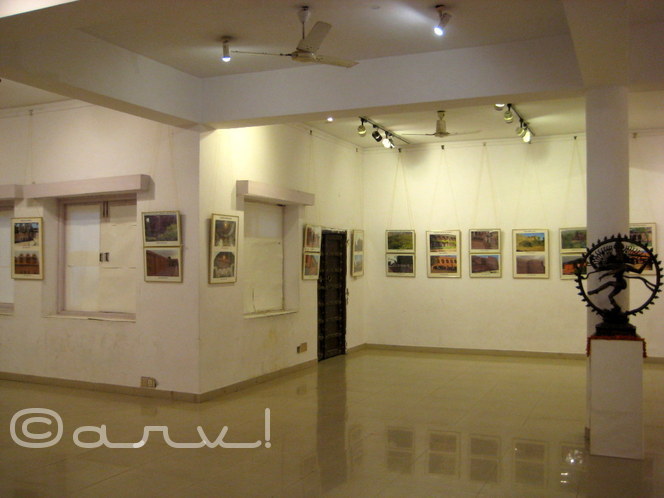
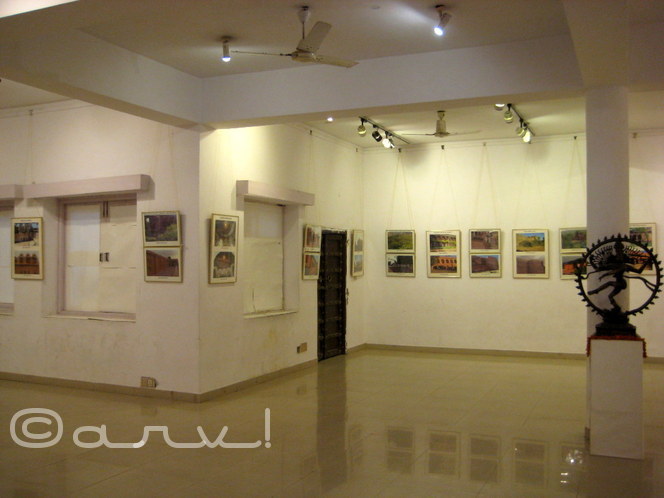
Recently, Department of Archaeology & Museums in Jaipur held an exhibition in the popular Jawahar Kala Kendra – Parijaat II gallery on heritage sites restored in Rajasthan undertaken over recent years. The exhibition was aimed towards spreading awareness about heritage sites in Rajasthan and how the Department of Archaeology & Museums is working in the field of heritage conservation & restoration. A large part of the population is not even aware of the existence of Department of Archaeology & Museums in Jaipur. Here are a few pictures of this exhibition.
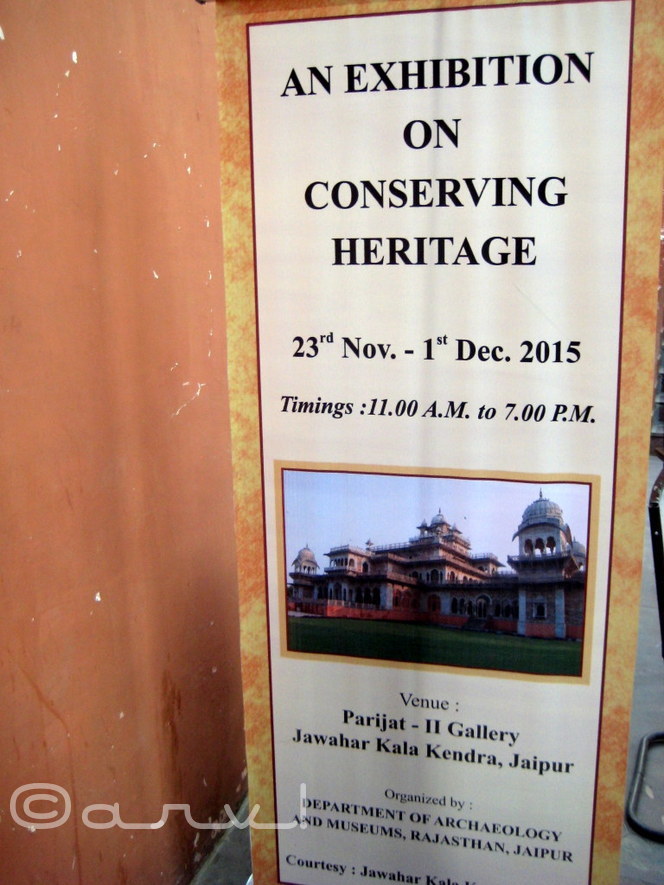
Heritage Conservation in Rajasthan – An Exhibition by Department of Archaeology & Museums
Department of Archaeology & Museum in Jaipur is responsible for heritage sites and tourist attractions in the city. It includes Amer Fort, Nahargarh Fort, Hawa Mahal, Albert Hall Museum, among many others. This department is responsible for maintaining and operating these tourist attractions. The tickets in Jaipur for these attractions are issued by Department of Archaeology and Museum. Read Man behind Heritage conservation
How does Department of Archaeology & Museums differs from Archaelogical Survey of India?
Archaelogical Survey of India is a body entrusted for sites which are listed sites, a federal body that works under ministry of culture. This is under central government and its sites span all across India. A few sites in and around Jaipur are Bhangarh Fort, Jagat Shiromani Temple Amer in Jaipur.
Department of Archaeology and Museum.on the other hand is a body run under Rajasthan Govt. On its website, it is a body responsible for discovering, preserving, and managing cultural heritage sites and state museums of regional importance within Rajasthan. It administers and manages many state museums, conducts exploration,surveys & excavations of archaeological sites.It also promotes tourism in Rajasthan as many tourist attractions aremanaged by the department.
If you find any heritage site of importance in the state of Rajasthan, you can contact Department of Archaeology & Museum.
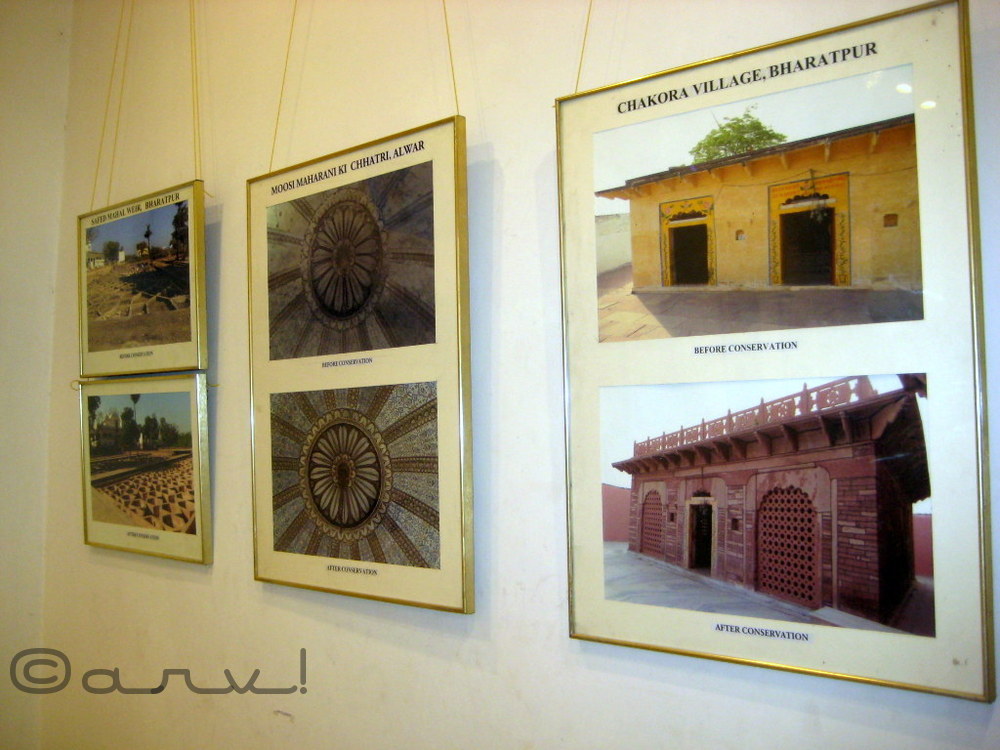
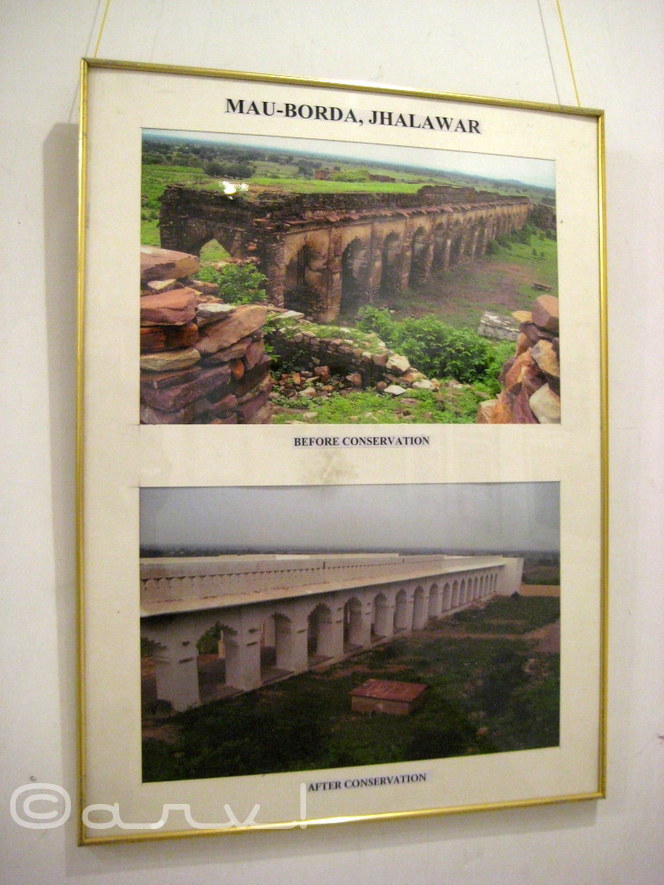
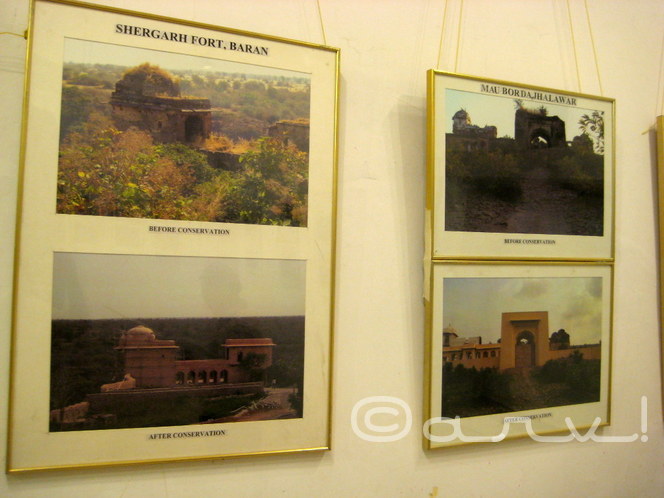
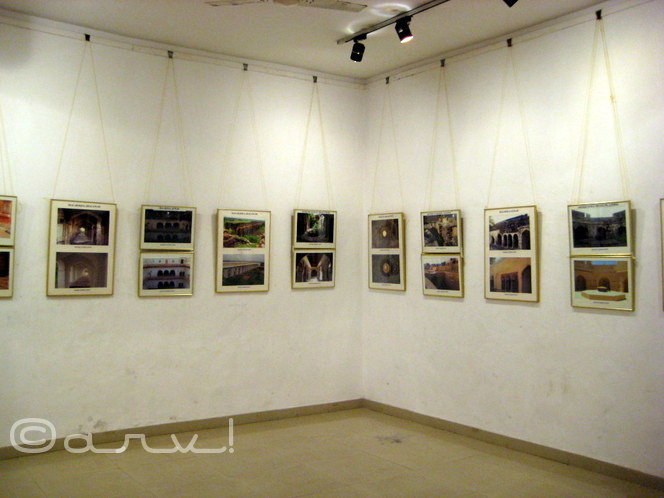
Which historic sites in Rajasthan were restored by Department of Archaeology & Museum? Rajasthan Heritage Restoration Examples
A few sites that were displayed in the exhibition at Jawahar Kala Kendra which were conserved & restored by Department of Archaeology & Museum were:
- Shergarh Fort – Baran
- Mau Borda – Jhalawar
- Chakora Village – Bharatpur
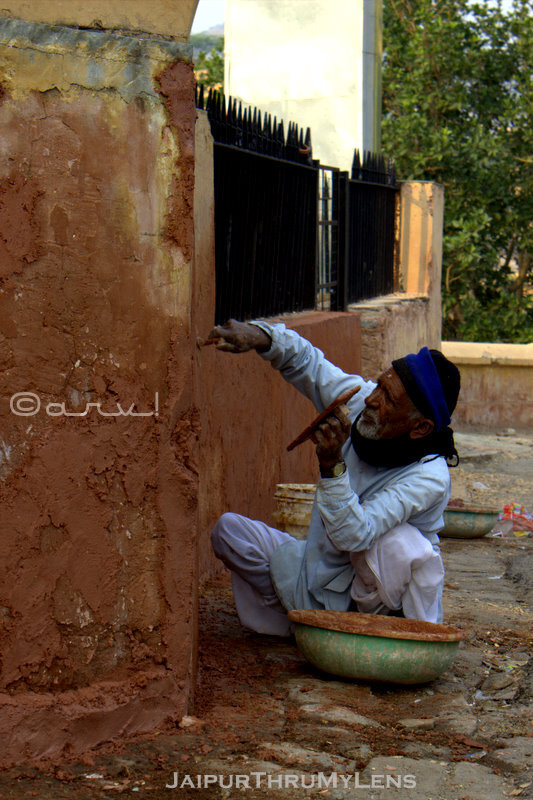
Traditional Lime Mortar Technique in Heritage Restoration and Conservation
All these sites require lime and mortar techniques. There aren’t that many skilled people using this traditional technique. Read Faces behind heritage conservation
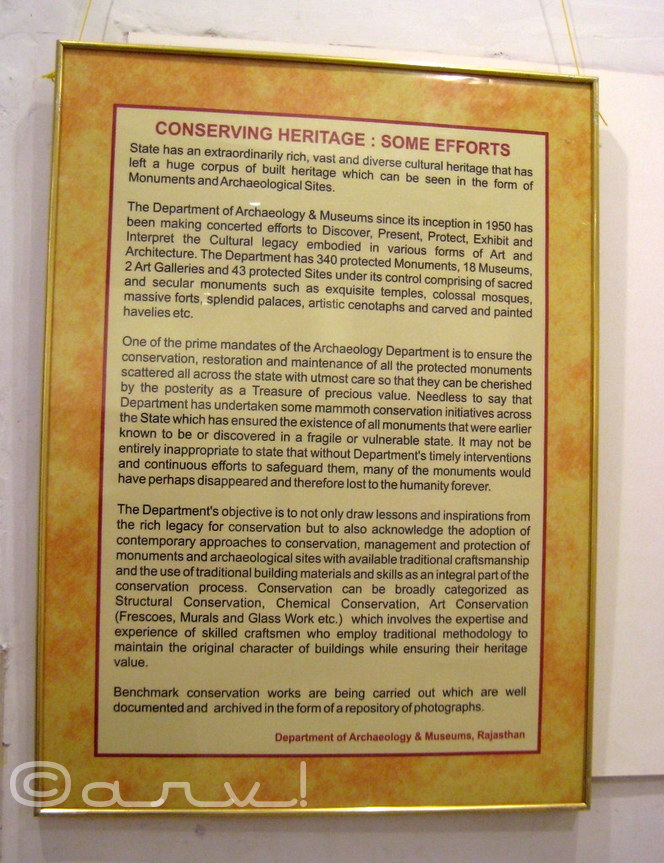
A statement from Department of Archaeology & Museum on Heritage Conservation in Rajasthan
Rajasthan state has an extraordinarily rich, vast and diverse cultural heritage that has left a huge corpus of built heritage which can be seen in the form of Monuments and Archaeological Sites.
The Department of Archaeology & Museums since its inception in 1950 has been making concerted efforts to Discover, Present, Protect, Exhibit and Interpret the Cultural legacy embodied in various forms of Art and Architecture. The Department has 340 protected Monuments, 18 Museums, 2 Art Galleries and 43 protected Sites under its control comprising of sacred and secular monuments such as exquisite temples, colossal mosques, massive forts, splendid palaces, artistic cenotaphs and carved and painted havelies etc.
One of the prime mandates of the Archaeology Department is to ensure the conservation, restoration and maintenance of all the protected monuments scattered all across the state with utmost care so that they can be cherished by the posterity as a Treasure of precious value. Needless to say that Department has undertaken some mammoth conservation initiatives across the State which has ensured the existence of all monuments that were earlier known to be or discovered in a fragile or vulnerable state. It may not be entirely inappropriate to state that without Department’s timely interventions and continuous efforts to safeguard them, many of the monuments would have perhaps disappeared and therefore lost to the humanity forever.
The Department’s objective is to not only draw lessons and inspirations from the rich legacy for conservation but to also acknowledge the adoption of contemporary approaches to conservation, management and protection of monuments and archaeological sites with available traditional craftsmanship and the use of traditional building materials and skills as an integral part of the conservation process. Conservation can be broadly categorized as Structural Conservation, Chemical Conservation, Art Conservation (Frescoes, Murals and Glass Work etc.) which involves the expertise and experience of skilled craftsmen who employ traditional methodology to maintain the original character of buildings while ensuring their heritage value.
Benchmark conservation works are being carried out which are well documented and archived in the form of a repository of photographs.
A large number of conservations listed and shown in the exhibition were not in Jaipur, rather spread all over Rajasthan. Given the fact that there are a large number of heritage sites, which run in thousands, spread all over the state it is a herculean task to restore all of these. The department faces constraints of time and monetary resources. In light of the above, we need to appreciate their efforts.
Restoration vs Reconstruction
Many heritage sites in Rajasthan have been restored. Unfortunately, these have been reconstructed rather than restored. In the name of restoration, a lot of new concepts and ideas are implemented. One of the best examples is that many heritage conversation architects implementing government funded restoration project have preference for using sandstone. In places or regions which don’t have any precedence of using sandstone in the past, such practices don’t go in line with restoration concept. In my conversation with some architects about heritage conservation in Rajasthan, they shared that a few architects prefer this because it saves cost and is much easier than using traditional techniques. I hope the Department of Archaeology & Museums will be sensitive to the distinction between restoration and reconstruction. A good example is Sisodia Rani Ka Bagh in Jaipur.
One of the best examples of heritage conservation in Jaipur is Maharaja School of Art and Craft. This building is still in its original conditio to a great extent. In spite of being in the walled city, where the Pink or terracotta color is everywhere, they have not used sandstone in heritage restoration. Another example is Anokhi Museum in Amer. But many more new elements have been added both inside the Haveli and the facade.
Summary
I also felt that while some sites have been restored beautifully. A few turned out more beautiful than their original condition. There are many sites that have been restored using different stones than the original ones, which meant that the result is out of place (vis-a-vis original ones)!! I’m not sure if this is good or bad. It could be a technical reason for some stones may not be available for restoration, cost factor or the technique cannot be replicated. In any case, it is a better option to restore it rather than let it lie to crumble. It was a great effort by the Department of Archaeology & Museums aimed towards educating the public about the efforts undertaken by them.
Discover more from JaipurThruMyLens
Subscribe to get the latest posts sent to your email.

 JaipurThruMyLens
A great effort . However , I do feel in some places the conservation work takes away for the old world charm of a place , if not done cautiously with the right expertise .
LikeLiked by 1 person
I agree with you completely!
LikeLike
So beautiful!
LikeLiked by 1 person
Thanks ladyfi!
LikeLike